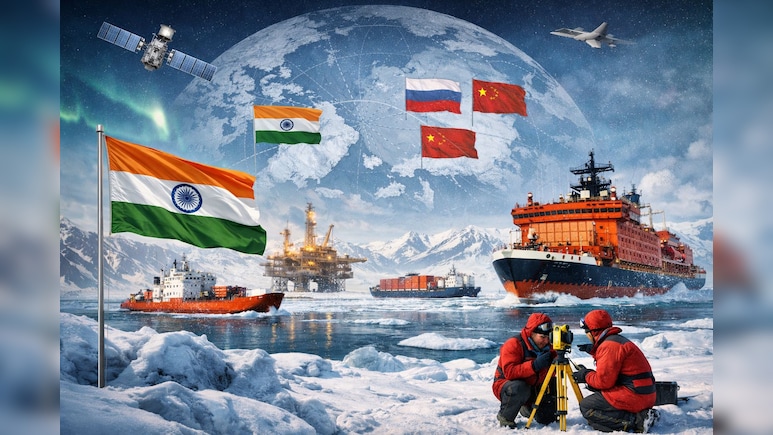
The Arctic is warming nearly four times faster than the global average. This shift is opening new shipping routes and exposing reserves of oil, gas and critical minerals. Melting ice is also affecting global climate systems, including the Indian monsoon, the Himalayas and sea levels. The region matters to India for climate change, trade, resources and geopolitics.
What India Is Doing In The Arctic
India's Arctic engagement began with the Svalbard Treaty in 1920. It launched its first Arctic expedition in 2007, set up the Himadri research station in 2008 and became an observer to the Arctic Council in 2013.
India has completed fifteen Arctic expeditions. Scientists found that Arctic warming affects Indian weather patterns. They also found that thawing permafrost releases stored carbon and microbes, which pose climate and health risks as ice melts faster. These developments have direct implications for India and the wider climate system.
Also Read | Layoffs Are Rising In Tech, But These Skills Are Helping People Unlock Better Pay
India has strengthened cooperation with Nordic countries in polar research, renewable energy, green shipping and sustainable development. It also works with Canada, an Arctic state, and South Korea, an Arctic observer, on scientific research in the region.
India has also engaged with Russia. It signed a five-year agreement that includes access to Arctic ports, logistics support, polar navigation training, shipbuilding and expanded connectivity through the Northern Sea Route, the Chennai-Vladivostok corridor and the International North-South Transport Corridor. India maintains diversified partnerships through its multi-alignment approach, reflecting its strategic autonomy.
ALSO READ: Beyond GDP: Better Measurement Needed To Measure Real Costs Of Growth — The Reason Why
China's Arctic Presence And Regional Pushback
China's Arctic engagement has raised concerns in several countries, including India. After becoming an Arctic Council observer in 2013, China's 2018 Arctic Policy described the country as a "near-Arctic state" focused on science, shipping and economic cooperation under the Polar Silk Road.
Over the past decade, China expanded its Arctic activities through icebreaker missions, research bases, investment in Russian energy projects and greater use of the Northern Sea Route. Xuelong 2 recently completed China's largest Arctic expedition. A Chinese container ship also finished its first scheduled commercial voyage to Europe through the Northern Sea Route. China has stated publicly that its involvement centres on climate research.
Concerns remain over China's dual-use research, digital infrastructure projects, operational expansion and close ties with Russia. Nordic countries have reduced cooperation. Sweden blocked Chinese access to Arctic space infrastructure and exited joint research platforms. Finland and Denmark scaled back engagement.
ALSO READ: India-US Trade Deal: We Should Worry About The Fine-Print Devil Now | The Reason Why
India's Multi-Alignment Advantage - And Its Limits
India's ability to work across competing blocs shapes its Arctic role. Nordic states, which support a rules-based order and monitor China's Arctic activities, view India as a credible and non-military partner. Russia's reliance on China has increased in recent years, and Russia sees India as an alternative partner. This multi-alignment gives India access to scientific, economic and institutional channels and positions it between the two sides. Converting access into influence may prove difficult.
India's positions on Russia-Ukraine and Israel-Palestine have not gained support in several European capitals, which may complicate its efforts in Arctic governance. At the same time, India's democratic system, non-expansionist stance and support for international law contribute to its acceptance.
ALSO READ: Wars Hurt Some Stock Markets — And Help Others | The Reason Why
Climate Action Can Make India A Serious Player
As Arctic access increases, India may expand beyond research into economic preparedness. This includes developing icebreakers, training for polar navigation, building insurance and shipping systems, ensuring port compatibility and contributing to Arctic-related security, economic and environmental standards.
India's strongest basis for engagement remains climate action. The Himalayas, often called the "third pole," face direct effects from Arctic ice melt on monsoons, glaciers and sea levels. These factors affect food security and coastal stability. By linking Arctic developments to climate risks facing the Global South, India can strengthen cooperation on environmental issues and increase its role in Arctic discussions.
The Road Ahead
India's economic and military capacity, along with its potential role as an interlocutor, could shape its position in the Arctic. Progress depends on whether India connects science, economic interests, climate policy and governance into a coherent framework.
As global alignments shift, India needs a clear and consistent Arctic approach. This framework must protect strategic autonomy, align with domestic priorities and remain stable despite geopolitical changes. Without it, India may remain on the margins of Arctic affairs.
ALSO READ: The Shadow Fleet And Rise Of Parallel Global Energy System | The Reason Why
Disclaimer: The views expressed in this article are solely those of the author and do not necessarily reflect the opinion of NDTV Profit or its affiliates. Readers are advised to conduct their own research or consult a qualified professional before making any investment or business decisions. NDTV Profit does not guarantee the accuracy, completeness, or reliability of the information presented in this article.
Essential Business Intelligence, Sharp Market Insights, Practical Personal Finance Advice, Daily Fuel, Gold and Silver Prices and Latest Stories — On NDTV Profit.