The government will earn a net Rs 25,000 crore from the increase in customs and excise duty on a host of products, including cigarettes. The surcharge on the super-rich would help garner an additional income of around Rs12,000 crore this fiscal on the direct tax side.
The government has proposed to increase budget allocation for the Ministry of Agriculture and Farmers Welfare by over 78 percent to Rs 1.39 lakh crore for the current financial year.
Out of this, Rs 75,000 crore will be for the flagship scheme Pradhan Mantri Kisan Samman Nidhi, according to the budget document.
The government had allocated Rs 77,752 crore in the revised estimate for 2018-19.
As the country reads into the fineprint of Finance Minister Nirmala Sitharaman's Union Budget 2019, finance ministry officials spoke about their views on the fiscal document.(read more)
Indian Railways received a budgetary allocation of Rs 65,837 crore, and the highest-ever outlay for capital expenditure amounting to Rs 1.60 lakh crore from Finance Minister Nirmala Sitharaman in Union Budget 2019. Last year, the capex outlay for the railways was Rs 1.48 lakh crore while the budgetary allocation was Rs 55,088 crore.
In Budget 2019, funds of Rs 7,255 crore have been allocated for construction of new lines, Rs 2,200 crore for gauge conversion, Rs 700 crore for doubling, Rs 6,114.82 crore for rolling stock, and Rs 1,750 crore for signalling and telecom. The allocations have remained the same as in the interim budget in February, which was presented by the then Interim Finance Minister Piyush Goyal.
India’s plan to borrow in foreign currency, to supplement domestic borrowings, is a bad idea, according to former Reserve Bank of India Governor C Rangarajan. “We have discussed this since early 90s, right after liberalisation,” he told BloombergQuint in an interaction. “We have discussed it’s much better that sovereign borrowing in foreign currency should be avoided.”
India’s external debt is currently low and the government will now start to borrow a part of its funding requirement from the overseas market in foreign currency, Finance Minister Nirmala Sitharaman said in her budget speech today.
An increase in the minimum public float will improve governance as well as enhance liquidity and improve market integrity, Manan Lahoty, partner at L&L Partners, told BloombergQuint. “It will allow institutional investors to take larger positions, which will boost inflows from foreign investors.” (read more)
Buying an electric vehicle can now get you a tax relief.
Finance Minister Nirmala Sitharaman, in her budget speech, proposed a new section in the Income Tax Act, allowing a deduction of interest of up to Rs 1.5 lakh on a loan taken to buy an electric vehicle between April 1, 2019 and March 31, 2023. The deduction will lower the taxable income and the tax outgo. (read more)
Finance Minister Nirmala Sitharaman in her budget speech today annoucned a Rs 2 hike in tax on every litre of petrol and diesel. The average earnings of the government from sale of every litre of petrol and diesel now will be more than twofold and threefold, respectively, since it first came to power in 2014, data compiled by BloombergQuint showed. But that’s lower than what the government earned in 2016.
The Bharatiya Janata Party on Friday hailed Union Budget 2017 as one for a “new India”, which laid the foundation for an inclusive and progressive nation, while the Congress panned it as “old wine in new bottle”.
Criticising Finance Minister Nirmala Sitharaman's budget speech, Congress leader in Lok Sabha Adhir Ranjan Chowdhury said it was just a repetition of “old promises”.
“They (the BJP) are talking about a new India, but it is simply old wine in a new bottle,” he told reporters outside Parliament.
He claimed that no new initiatives were announced by the government. The Modi government has tried to project India as an ‘El Dorado’ (a place of fabulous wealth for all), but in reality the “pain of the economy is being experienced”, he said.
India cannot become a $5 trillion economy without jobs, BJP Spokesperson Nalin Kohli says in an interacton with BloombergQuint after Budget 2019, which emphasised on the need for job creation in the country.
Here's what he made of the Budget 2019:
- Budget 2019 gives a big boost for electric cars, changing transporation paradigm.
- Upgrade in railway infrastructure, startup moves, will boost private sector activity.
- Need to distinguish between 'job creation' And 'employment generation'.
- Government jobs in the traditional sense will naturally decline in 'minimum government' agenda.
- Announcement to create world-class tourism hubs will open up employment.
- Simplification of the tax process shows the government is not unfriendly to the well-off.
"Take it from me, our Congress' finance minister will in future bring an iPad," says Former Finance Minister P Chidambaram on Sitharaman keeping budget documents in four-fold red cloth instead of a briefcase.
Meanwhile, Niti Aayog VC Rajiv Kumar said: “We've strongly welcomed it (Union Budget 2019). Not only because some of our ideas and suggestions have been incorporated by the finance minister, but also because it's a budget that focuses on sharpening growth, promoting private investments in the country.”
The government proposed to raise the minimum public shareholding may result in equity sales of about Rs 3.9 lakh ($57 billion), creating a supply overhang on the market that’s trading near a life-time high, according to analysts including Centrum Broking Pvt.
The proposal may have another side-effect: it could prompt domestic units of multinationals, who don’t rely on local funding, to delist from exchanges.
Government & RBI to decide how much external borrowings should be done, says former RBI Governor C Rangarajan. #Budget2019
— BloombergQuint (@BloombergQuint) July 5, 2019
Read more: https://t.co/OB36GuTZde pic.twitter.com/EzxAzAbS0W
Commerce Minister Piyush Goyal: Budget 2019 has given a huge thrust to startups, job creation, Make in India. It has given pension to the traders, large part of the community that was left out of the social security network. It's very reform-oriented. It's a budget for 130 crore Indians.
- Rs 3,18,931.22 crore has been allocated for 2019-20 for the defence sector in Budget 2019.
- Rs 2,10,682.42 crore of this will be for revenue expenditure and Rs 1,08,248.80 crore for capital expenditure for modernisation of armed forces.
- Rs 1,12,079.57 crore allocated crore for defence pensions.
- Including pensions, total defence allocation comes to Rs. 431,010.79 crore.
- This is 15.47 % of the total central government expenditure for coming fiscal.
“It is a futuristic budget. It will be successful in taking India to a $5 trillion economy. It has taken care of all the sections of society, be it poor, backward or rich people,” says Defence Minister Rajnath Singh.
Indian equity benchmarks ended lower after the Finance Minister Nirmala Sitharaman's Union Budget 2019 failed to impress investors.
The S&P BSE Sensex closed 395 points or 0.99 percent lower at 39,513 and the NSE Nifty 50 closed at 11,811.15, down 1.14 percent. The broader market index represented by the NSE Nifty 500 closed 1.22 percent lower.
The benchmarks indices trimmed their weekly returns after gains Indiabulls Housing Finance Ltd. and IndusInd Bank Ltd. during the week were offset by losses in Yes Bank Ltd.and Sun Pharmaceutical Industries Ltd.
The market breadth was tilted in favour of sellers. About 1265 stocks declined and 476 shares advanced on National Stock Excahnge.
Eight out of 11 sectoral gauges compiled by NSE ended lower, led by the NSE Nifty Metal Index’s 3.7 percent fall. On the flipside, the NSE Nifty FMCG Index was the top sectoral gainer, up 0.28 percent.
Finance Minister Nirmala Sitharaman's Union Budget 2019 has sought to boost investments while continuing the government’s focus on social sector spending.
In her maiden budget speech, Sitharaman announced plans to sell India’s first global sovereign bonds and ease rules for overseas investors to help revive economic growth—amid much table-thumping by her party members and allies as the opposition silently looked on.
Here’s a short list of winners and losers from the announcements today.
- NBFCs a critical component of financial system, lend to the last mile.
- RBI's combined regulation of NBFCs and HFCs will help ease situation.
- Have addressed liquidity as well as regulatory issues in NBFCs/HFCs.
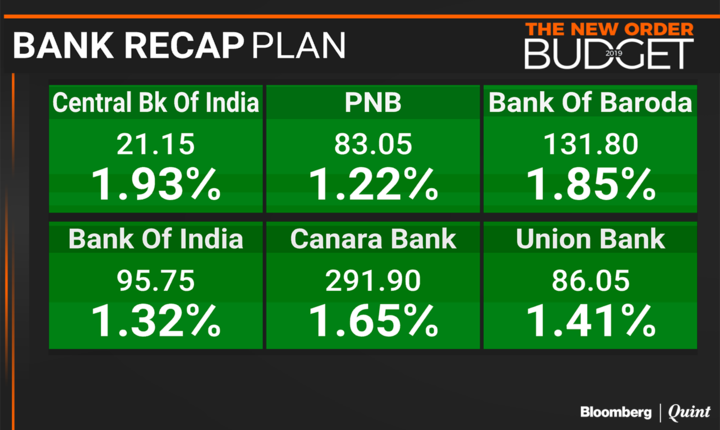
- Have also addressed the recent troubles of PSU banks.
- All revenue targets are within reasonable limits.
- Rural consumption is being pumped by government's infrastructure spending.
- Have increased each of the outlays for SC, ST and poor.
- Petrol/diesel moves made given global situation, resource requirements.
- TDS on cash withdrawal from bank a/c can be reconciled with tax return.
- FY20 direct tax targets higher by 17.5 percent vs 23-24 percent forecast earlier.
- FY20 will see reduction in off-budgetary borrowing.
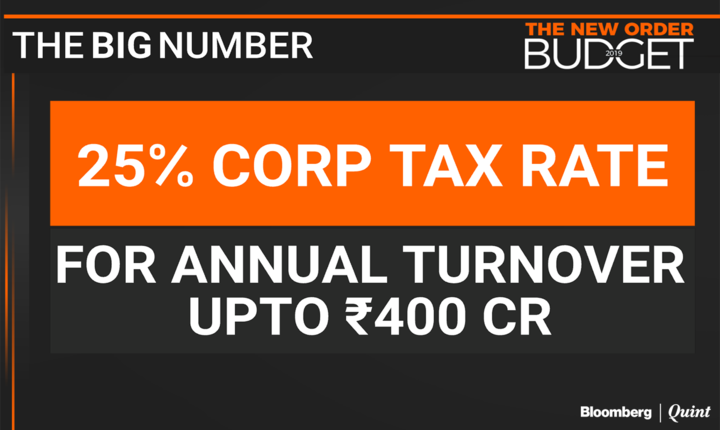
- Progressively moving toward promise of 25 percent corporate tax rate for all.
- Expecting Rs 90,000 crore dividend from RBI.
- Have increased spends on all major defence expenditure heads.
- Yet to decide on exact quantum of sovereign overseas bond.
- Whether profit-making or not is not a criteria for strategic sale consideration.
- Progressively mainstreaming instruments like InvITs, NHAI's TOT route.
- Net effect of indirect tax changes to yield Rs 25,000 crore.
Finance Secretary says
India’s plan to sell sovereign bonds overseas is most welcome as it will open up a new source of funding the fiscal deficit, says Harihar Krishnamoorthy, treasurer at FirstRand.
Once successfully established with investors, it will play a critical role in reducing the local government borrowing in rupee and alleviate the pressure on local liquidity, leaving more funds in the local market, he told Bloomberg.
Key Budget Numbers- Net market borrowing pegged at Rs 4.73 lakh crore.
- Gross market borrowing at Rs 7.1 lakh crore.
- Food subsidy at Rs 1.84 lakh crore versus Rs 1.71 lakh crore previous year.
- Fertiliser subsidy at Rs 79,996 crore versus Rs 70,086.
- Oil subsidy at 37, 478 crore versus Rs 24,833 crore.
- Dividend/Surplus of RBI, PSU banks pegged at Rs 1.06 lakh crore.
- Defense spending at Rs 3.05 lakh crore versus Rs 2.85 lakh crore.
- Aims to buyback government bonds worth Rs 50,000 crore in FY20.
“It is positive for public sector banks even though some of the banks have come out of PCA,” Bank of Baroda’s Executive Director AK Garg said.
“The regulatory capital issues are being resolved. They are also looking to providing requisite growth capital. Therefore, going forward, banks are in a position to start lending to the areas which are the government’s priority mainly SME and agriculture,” Garg told BloombergQuint.
The government proposes to restrict Securities Transaction Tax (or STT) to the difference between settlement and transaction price in case of options. Sitharaman said capital gains to be deducted at source, like banks, mutual funds and EPFO.
- Enhanced interest deduction of Rs 3.5 lakh for affordable home buyers
- Government to allow Rs 1.5 lakh additional deduction on interest on home loan taken by March 2020
- Additional tax deduction on home loan interest for houses worth up to Rs 45 lakh
India will start raising part of its borrowing in the foreign market. Previous governments have stayed away from topping global bond markets.
- NBFCs that are fundamentally sound continue getting funding by MFs, banks
- PSU banks to get limited credit guarantee for investment in high-rated NBFC
- NBFCs playing important role in sustaining consumption demand
- Propose to return regulatory authority over housing finance sector to RBI from NHB
- To set up expert committee to study long-term finance in infrastructure
- To invest Rs 100 lakh crore in infrastructure over five years
- To cut net-owned fund requirement for re-insurers to join IFSC to Rs 1,000 crore
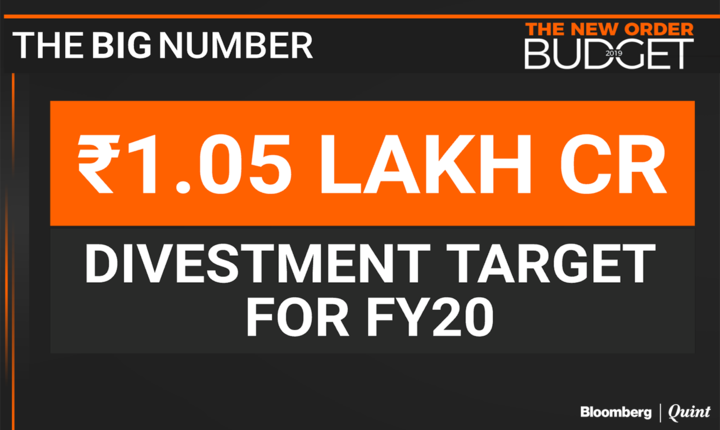
- To retain 51 percent stake in PSUs even after disinvestment
- Proposes to encourage retail participation in CPSEs
- Strategic disinvestment of select CPSEs is a priority of the government
- To restart the Air India disinvestment process
The government will target a fiscal deficit of 3.3 percent of the Gross Domestic Product for 2019-20, Finance Minister Nirmala Sitharaman said in her budget speech on Friday. However, the target, which is 0.1 percent lower compared to the interim budget of 3.4 percent of GDP, comes against the backdrop of a weak Indian economy and slower than expected tax revenue collections. (read more)
- The International Yoga Day is now a global phenomenon, she says.
- To develop 17 iconic tourism sites as world-class tourist centres.
- Approves set-up of 18 embassies and high commissions in Africa
- Proposes revamp of IDEAS schemes.
- Recent elections showed record turnout of women, at par with men.
- Women entrepreneurship boosted by government schemes.
- Government to extend interest subvention for Women SFG to all parts of India.
- One woman in every SHG will be eligible for Rs 1 lakh under MUDRA scheme.
"Everything that the government does through 'Minimum Government, Maximum Governance' is aimed at 'ease of living'," says Nirmala Sitharaman in budget speech.
- PM Shram Yogi Man Dhan aims at providing Rs 3,000 pension per month
- 35 crore LED bulbs have been distributed under Ujala Yojana
- Annual cost saving of Rs 18,341 crore due to LED bulbs
- Railway station modernisation to start this year to ease travel experience
Catch the live updates here
Simplifying India’s Labour Laws: Two Steps Forward, One Step Back
"Five years ago, India didn't have any institutions among the top 200 universities. Now we have three—two IITs and Indian Institute of Sciences, Bangalore,” says Sitharaman.
The government she says is also committed to expand Khelo India Scheme.
Swachh Bharat Abhiyan has touched the very conscience of the nation besides bringing enormous health and environmental benefits, says Finance Minister Nirmala Sitharaman in her budget speech.
- 9.6 crore toilets have been constructed since Oct. 2, 2014.
- More than 5.6 lakh villages have become Open Defecation Free.
- Swachh Bharat to undertake sustainable solid waste management in every village.
“We have to build on this success. We must not only sustain the behavioural change seen in people but also harness the latest technologies available to transform waste into energy,” says Sitharaman.
“Ensuring India’s water security and providing access to safe and adequate drinking water to all Indians is a priority of the government. A major step in this direction has been the constitution of the Jal Shakti Mantralaya.
- Jal Shakti Mantralaya will work with States to ensure Har Ghar Jal to all rural households by 2024 under the Jal Jeevan Mission.
- This Mission will focus on integrated demand and supply side management of water at the local level, including creation of local infrastructure for source sustainability.
- The Jal Jeevan Mission will converge with other central and state government schemes to achieve its objectives of sustainable water supply management across the country.
- The Government has identified 1592 Blocks which are critical and over exploited, spread across 256 District for the Jal Shakti Abhiyan.
Finance Minister Nirmala Sitharaman acknowledges farmers contribution for making India self-sufficient in pulses. "We will invest widely in agriculture infrastructure," she says in her budget speech. “I am sure they will repeat such a success even in the production of oilseeds. Our import bill shall be reduced by their seva."
- ‘Scheme of Fund for Upgradation and Regeneration of Traditional Industries’ (SFURTI) aims to set up more Common Facility Centres (CFCs)
- This will facilitate cluster-based development to make the traditional industries more productive, profitable and capable for generating employment opportunities.
- The focused sectors are Bamboo, Honey and Khadi clusters.
- SFURTI envisions setting up 100 new clusters during 2019-20 which should enable 50,000 artisans to join the economic value chain.
- Scheme for Promotion of Innovation, Rural Industry and Entrepreneurship’ (ASPIRE) has been consolidated for setting up of Livelihood Business Incubators (LBIs) and Technology Business Incubators (TBIs).
- The Scheme contemplates to set up 80 Livelihood Business Incubators (LBIs) and 20 Technology Business Incubators (TBIs) in 2019-20 to develop 75,000 skilled entrepreneurs in agro-rural industry sectors.
- Dairying through cooperatives shall also be encouraged by creating infrastructure for cattle feed manufacturing, milk procurement, processing & marketing.
- “We also hope to form 10,000 new Farmer Producer Organizations, to ensure economies of scale for farmers over the next five years,” Sitharaman says.
"We keep 'Gao, Gareeb, Kisaan' at the centre of everything we do," says Finance MInister Nirmala Sitharaman, while announcing rural reforms in her budget speech.
- Every single rural family except those unwilling to get access will have electricity and LPG connection by 2022.
- As many as 1.5 crore rural home have been completed under the Pradhan Mantri Aawas Yojana in five years.
- The second phase of PMAY for 2019-20 will see construction of 1.95 crore houses.
- Nearly 1,25,000 km of roads will be upgraded under Pradhan Mantri Gram Sadak Yojana at estimated cost of nearly Rs 80,200 crore.
- All weather connectivity provided to 97 percent of 2019 target under the Pradhan Mantri Gram Sadak Yojana.
Current rental laws are archaic as they do not assess the relation between the lessor and lessee in a fair manner. The government will look at improving the laws, says Finance MInister Nirmala Sitharaman in her budget speech.
- Merge NRI portfolio route with FPI route.
- Raise limit on FPI to be at par with FDI
- Examine raising FDI caps in aviation, media, animation, insurance.
- Allow FPIs to invest in listed securities of RITES, InVITs
- Raise minimum public holding in listed equities to 35 percent from 25 percent.
- Allow AA-rated bonds to be used as collateral in tri-party repo market.
Rs 350 crore has been allocated for interest subvention scheme for GST-registered MSMEs, says Finance Minister Nirmala Sitharaman in her budget speech.
- Pradhan Mantri Karam Yogi Man Dhan Scheme launched for retail traders.
- Government to extend pension benefit to three crore retailers.
- Rs 350 crore allocated for interest subvention scheme for GST-registered MSMEs.
- Modern tenancy law will Be finalised, distributed to states.
- Credit Guarantee Enhancement Scheme will be set up in 2019-20.
The government is examining the UDAY scheme and will improve it further. The recommendations of high-level empowered committee of retiring power old plants and other structural reforms will also be taken up now. UDAY has also helped so far and it will get better further in the coming years, she says.
On Metro trains, Sitharaman says 657 km of metro line operationalised so far in with 300km approved in 2018-19.
“Five years ago India was the 11th largest economy, now it’s the sixth,” says Nirmala Sitharaman, while underscoring the need to undertake structural reforms. The fiannce minister says the Indian economy has grown to $2.7 trillion from $1.85 trillion in 2014—a $5 trillion economy is now possible in next few years.
Finance Minister Nirmala Sitharaman starts off her maiden budget speech acknowledging the decisive mandate given by India’s voters in the recently concluded elections. The people of India have validated goals of national security and economic growth, she said. “We shall further simplify procedures, incentivise performance, reduce red tape,” she promised in her budget speech.
The Union Cabinet has approved the Budget 2019. Finance Minister Nirmala Sitharaman will begin her budget speech in the Lok Sabha shortly.
Catch the minute-by-minute market updates, here.
Copies of #Budget2019 have been brought to the Parliament.
— BloombergQuint (@BloombergQuint) July 5, 2019
Catch all budget updates here: https://t.co/dzYkJMBaMe pic.twitter.com/v84Ifoehef
Naina Lal KIdwai, former president of FICCI and chairperson, Advent Private Equity India Advisory Board, has the following expectations from the Budget 2019:
- Government infrastructure spending holds key, given lack of private participation.
- Bringing back rural economy to growth is paramount.
- U.S.-China trade war is throwing a lot of opportunities for India.
- Combination of export, domestic consumption growth could revive investments.
- India’s real estate sector is in dire need of help.
Commenting on Finance Minister Nirmala Sitharaman keeping budget documents in a four fold red cloth instead of a briefcase, Chief Economic Adviser Krishnamurthy Subramanian said, “It is in Indian tradition. It symbolizes our departure from slavery of Western thought. It is not a budget but a bahi khata.’ ANI
Rashtrapati Bhavan: As per tradition, Finance Minister Nirmala Sitharaman calls on President Ramnath Kovind before presenting the Union Budget pic.twitter.com/5vOMn9qj2H
— ANI (@ANI) July 5, 2019
The government’s Economic Survey 2018-19, presented a day ahead of Union Budget 2019, pins its hopes on a revival in private investment to help spark-off a ‘virtuous cycle’ for the Indian economy.
India has struggled with a lack of private investment for the last few years due to overcapacity, excess leverage of corporate balancesheets and reduced capacity within the banking system to lend. The Survey, just like the one presented in 2018, suggests an urgent need to revive private investment. (read more)
The government can use the budget platform to send strong messages among investors, said Pramod Gubbi, Founder, Marcellus Investment Managers. Gubbi said ‘bold’ decisions such as reducing the cost of factors of production- land, labour and capital could be taken as the ruling government has a bigger mandate. (read more)
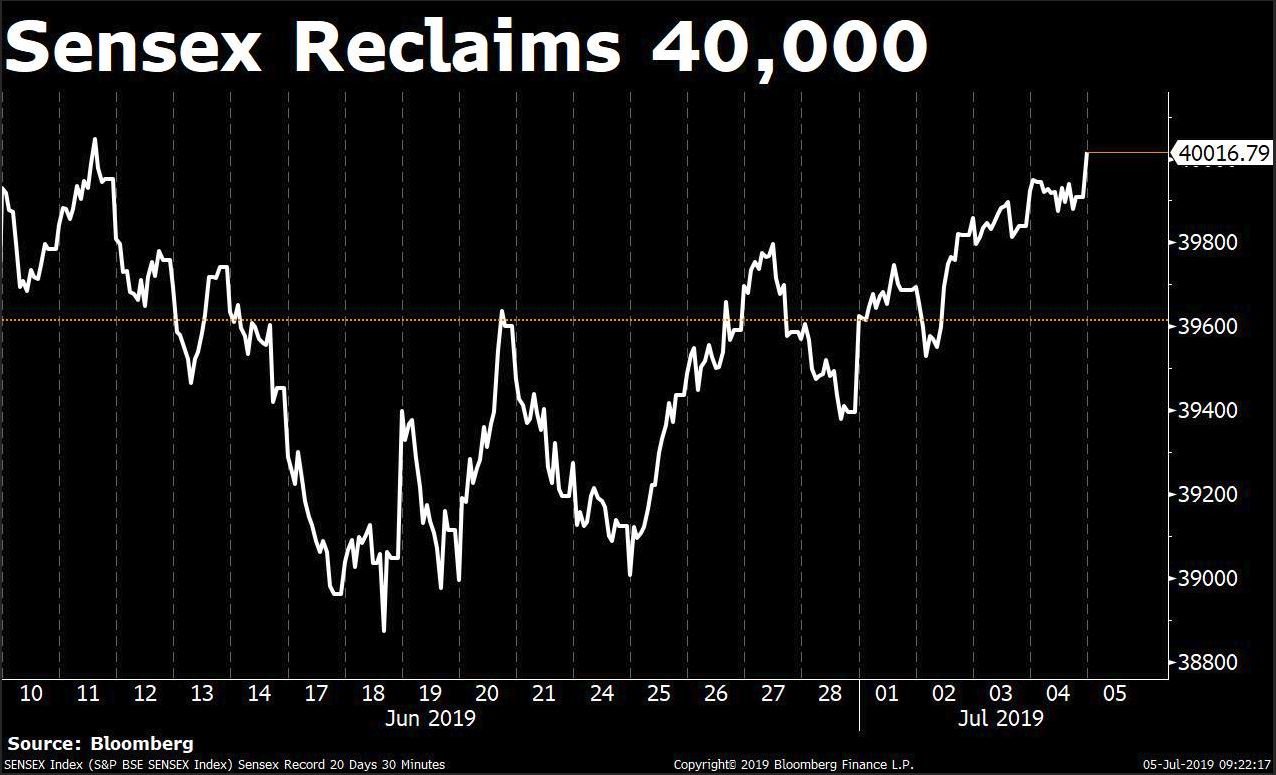
Sensex and Nifty extended gains for the fifth consecutive trading session ahead of Budget 2019, which will be presented at 11:00 am by Finance Minister Nirmala Sitharaman.
The S&P BSE Sensex rose as much as 0.31 percent to 40,031.81 and the NSE Nifty 50 rose as much as 0.29 percent to 11,981. The broader market index represented by the NSE Nifty 500 Index rose as much as 0.29 percent.
The benchmarks indices are set for their longest gaining streak in nearly four months.
Finance Minister Nirmala Sitharaman, MoS Finance Anurag Thakur, Finance Secretary S C Garg, Chief Economic Advisor Krishnamurthy Subramanian and other officials outside Finance Ministry. #Budget2019 to be presented at 11 am in Lok Sabha today pic.twitter.com/oCyrMSNg7N
— ANI (@ANI) July 5, 2019
The Indian Rupee opened lower against the U.S. dollar ahead of Finance Minister Nirmala Sitharaman Budget 2019 speech today. The home currency depreciated as much as 0.1 percent to 68.58 against the greenback. In the bond market, the 10-year yield rose marginally higher to 6.75 percent.
Finance Minister Nirmala Sitharaman, with her Budget 2019 team, has left for the Rashtrapati Bhavan to meet President Ram Nath Kovind ahead of the presentation of the Union Budget 2019 in Parliament today.
Delhi: MoS Finance Anurag Thakur offers prayers ahead of #Budget2019. Finance Minister Nirmala Sitharaman to present the Budget at 11 am in Lok Sabha today pic.twitter.com/fFMWQiyoTH
— ANI (@ANI) July 5, 2019
Delh: Finance Minister Nirmala Sitharaman arrives at Ministry of Finance. She will present the #Budget2019 today at 11 am in Lok Sabha. pic.twitter.com/ttrVBWK10O
— ANI (@ANI) July 5, 2019
Chief Economic Adviser KV Subramanian's Economic Survey 2018-19, presented a day before Union Budget 2019, pegs India GDP growth rate at 7 percent. Political stability will be key to reviving demand and investment activity in the Indian economy, according to the report.
“For the next budget exercise, the development goal might supersede the rigid objective of fiscal austerity,” said Soumya Kanti Ghosh, group chief economic adviser at State Bank of India in Mumbai. “Sticking to a particular fiscal number *is not that important* in the current scenario.”
Sitharaman will need to balance allowing the budget deficit to widen without risking a credit-rating downgrade and rattling bond markets. Key to that will be finding additional revenue to finance higher spending and keeping borrowing under control. Bloomberg
The government may sell stakes in state-run companies to help boost revenue. Last year, it raised Rs 85,000 crore from selling stakes in PSU firms, including Coal India Ltd. and Bharat Heavy Electricals Ltd. Expect Finance Minister Nirmala Sitharaman to announce a government disinvestment target of Rs 1 lakh crore in her budget speech, higher than the Rs 90,000 crore penciled-in in the interim budget, according to Yes Bank analysts led by Shubhada Rao. Bloomberg
Revenue from GST and customs levies undershot targets last year, and Finance Minister Nirmala Sitharaman will need to find additional resources to fund government welfare schemes without increasing the tax burden on individuals.
She’s expected to give consumers relief by increasing the personal income tax slab for some individuals in the budget, according to people familiar with the matter.
Analysts at Kotak Mahindra Bank, led by Suvodeep Rakshit, estimate that government's tax revenue will probably be Rs 1.4 lakh crore lower than was forecast in the interim budget. “This will be the most significant threat to the fiscal math,” the analysts said in a note. Bloomberg
Also Read: BQ Explains: A Crash Course In Personal Income Tax
One of the key election pledges of Modi’s Bharatiya Janata Party was to spend $1.44 trillion for infrastructure development in the next five years. In Budget 2019, Finance Minister Nirmala Sitharaman is expected to outline details of this plan as well as investment in agriculture and other sectors that can be drivers of GDP growth.
Markets will also be looking for how much capital the government will inject into public sector banks after a massive Rs 1.06 lakh crore PSU bank recapitalisation plan last year.
Now that elections are over and the country has given an unambiguous verdict, this budget should take some hard decisions towards initiating a host of structural reforms that would trigger investment activity in the Indian economy, said Partha Ray, a professor of economics at the Indian Institute of Management in Kolkata. Bloomberg
The government is seeking to extract higher dividends from the Reserve Bank of India to help boost its revenue and finance the fiscal deficit, and Budget 2019 may give a provisional figure on how of RBI excess reserves will be transferred for the remainder of the fiscal year.
RBI gives dividends to the government every year and made an interim payout of Rs 28,000 crore in February.
The government has been pushing for RBI to boost its contribution, with officials from Sitharaman's ministry estimating central bank's surplus capital at Rs 3.6 lakh crore. A panel led by former former Governor Bimal Jalan was set up to study RBI’s external capital framework, and is yet to finalize its report Bloomberg.
Government Considering More Powers To RBI To Regulate NBFCs, Says Nirmala Sitharaman
The Nifty can test its all-time high today according to IIFL’s Senior Technical Analyst Hadrien Mendonca. However, he recommends investors remain cautious while taking positions.
“One can take a position on the Nifty with a stop-loss of 11,800 on a conservative basis and hold on to long positions with a target of 12,100. Since it is going to be a risk trade, only ‘brave hearts’ should attempt it,” said Hadrien Mendonca, senior technical analyst at IIFL.
India has a lot of room for higher fiscal deficit and to lower interest rates to spur economic growth.
That’s according to Mark Mobius, co-founder of Mobius Capital Partners, who expects India’s fiscal deficit to rise to as high as 5 percent of its GDP. The deficit, he said, won’t deter foreign investments if the higher slippages are aimed at improving the country’s economic performance. (read more)
Finance Minisiter Nirmala Sitharaman faces different conditions than her predecessor in Union Budget 2019, says Bloomberg Opinion’s Mihir Sharma.
In the months since the interim budget in February, the Indian economy has taken a turn for the worse. In May, we learned that the economy had grown at only 5.8 percent in the three months between January and March, significantly lower than expected.
The monsoon—crucial for growth in agriculture, which employs half or more of India’s workers—has under-performed. Rain in June was a third less than expected; it was the fifth-driest June in a century. That means consumer demand in India will be under further pressure and the government will be expected to step in to support spending and provide welfare. (read more)
India’s chief economic adviser said the government will keep its fiscal deficit under control as it sees a rebound in economic growth from a five-year low.
In a report ahead of the budget speech, the Finance Ministry said growth will probably reach 7 percent in the current fiscal year that began on April 1.
The government will seek to avoid undermining private investment by widening the fiscal deficit, Krishnamurthy Subramanian, author of the Economic Survey 2018-19 report and chief economic adviser, told reporters Thursday.
“We will be sticking to the fiscal deficit path,” Subramanian said. “If investment, especially private investment, has to get fostered, crowding out can’t happen.” (read more)
A surprise pick by Modi, the new minister remains a relatively unknown entity to the financial world. Her critics say there’s a risk she could simply become a figurehead, with polices shaped by the prime minister. Her supporters argue that her reputation for prudence and team spirit will help her work out a middle ground.
Economic growth is high on the agenda and the government is undertaking various reforms to achieve this, Sitharaman told lawmakers on Tuesday. (read more)
The Union Budget 2019 plans to narrow the Narendra Modi government's fiscal deficit target and sell its first global bond to raise funding for infrastructure spending to spur economic growth.
The fiscal deficit goal for 2019-20 was lowered to 3.3% of India's GDP from 3.4% set in February’s interim budget, Finance Minister Nirmala Sitharaman said in her budget speech in Parliament in New Delhi Friday. That plan will in part be funded by taxing the wealthy and higher government disinvestment.
“Those in the highest income brackets need to contribute more to the nation’s development,” Sitharaman said. She aims to raise Rs 1.05 lakh crore from asset sales, compared with Rs 90,000 crore targeted previously.
Here are the live updates on Union Budget 2019 and highlights from Nirmala Sitharaman's budget speech.
Essential Business Intelligence, Sharp Market Insights, Practical Personal Finance Advice, Daily Fuel, Gold and Silver Prices and Latest Stories — On NDTV Profit.