Get App
Download App Scanner
Scan to Download
Advertisement
LIVE UPDATES

Shaktikanta Das Live: RBI Provides NPA Relief To Banks, Curbs Dividends

Shaktikanta Das Live: RBI Provides NPA Relief To Banks, Curbs Dividends
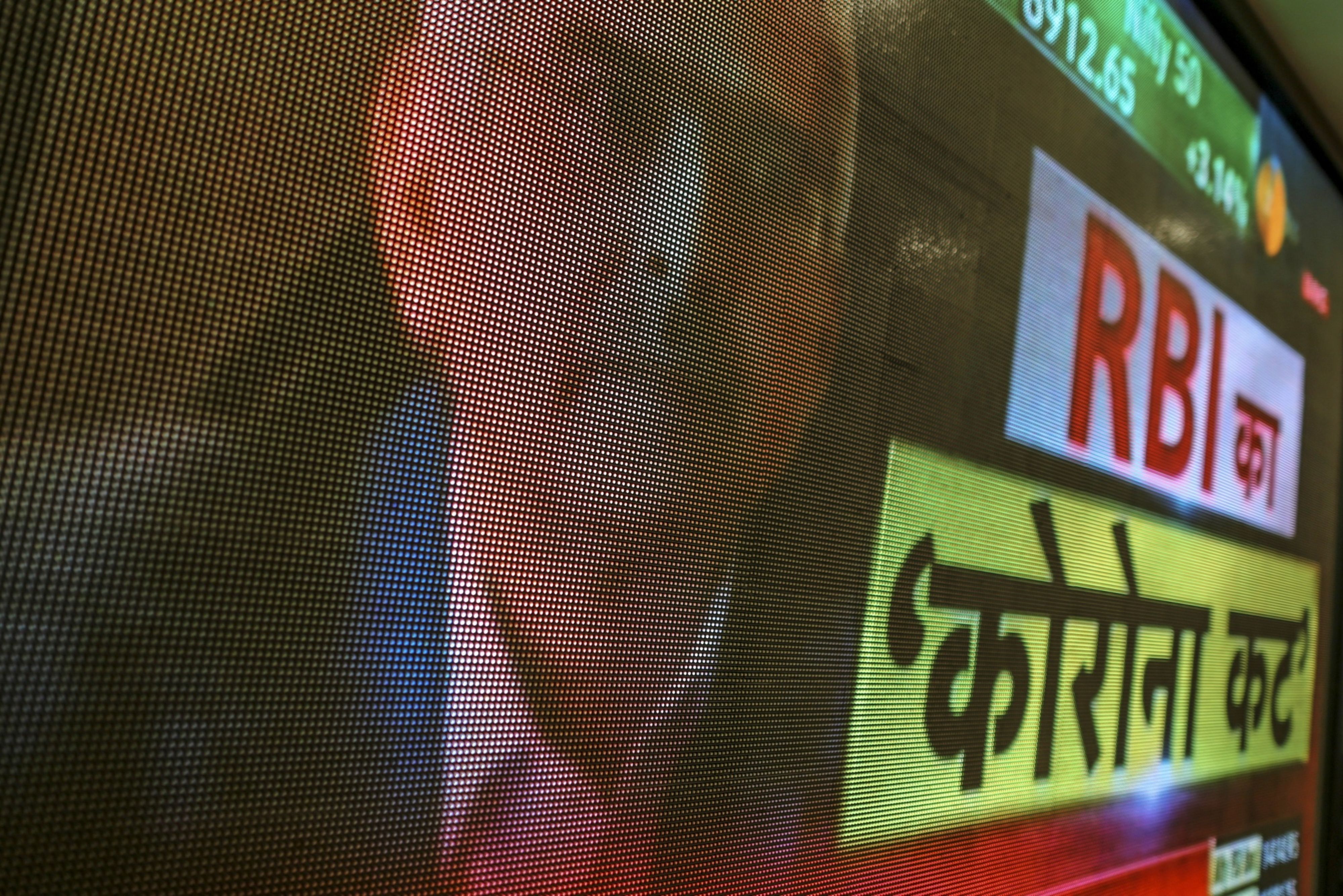
A screen displays an image of the Reserve Bank of India (RBI) Governor Shakitanka Das inside the Bombay Stock Exchange in Mumbai, India. (Photographer: Dhiraj Singh/Bloombergg)
6 years ago
Catch all live updates on the RBI's second such live briefing amid the Covid-19 outbreak. 

M Govinda Rao, Member of the 14th Finance Commission welcomed the RBI’s announcement on WMA, saying the increase in limit for states very important at this particular point of time.

  • Will protect states from going in for long term borrowing immediately
  • States are on the frontlines, spending on health care, migrant welfare etc.
  • If all states borrowed from the market immediately, we could have seen a spike in yields
  • Now states can phase out their borrowing needs & borrow at cheaper rates
  • Will have to be seen if the WMA limit hike is adequate; will depend on how much states will have to spend on Covid-19 fight
  • States' FRBM limit may need to be raised, over & above this temporary relief on the WMA limit
  • Have to be careful about how much additional money supply that's injected into the system

Mrityunjay Mahapatra, MD & CEO, Syndicate Bank
  • RBI has tried to balance the need for system liquidity & providing assistance to impacted businesses and the need to maintain banking system's health
  • Banks have been asked provide additional 10 percent till a review is made
  • Without the relaxation, 15 percent provision would've had to be made
  • There's some relaxation, but it's not as if there's full relief
  • Resolution timeline extension will also ease provisioning requirements
  • Restriction on dividends won't have much impact on banks' balance sheets
  • Disclosures of account details (standard, moratorium etc.) are market imperatives
  • Overall incentives for lending has gone up
  • Risk matrices of individual banks will play out differently
  • Expect banks to expand risk appetite

“These early developments suggest that inflation is on a declining trajectory having fallen 170 basis points from its January 2020 peak. In the period ahead, inflation could recede even further. barring any supply side shocks, it may settle well below the target of 4 percent in the second half of FY21. Such an outlook could make policy space available to address the intensification of risks for growth and financial stability brought around by Covid-19. This space needs to be used effectively and in time.”

Date for commencement of commercial operations, in NBFCs loans to commercial realty projects, can be extended by 1 year, Das said.

  • LCR requirement for scheduled commercial banks is being brought down to 80 percent from 100 percent with immediate effect.
  • It will be brought back up gradually.

  • In respect of all accounts for which banks and financial institutions grant a moratorium, the 90-day NPA norm will exclude moratorium period.
  • Asset classification standstill for all accounts where moratorium granted.
  • NBFCs do have flexibility to consider such relief to their borrowers.
  • Banks will have to maintain additional provision of 10 percent on all such accounts over two quarters.
  • Period of resolution plan as spelled out by June 7 circular extended by 90 days.
  • Scheduled commercial banks and co-op banks will not make any further dividend payouts for profits from FY20 until further instructions.

The RBI slashed the reverse repo rate by 25 basis to 3.75 percent, Das said.

The repo rate remains the same since that decision is taken by the MPC, he added.

  • To provide special refinance facilities of Rs 50,000 crore to NABARD, SIDBI, NHB to address sectoral credit needs.
  • NABARD to receive Rs 25,000 crore to enable refinancing of rural regional banks, cooperative banks and microfinance institutions
  • SIDBI will receive Rs 15,000 crore or on-lending and refinancing to scheduled commercial banks, non-banks and microfinance institutions
  • NHB to receive Rs 10,000 crore to support housing finance companies
  • Advances under these facilities will be charged as per the RBI policy repo rate of 4.40 percent
  • RBI will assess the situation and review in consultation with the institutions and will step up the level of liquidity support if required, he said.

After announcing measures to introduce liquidity worth 3.2 percent of the GDP int he last briefing, Governor Das is now announcing additional measures.

  • Undertaking TLTRO-2.0 for amount of Rs 50,000 crore to begin with in tranches of appropriate sizes.
  • RBI might step up this amount as per requirement.
  • TLTRO-2.0 funds to be invested in bonds, CPs, NCDs of NBFCs with at least 50 percent going to mid-sized NBFCs and MFIs.

Das says he is announcing additional measures to address current conditions.

  • India among handful of countries projected to cling on tenuously to economic growth.
  • Is expected to post sharp turnaround, resume pre-Covid trajectory with 7 percent growth in FY22.
  • 21.3 percent growth in tractor sales up to February 2020 may provide offset to farm labour shortage resulting from lockdown.
  • Revival in electricity generation halted by sharp fall of 25-30 percent in daily demand.
  • Forex reserves currently cover 11.8 months of imports.
  • Systemic liquidity surplus averaged at Rs 4.36 lakh crore from March 27 – April 14.
  • Activity in corporate bond market has picked up appreciably.
  • Indications that redemption pressures faced by mutual funds has moderated.

“As Gandhi said, ‘Amidst of death, life persists, in the midst of untruth, truth persists and in the midst of darkness light persists.’

Reserve Bank of India Governor Shaktikanta Das begins briefing.

Prime Minister Narendra Modi on Thursday assessed the novel coronavirus’ impact on Indian economy and the possibility of a second stimulus package to boost sectors hit hard by the pandemic.

Several multilateral agencies, including the World Bank and the International Monetary Fund, have drastically cut their India GDP growth forecasts for 2020-21 after economic activity in the country halted due to the 40-day coronavirus lockdown.

While the World Bank expects India to grow at 1.5-2.8 percent in 2020, the IMF predicts a 1.9 percent expansion. The global economy, meanwhile, is in the throes of the worst recession since the Great Depression in 1930s, IMF said.

Click here to know more about the state of the economy.

The Monetary Policy Committee reduced the repo rate by 75 basis points and the reverse repo rate by 90 basis points, without giving any outlook on growth and inflation.

Liquidity Measures

  • RBI will conduct auctions of TLTRO of upto three-year tenor of appropriate sizes for a total amount upto Rs 1 lakh crore at a floating rate, linked to policy repo rate.
  • CRR of all banks to be reduced by 100 basis points to 3 percent beginning March 28, for one year. This will release liquidity of 1,37,000 crore across the banking system
  • These liquidity measures will inject liquidity of Rs 3.74 lakh crore to the system.

Regulatory Measures

  • All lending institutions are being permitted to allow a moratorium of three months on repayment of installments for term loans outstanding as on March 1, 2020.
  • Lending institutions permitted to allow deferment of three months on payment of interest w.r.t all such working capital facilities o/s as of March 1, 2020
  • Deferring payments will not result in asset classification downgrade.
  • Further deferring implementation of last tranche of 0.625 percent of capital conservation buffer to Sept. 30, 2020
  • Banks in India that operate IFSC banking units allowed to participate in offshore INR NDF market w.e.f. June 1, 2020

Reserve Bank of India Governor Shaktikanta Das is set for a live briefing at 10 a.m. today as India continues to grapple with an increasing number of Covid-19 infections and the economic fallout from a necessary lockdown.

This is the second such briefing being conducted by Das amid the outbreak. The last one was on March 27 where the central bank slashed rates ahead of its time and introduced more than 3.7 lakh crore in liquidity through various measures.

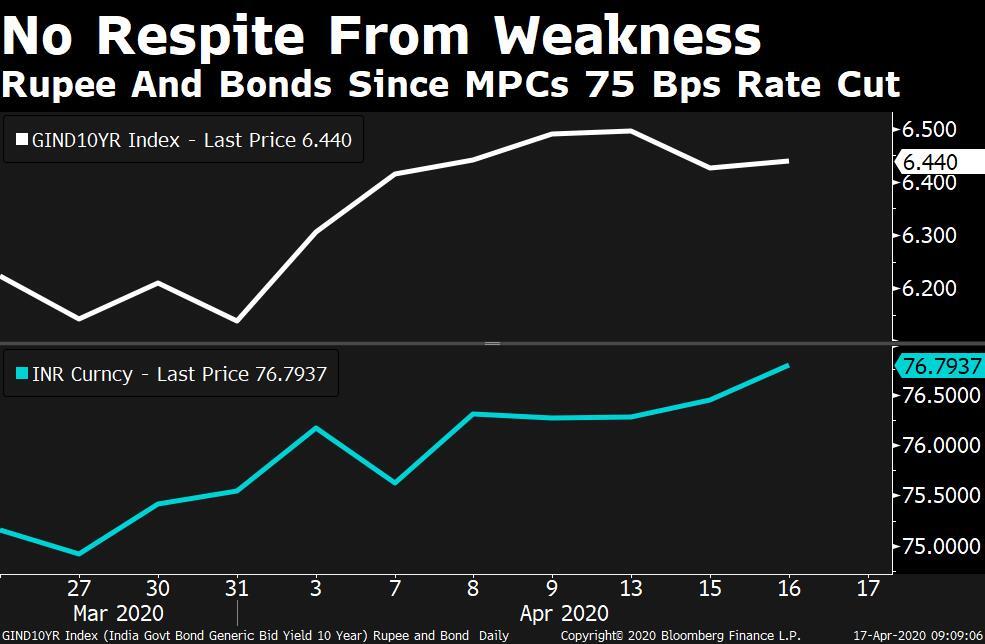
The government is slated to sell Rs 20, 000 crore ($2.6 billion) of bonds. Its first auction of Rs 19,000 crore was unexpectedly fully subscribed as investors bought on expectations that the Reserve Bank of India would purchase more debt in the secondary market to cap rising yields.

The government is selling Rs 45,000 crore of debt, including Treasury bills, every week for the first half of the fiscal year to help fund Prime Minister Narendra Modi’s record borrowing plan of Rs 4.88 lakh crore during this period. The weekly debt issuance is about 20 percent higher than a year ago.

Read More

Essential Business Intelligence, Continuous LIVE TV, Sharp Market Insights, Practical Personal Finance Advice and Latest Stories — On NDTV Profit.


Newsletters

Update Email
to get newsletters straight to your inbox
⚠️ Add your Email ID to receive Newsletters
Note: You will be signed up automatically after adding email

News for You

Set as Trusted Source
on Google Search