Sedition Case Against Amnesty International
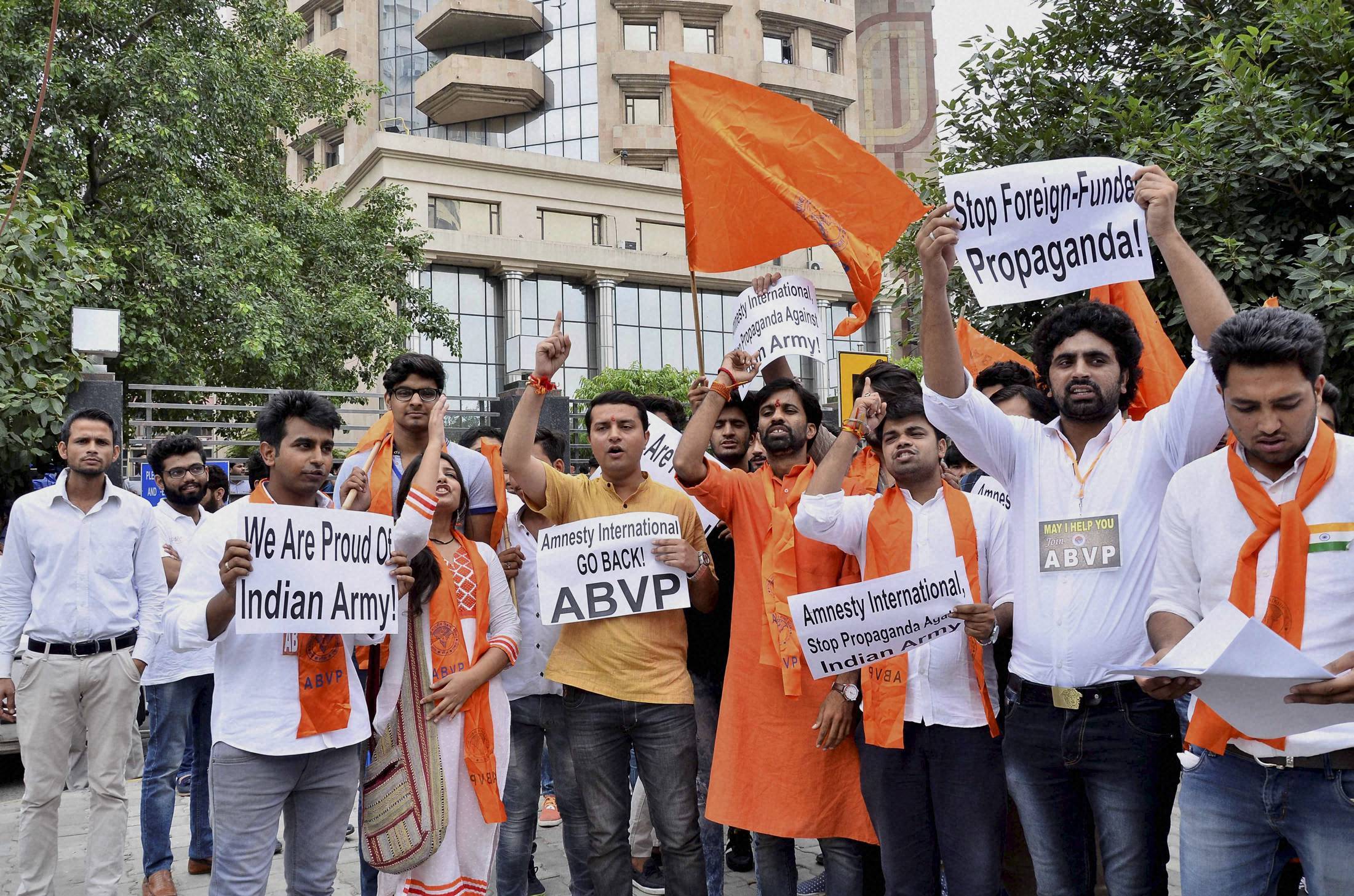
It's a depressing irony thatcolonial era legislation, designed to suppress the Indian freedom movement hasbeen used against a peaceful gathering on India's 70th IndependenceDay. The ABVP's complaint to the police against Amnesty International's event onKashmir in Bengaluru resulted in a FirstInformation Report filed against Amnesty which would not have been out ofplace in any city under British colonial rule in the first half of thetwentieth century.
No legislature, irrespective ofthe party in power, has taken the initiative to abolish the offence. It is notas if the police forces would be utterly powerless against violent extremistswho seek to overthrow the Government should this provision be repealed. The chapteron “Offences against the State” in the Indian Penal Code, 1860 alreadycovers violent uprisings, political assassinations, and conspiracies. WhatSection 124A does is to criminalize a certain kind of speech – in terms wideenough to cover any form of criticism of the Government of the day.
This should have made Section124A unconstitutional once the Constitution came into force as a violation ofArticle 19(1)(a). However, when it was challenged, the Supreme Court in Kedar Nath v State of Biharin 1962 read it to mean that unless the speech was an imminent call toviolence, it would not be covered under Section 124A and therefore, upheld theconstitutional validity of the Section. Subsequently, in 1995, in Balwant Singh v State ofPunjab the Supreme Court clarified, once again, that merelyraising slogans – in this case, for the secession of “Khalistan” from India –would not attract the penalty of Section 124A.
If the law could be translatedand transmitted simply to our police forces, much of the abuse of Section 124Awould be over instantly.
Unfortunately, that's far fromthe case.
Misusing Sedition Law
What allows such misuse of sedition law are actually two separate, but related things.
First, while the police in any state in India are notorious for their reluctances, and in some cases, outright refusal, to act on complaints by victims of crime, it is hard to find a police officer who will even hesitate once to lodge an FIR when a complaint of sedition is made. No matter how many times the Supreme Court re-iterates its fifty-five-year-old judgment explaining what Section 124A actually cover, you are never going to find a police officer who will turn down a complaint by someone in government, a member of the ruling party (Centre or State) or one of its affiliates, when it comes to an offence of sedition. The State Government's control over police functioning ensures this.
Second, even if a police officer wanted to ignore a blatantly wrong complaint of sedition, the Supreme Court's recent guidelines in Lalita Kumari v State of UP have tied her hands a bit further. The guidelines here were laid down in an attempt to ensure that police don't refuse to register FIRs when offences are complained of, it has also meant that there is an easy way out for the police to refuse to apply their minds to a complaint to see if an offence is made out. Even though Lalita Kumari does not mean that an FIR should automatically follow a complaint, irrespective of the content of the complaint, it creates a shield for the police when there's pressure on them to register an FIR even when no offence is made out.
Will the Fifty Year old Judgment be set Aside?
Of course it is highly unlikely that Amnesty International will be held guilty under Section 124A of the IPC. Likewise, Kanhaiya Kumar or the Kudankulam power plant protestors or Arundhati Roy. The point of these complaints and FIRs is not to ensure a successful prosecution for a crime. It is straightforward abuse of process intended to harass and intimidate someone into silence. It is a pity that this gets lost in the sound and noise of the news cycle. Sedition is an instance (one can think of State Government bans on film exhibitions as another) where, even if the Supreme Court has laid down the correct law, drawing the balance in favour of free speech, a dysfunctional and incompetent wing of the Government will do exactly the opposite, with no consequences.
The judgment in Shreya Singhal's case striking down Section 66A of the Information Technology Act, 2000 gives hope that the Court may be slowly (but surely) opening its eyes to the real effects of a law as a basis for striking down a law as unconstitutional. More so, if such real effects infringe on the fundamental rights of citizens, because of the vague, open ended terms it uses blurs all distinction between use and abuse.
Immediately after the Amnesty incident in Bengaluru, “Common Cause” has filed a writ petition in the Supreme Court seeking to put an end to the abuse of Section 124A. Given that it is an uphill task to argue that a fifty-year old judgment should be set aside, perhaps this is the next best alternative. One hopes that the Supreme Court appreciates that constitutional validity of laws should not just rest on interpretational ballet in a courtroom but a clear headed understanding of how the law has operated in the real world. If it does so, the Supreme Court will begin to truly usher in freedom for large sections of society.
Alok Prasanna Kumar is Senior Resident Fellow of the Vidhi Centre for Legal Policy, based in Delhi and has practised as an advocate in the Supreme Court of India.
The views expressed here are those of the author's and do not necessarily represent the views of Bloomberg Quint or its editorial team.
Also Read: The Bill That Will Doom GST
Essential Business Intelligence, Continuous LIVE TV, Sharp Market Insights, Practical Personal Finance Advice and Latest Stories — On NDTV Profit.