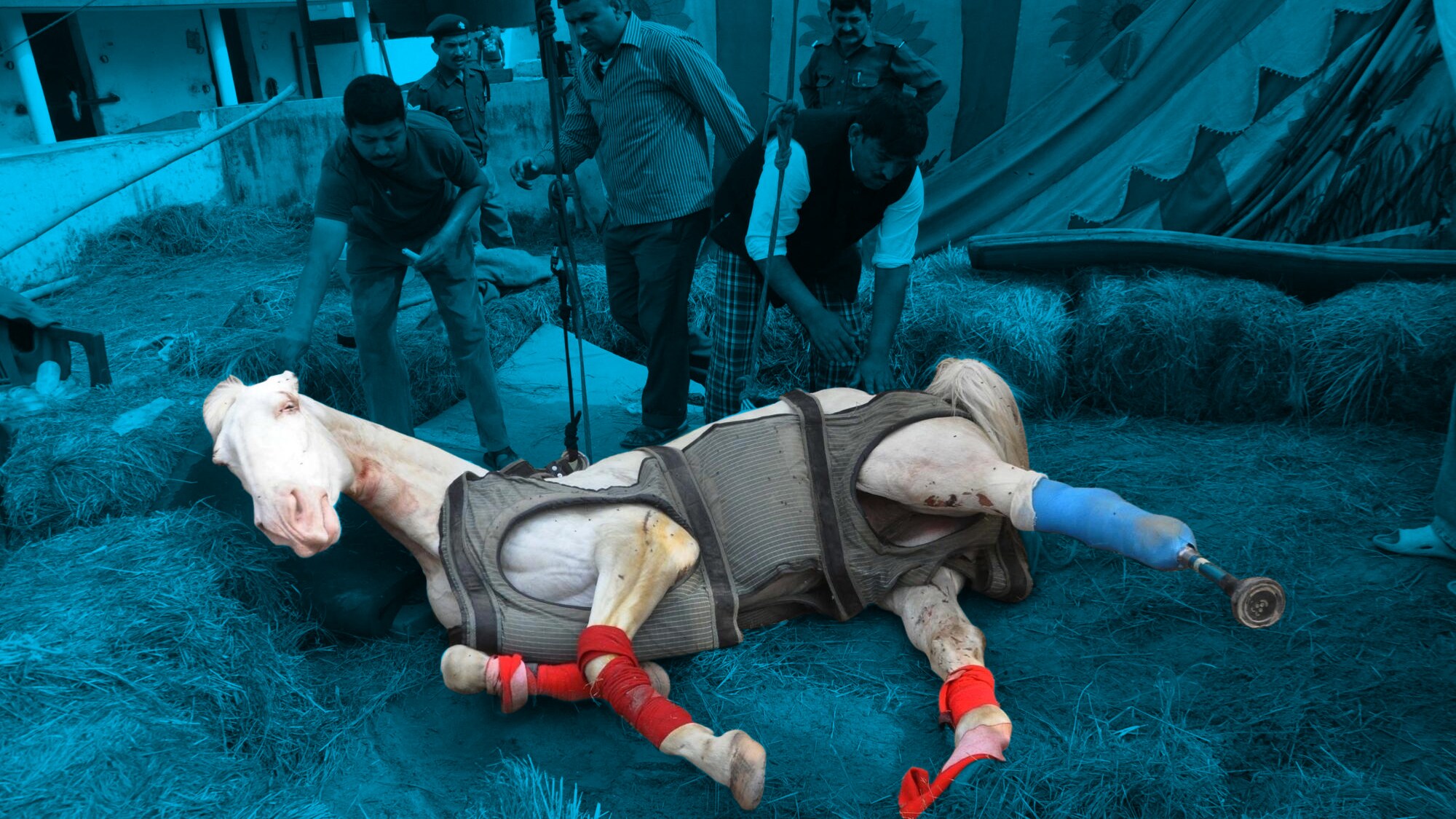
Recent events surrounding the death of police horse Shaktiman followingthe merciless thrashing it reportedly received from a BJP MLA during a partyrally in Uttarakhand and the ensuing political battle over who deserves blame raises the more important moral battle around our treatment of animals in India.Such incidents have become all too common (just a few days after this tragicincident, a young man was charged with stabbing stray dogs on the streets ofDelhi). This pattern of animal abuse across India reveals enduring weaknessesin our country's laws against cruelty to animals.
It is beyond my comprehension how such incidents occur in a land thathas worshipped animals for centuries. The very core values of Hinduism live inconsonance with nature, as vividly demonstrated in the Mahabharata andRamayana. Gods have presented themselves as animals in their various avatars,formed partnerships with them and used them as sacred vehicles (vahanas) and companions – from thelittle mouse that Ganesha rides, to Ananthaor Sheshanaga, Vishnu's snake bed and protector, or Hanuman, Rama's vassal whoplays an integral role in helping him defeat the ten-headed King Ravana.Animals have been celebrated in our lives and culture from the very beginning.
Reviewing Laws on Animal Cruelty
Yet, inrecent times, India has become synonymous with a lack of regard for and theattendant ill treatment of animals. The penalties for cruelty to animals, as enactedin 1960, range from a scant Rs 10 to a mere Rs 50, and remain unchangeddespite the rising criminal acts against animals.
This farce of a penalty underSection 11 of the Prevention of Cruelty to Animals Act (PCA), broadlyencompasses offences such as causing unnecessary pain or suffering to ananimal, confining or chaining an animal for unreasonable periods of time,mutilating or killing an animal, and shooting animals for entertainment andsport. (One man even posted on YouTube a video of himself torturing a puppy.)
Despite the increased rate of inflation and other socio-cultural changes, the penalty has not been upwardly reviewed in over five decades, nor has the disturbing number of incidents of maltreatment of animals been, apparently, a good enough reason to revise this figure in the direction of greater stringency.
This absurd punishment amounts to less than a slap on the wrist: a fifty-rupeefine for a crime of severe gravity. The lack of deterrence has earned India aninternational reputation for failing the cause of animal rights, encouragingforeign companies to conduct tests on animals and to exploit weaknesses andambiguities in our laws. Many of India's universities and research centres havealso been lax about compliance with existing standards.
Ban on Animal Testing
In 2012, the Ministry of Environment and Forestsissued a directive instructing all institutes and establishments associated withthe life sciences to introduce alternatives to animal dissection, and yet someuniversities continue to follow old, inhumane methods. People for the EthicalTreatment of Animals (PETA), has alleged that even India's premier researchfacilities have conducted questionable experiments on animals without a thoughtfor international legal and moral standards.
In 2013, in response to troubling tales of vivisections (the dissectionof live animals for teaching purposes), I had campaigned to promote the preventionof the use of animals in teaching wherever possible (the guiding principlebeing that if an animal dissection was reasonably avoidable, it should beavoided). The main targets of my effort were medical schools where the practiceof dissection continued as a matter of business as usual. In early 2014, theUniversity Grants Commission (UGC) implemented an official recommendation fromtwo years earlier to stop animal dissection and experimentation in zoology andlife sciences courses, while the Medical Council of India (MCI) amendedregulations for teaching physiology and pharmacology by adopting non-animalteaching methods.
Use of alternative training methods could save the lives of approximately 19 million animals each year. The continued use of dissection at undergraduate and post-graduate levels is entirely avoidable – and therefore ought to be proactively avoided.
The protection of animal rights, already enshrined in the law of the land,should provide 21st century solutions to 20th century problems. TheMinistry of Environment and Forests' guidelines under the PCA have not been effectiveeven if intentions lie in the right direction. Unlike 1960, today there exists a plethora of technological developmentsthat facilitate humane treatment of animals, as a reflection of our own evolvedsense of what it means to be human.
Glimmerof Hope
The onus is only partially onlawmakers – and yes, we have made some progress in the last few years. In2014, the Ministry forHealth and Family Welfare published a draft notification to amend The Drugs andCosmetics Rules, 1945, to ban the import of cosmetics tested on animals, as Ihad proposed. Humane Society International estimates that approximately 100,000to 200,000 mice, rabbits, hamsters, guinea pigs, dogs, and monkeys suffer anddie for the sake of cosmetics -- an alarming number, which may be an undercountsince many countries do not have reliable statistics or data.
For that reason, Isuggested that the wording of the ban be revised to ensure that the import of anyfinal cosmetic product tested on animals should be prohibited, closing aloophole that allowed for the ingredientsfor such cosmetics to be tested on animals. The ministry agreed, ensuring thatthe spirit of the law was not circumvented by a technical difference between a“product” and its “ingredients”. This made India the only nation in Asia tohave such a ban, earning a place alongside the European Union, Norway andIsrael as a promoter of cruelty-free cosmetics.
Morerecently, as a further victory to animal rights activists, bans on animaltesting have even been extended to include various household products (soaps,detergents, etc.) as well. This will prevent the infliction of painful andlethal poisoning of animals during drug toxicity tests – and will also benefitthe pharmaceutical industry by reducing one step in bringing the drug to themarket.
Animal Welfare Must be aPriority?
- Cruelty to animals stemsfrom the fact that strict punishment is not provided in law.
- Under the Cruelty toAnimals Act 1960, minimal punishment is a fine of Rs 10 and maximum penalty is Rs 50.
- May 3, 2016: Over 24,000cases of animal cruelty have been reported from 2012-2015, informs thegovernment.
- May 27, 2016: Environmentministry panel sends a letter to the UGC urging it to reconsider ban on animaldissection.
- November 18, 2015:Supreme Court affirms culling of stray dogs illegal, emphasises on striking a balance betweenempathy and safety of humans.
Underfunded Birth Control Programmes
However, other acts of animalcruelty persist and are often justified in the light of fear and, appallingly,convenience. In 2015, I raised a point in Parliament as I was deeply troubledby the stray dog crisis in Kerala that too often results in dog bites and thespread of disease. Such attacks imperil people, affect tourism, andoverwhelmingly harm the impoverished. But a stray dog menace does not justifyneedless cruelty, and measures in favour of upholding animal rights can be in linewith measures to reduce stray dog populations.
For instance, theAnimal Birth Control (ABC) Programme developed by the Animal Welfare Board ofIndia establishes mechanisms for monitoring, vaccinating, and sterilising dogs.The ABC Programme offers a more humane, effective, and systematic solution to reducestray dog populations. But such programmes are underfunded, which motivated me tourge the government to provide financial assistance to Kerala to effectively implement the ABC Programme to sterilise and vaccinate –rather than kill -- all stray dogs.
Respect for Mute Beings
We can nolonger afford to stand still while defenceless beings are attacked and hurt inthe name of our well-being or, more often than not, for the sake of ourconvenience. Animal cruelty is not worthy of a country with India's culturaland historical compassion for all living beings.
We cannot allow ambiguous law,paltry fines, and repeated institutional deficiencies to fail our animals.
We muststrive to change our mental makeup to learn to appreciate and respect animal life.It is notenough for one individual or one institution to safeguard animals from abuse—itrequires the whole country to come together in the name of humanity. After allit was Mahatma Gandhi who said that ‘the greatness of a nation can be judged bythe way its animals are treated'. And by this yardstick, we have a long way togo before we can call ourselves great.
(Former UN under-secretary-general, Shashi Tharoor is a Congress MP and an author.)
Also read:
The Silent Agony of Shaktiman: Does She Deserve Dignity in Death?
After New Nirbhaya Law, it's Time a ‘Shaktiman Act' is Legislated
Essential Business Intelligence, Continuous LIVE TV, Sharp Market Insights, Practical Personal Finance Advice and Latest Stories — On NDTV Profit.