The Reserve Bank of India has updated its real effective exchange rate indices used to judge the competitiveness of the Indian rupee. The new indices, according to a paper published in the central bank's monthly bulletin, suggests that the rupee is fairly valued and appreciation due to large capital inflows, if permitted, would make the Indian currency uncompetitive.
By adjusting for inflation differentials and trade patterns, the real effective exchange rate indices give a clearer sense of the fair value of a currency.
The New ‘REER'
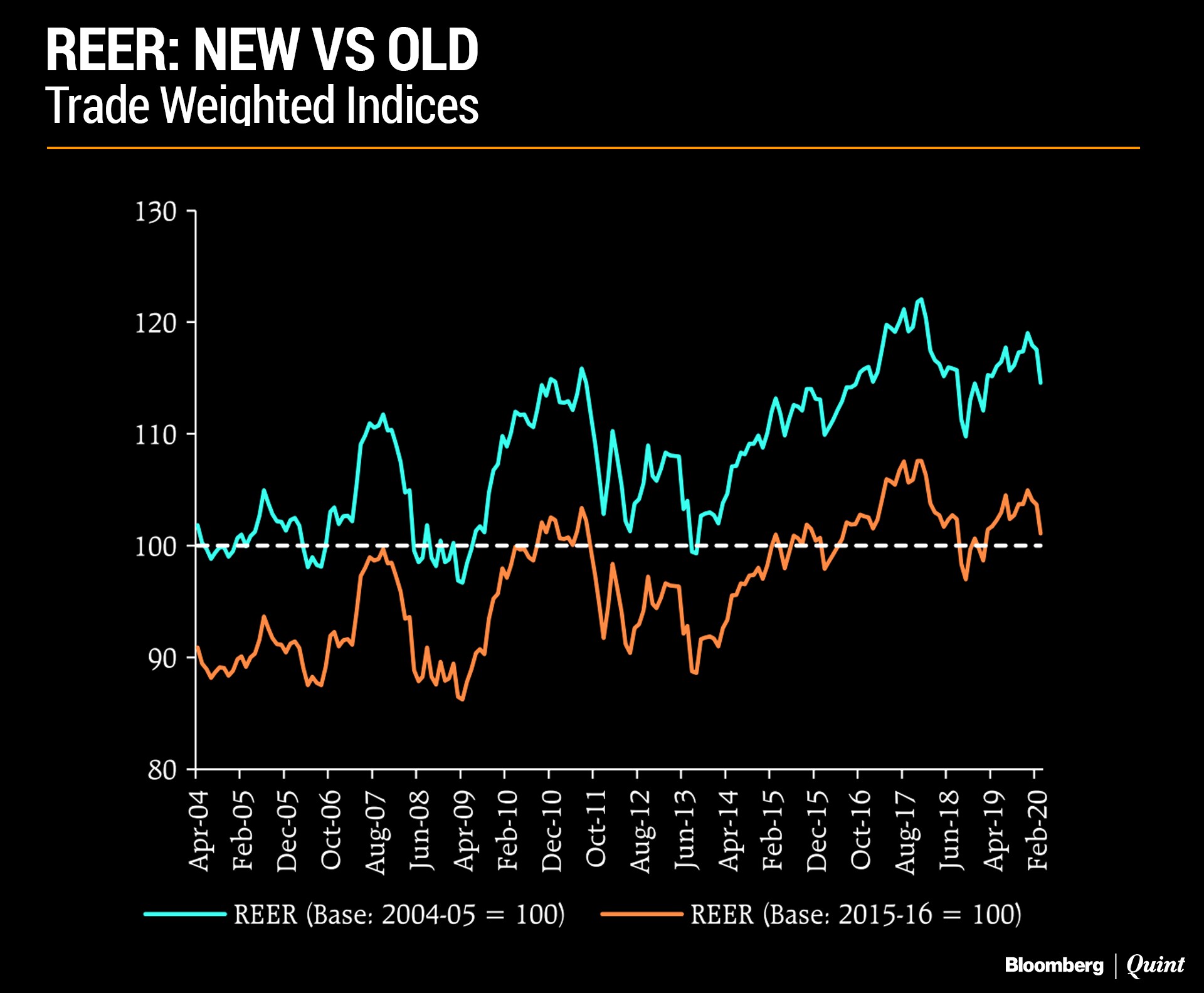
The base year for the real effective exchange rate index has been shifted from 2004-05 to 2015-16, a paper authored by John V. Guria and Jitendra Sokal of the RBI's Department of Economic and Policy Research said.
Explaining the choice of base year, the RBI paper said that it has been picked to ensure that the internal and external indicators are broadly in balance and close to potential. “Based on these definitions, 2015-16 is found to be a suitable year to rebase NEER/REER indices, with real GDP growth at 8.0%, CPI inflation at 4.9% and the current account deficit at 1.1% of GDP,” the paper said.
In addition, the existing basket has been expanded from 36 to 40 currencies, with the inclusion of eight new currencies and exclusion of four currencies, it said.
- The newly included currencies are: Angola, Chile, Ghana, Iraq, Nepal, Oman, Tanzania, and Ukraine.
- The excluded currencies are: Argentina, Pakistan, Philippines, and Sweden.
Rupee: Overvalued, Undervalued Or Fairly Valued?
The new REER, on average, was 0.8% above its base-year level during 2016-17 to 2019-20, the paper said.
This period has coincided with moderate inflation observed since the adoption of the flexible inflation targeting framework. “This implies that the inflation differentials between India and its trading partners were less of a concern for former's external competitiveness under FIT regime,” it added.
The paper went on to add that large capital flows unless absorbed may undermine the rupee's competitiveness. The central banks has added significantly to its forex reserves in the past year as it absorbed large capital inflows. As a result, forex reserves have risen to $542 billion as of Jan. 8, 2020 compared to $278 billion a year ago.
The paper signals that the central bank may continue to follow that approach.
Going forward, large capital inflows unless fully absorbed through current account deficit and/or mopped up as foreign exchange reserves can cause appreciation of the rupee and potentially undermine the export competitiveness. In such a milieu, focus on price stability under FIT [flexible inflation targeting] regime should remain a policy priority to offset the erosion in external competitiveness which may emanate from appreciation of the rupee in nominal terms.RBI Paper (January Monthly Bulletin)
Essential Business Intelligence, Continuous LIVE TV, Sharp Market Insights, Practical Personal Finance Advice and Latest Stories — On NDTV Profit.