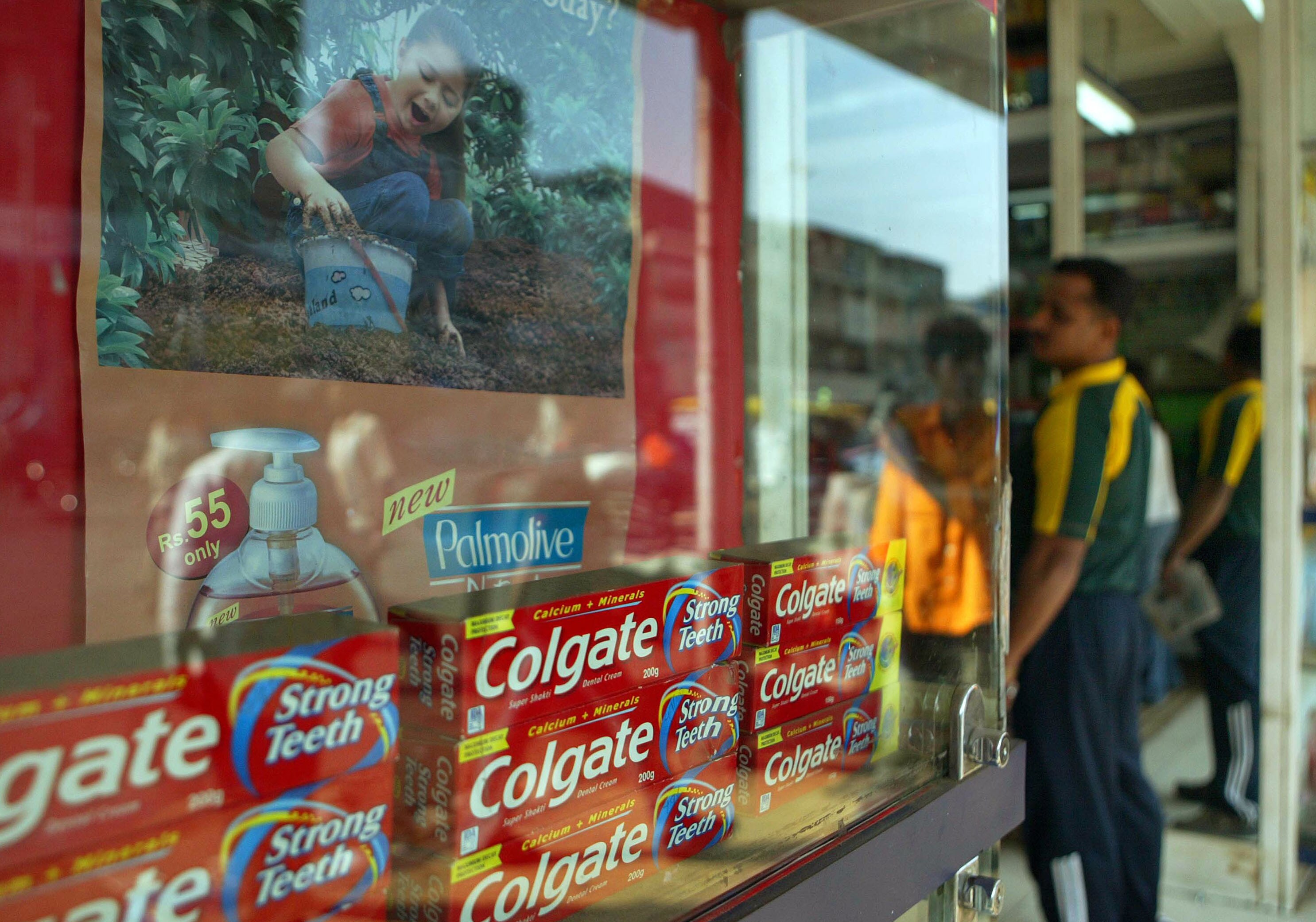
A year of faltering growth didn't stop Baba Ramdev-backed Patantali Ayurved Ltd. from eating into the share of larger rivals, including market leader Colgate Palmolive India Ltd., in India's Rs 10,000-crore toothpaste market.
Patanjali's share doubled in the year through March to 7.4 percent, according to Nielsen data sourced from the industry. Most of it came at the expense of Colgate Palmolive, and Pepsodent and Close-Up manufacturer Hindustan Unilever Ltd. Colgate Palmolive's volume share fell from 55.1 percent to 53.4 percent during the period—and compares with the highest-ever 57.8 percent in 2015.
Herbal appeal and lower pricing have won Patanjali consumers in the world's second-most populous nation with 1.3 billion people. Millions now use everything from honey to hair oil made by the company, helping it become the nation's No. 2 consumer goods maker with about Rs 10,500-crore sales in 2016-17. Dant Kanti (Sanskrit for shining teeth), a muddy-brown herbal toothpaste that leaves a tingling taste, is the second-biggest contributor to its revenue.
“It has made a bigger impact outside metros in tier 1, 2 and 3 cities,” Prashant Agarwal, joint managing director at brand consultant Wazir Advisors, told BloombergQuint. “Consumers in these areas have switched to using Patanjali products.”
The Rs 4,300-crore Colgate Palmolive is no pushover though. Toothpaste in many homes in India is still called Colgate, a brand recall built over more than eight decades that has given it over half the share in value and volumes. And it's defending its turf aggressively.
The company launched Vedshakti herbal toothpaste and plans more such offerings. “Colgate is focused on expanding its natural offering by broadening its geographic reach and introducing a wider range of price points,” its parent said in a conference all after January-March earnings.
A Colgate Palmolive spokesperson has yet to respond to BloombergQuint's emailed queries. Sanjiv Mehta, managing director and chief executive officer at HUL, had said at the fourth-quarter earnings conference that “there is more work for us to be done in oral care”.
Colgate Palmolive is perceived as an international rather than a domestic ayurvedic brand, Dhanraj Bhagat, consumer and retail partner at consultancy Grant Thornton India LLP, said. “But the moment you think about Patanjali, you think Ayurveda. They [Colgate] will have a very tough time competing.”
Bhagat suggested that the consumer products maker should create a sub-brand and position it accordingly to appeal to the Indian consumer.
Ramdev's Brand Appeal
And, Colgate Palmolive doesn't have Baba Ramdev's brand appeal to bank on. On prime-time Indian television, the yoga guru in is his saffron robes exhorts audiences to reject toothpastes made by multinational companies that at one time rejected the country's traditional oral-care practices. He hawks Dant Kanti.
While he doesn't take names on TV, Baba Ramdev had taken to Twitter about two years ago to take on Colgate Palmolive. He tweeted images from Colgate Palmolive's print campaign in the 1980s calling the use of abrasive charcoal and salt to clean teeth as harmful. Colgate's toothpastes now have both.
Colgate used to warn against Indian traditional ways of using salt & coal on teeth. But now they actively endorse it pic.twitter.com/eYywXQpK4P
To counter that, Colgate Palmolive aggressively spends on advertising. Its Indian arm spent about 12 percent of its revenue on marketing compared with 9 percent globally in the year ended March, according to an HDFC Securities report.
The global consumer goods maker also has the heft of a deep distribution network of about 58 lakh retail outlets in India. In comparison, Patanjali's products are sold through a million retail outlets, and over 5,000 of its own and modern trade stores, and online retailers, spokesperson SK Tijarawala had told BloombergQuint earlier.
“Patanjali's distribution is constantly on the rise, but still not as deep as that of Colgate or Hindustan Unilever,” Harish Bijoor, founder of brand consultancy firm Harish Bijoor, Consults Inc., said. Compared to the established players, its distribution reach is only 8 percent of the total market, he said.
Patanjali's Stagnant Growth
The last financial year wasn't great for Patanjali. Growth remained stagnant, Tijarawala told BloombergQuint. That's because Patanjali too felt the disruption caused by the goods and services tax rollout. And it couldn't rebound from the setback as fast as rival consumer goods makers like HUL and Colgate.
But Patanjali is only going to pose a greater challenge. It has lined up several launches—from packaged drinking water to dairy products—and expects to resume its high-growth trajectory this year, Tijarawala said.
One rival is unlikely to feel threatened: herbal products maker Dabur India Ltd. Patanjali's success has had a rub-off. In the year ended March, its share in the toothpaste market rose from 15 to 15.4 percent.
Dabur was in fact among the first challengers to Colgate-Palmolive with its Dabur Lal Dant Manjan (red toothpowder) as early as 70s. When televisions became more commonplace in the 80s, the Burman family-led company ran a TV campaign where a schoolmaster learns that the secret of a pupil's “pearl white” smile was Dabur's red toothpowder—only to be ribbed by students about his stained teeth.
About three decades later, Patanjali mounts a fresh challenge against Colgate Palmolive and Dabur won't mind smiling.
(Corrects an earlier version that misstated Close-Up as a Colgate Palmolive brand)
Essential Business Intelligence, Continuous LIVE TV, Sharp Market Insights, Practical Personal Finance Advice and Latest Stories — On NDTV Profit.