Patanjali Plans To Enter Restaurant, Textile Businesses
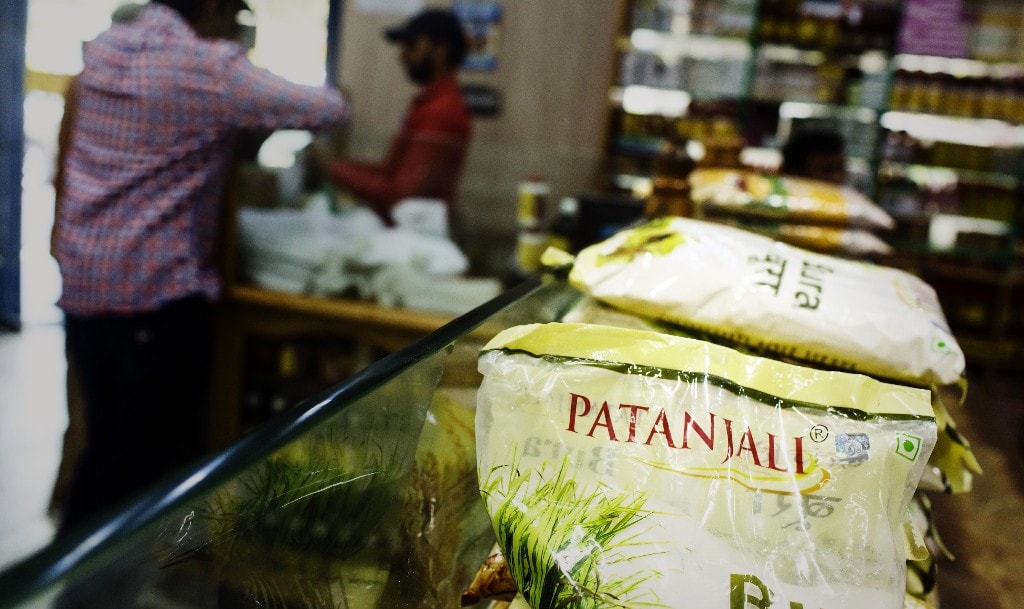
Patanjali Ayurved Ltd. plans to foray into restaurant and textile businesses, and is conducting research and development activities to ready itself for such ventures, Chief Executive Officer and Managing Director Acharya Balkrishna told BloombergQuint in an interview on Thursday.
“We can't say at this point how long it (foray into restaurant and textile businesses) will take; it is part of our plans. Our team is carrying out R&D for this, and we are working towards it,” said Balkrishna.
Patanjali recorded a revenue of Rs 10,561 crore for the financial year 2016-17, Yoga teacher and brand ambassador Baba Ramdev told reporters in New Delhi, announcing the fast-moving consumer goods (FMCG) player's earnings. Balkrishna added that the company's target for 2017-18 was to double its revenue year-on-year.
The company has witnessed exponential growth over the past three fiscals, from Rs 2,014 crore in 2014-15, to over Rs 10,000 crore in the financial year gone by. The company had set itself a revenue target of Rs 10,000 crore for the fiscal.
Also Read: Patanjali Aims To Double Market Share In The Food Processing Segment
The target for next year, as Swami ji (Ramdev) said, is to double the revenues generated this year. We are well prepared to meet the target.Acharya Balkrishna, CEO & MD, Patanjali
The company is in the process of setting up production units at Noida in Uttar Pradesh, Nagpur in Maharashtra, Indore in Madhya Pradesh, and one facility in Andhra Pradesh. Ramdev said the company had procured 700 acres of land in Noida for its planned unit, and that the juice processing unit in Nagpur will begin exports from 2018.
The company also plans to double its number of distributors to 12,000 within a year, from 6,000 presently, Ramdev said, adding that it also planned to employ 5 lakh people going ahead from around 1 lakh presently employed directly, or indirectly.
Patanjali competes with established companies such as Hindustan Unilever Ltd., Dabur India Ltd., and ITC Ltd., among others in the FMCG sector in India. Ramdev, while speaking about competition, took jibes at companies such as ITC, calling them foreign-funded. He said Patanjali planned to become India's largest “swadesi” FMCG brand in one or two years.
Speaking about market share across categories, Ramdev said the company's toothpaste had a domestic share of 14 percent, the shampoo and face wash segment had garnered 15 percent each, while its honey enjoyed half of the pie in its segment. Balkrishna said the market share figures had been calculated based on inputs from third-party agencies, as well as data provided “on the internet”.

-
Medicine Pricing: Where Must Profit Stop?

India must confront excessive margins, hidden incentives and regulatory gaps that threaten the integrity of medicine.
-
Why Amazon And Flipkart Are Struggling To Beat Meesho In India's Smaller Cities
With 274 million users and lowest-cost logistics, Meesho is defending its value commerce crown against giants like Amazon and Flipkart.
-
High US Salaries, No Green Card Certainty: The Financial Calculation Facing Indian H-1B Families
The suspension of PERM processing at eight technology employers does not cancel existing H-1B visas. What it does is force a question many Indian families have been avoiding: is the US salary worth tying your career and family plans to one employer?
-
Swiggy vs Eternal: Food Delivery's Two Rivals Are No Longer In The Same Race
Eternal is building a private AI assistant, dark.ai. Swiggy is still working out how to make Instamart pay, with an operating loss of Rs 895 crore in the July-September quarter while Blinkit stayed profitable.
-
Where You Live Shapes How You Get To Work | The Reason Why
Two-wheelers are the most popular way to get to work in India, accounting for nearly 43% of workplace commutes.
-
Unhedged Position: Can India See An Indonesia-Style Time Correction?
The Nifty is trading below levels it first clocked in 2024. Is there, then, as I have suggested in the headline, potential that the current time correction drags on painfully for the next three-five, even ten years?
-
Navigating Friction And Energy Realities: An Analysis Of Marco Rubio's October Visit To India
Occurring at a critical juncture marked by stalled trade negotiations and escalating geopolitical pressures over global energy supplies, the visit offers a profound window into modern US-India relations.
-
India Exports Capital. Why Not Export Trusteeship?
The big question, then, is whether India can build an institution that global borrowers, investors, banks, and lawyers can trust, even without an Indian connection.
-
France's Economy & Politics Are In Crisis | The Reason Why
Let's look at how the French economy and politics evolved under Nicolas Sarkozy, Franois Hollande and Emmanuel Macron.
-
You May Inherit The Business. You Must Earn Its Credibility.
Succession tests the founder's ability to share authority as much as it tests the next generation's readiness to assume it.










