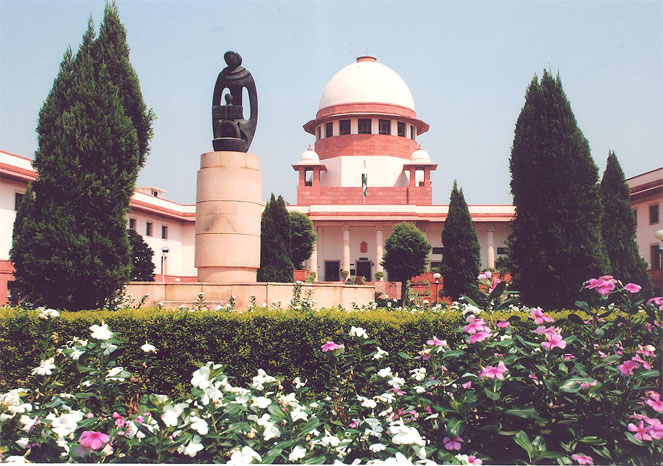
The impasse between the government and senior judiciary on the issue of judicial appointments has now intensified into a standoff within the judiciary itself.
A highly placed official in the higher judiciary has told BloombergQuint that Justice Chelameshwar, one of the five members of the Collegium which appoints judges to the Supreme Court and chief justices of the High Courts, did not attend the last Collegium meeting. His absence was in protest against the current process of appointing judges. Justice Chelameshwar, the source said, has urged for a more transparent system of appointments and has made recommendations to the Chief Justice of India (CJI) on the same. The source did not share details of the recommendations made but said that Justice Chelameshwar has suggested the Collegium streamline the screening process for judicial appointments.
Justice Chelameshwar did not comment on this information and BloombergQuint's queries to the Chief Justice of India's office did not elicit a comment either. Officials in the CJI's office said he does not want to comment on judicial appointments.
Differences Over Memorandum Of Procedure
This division within the judiciary may complicate the ongoing turf war between the Collegium and the government that has held up judicial appointments for almost 9 months now.
The differences are over the final draft of the Memorandum of Procedure (MoP).
When, in December 2015, the Supreme Court struck down as unconstitutional a law to set up a National Judicial Appointments Commission (NJAC), it also observed that “the Memorandum of Procedure (1999) provides for a participatory role to the judiciary as well as the political-executive” and this procedure “now needs fine tuning.” The Court directed the government to draft a Memorandum of Procedure but with the final stamp of approval from the Collegium.
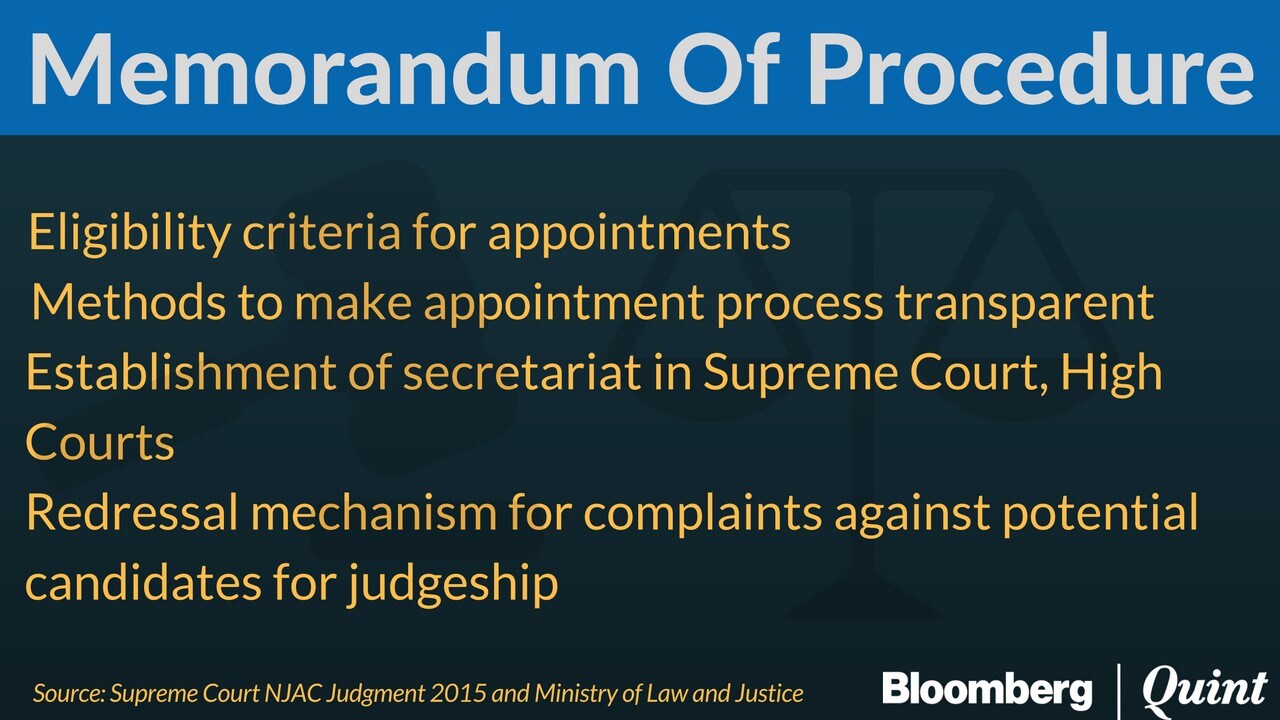
But for months now the two sides have not been able to agree on certain elements of the appointment process. Though, BloombergQuint learns from government officials that, in its recent draft of the MoP, the government has conceded to some of the provisions insisted upon by the Collegium.
BloombergQuint was able to access several MoP drafts exchanged between the Ministry of Law and Justice and the Collegium that suggest that the major points of contention relate to the appointment of judges based on seniority, authorisation to transfer judges and a committee to assist the Collegium.
Points Of Contention
1. Will Seniority Prevail?
In its August 3, 2016 draft MoP, the government has agreed to the Collegium's view that “seniority” should be the main criteria for elevation of judges. The government's previous position was that appointments be based on “merit -cum-seniority”.
2. From The Bar To The Bench?
Government officials indicate that it has also conceded to the Collegium's proposal of eliminating the cap on the number of jurists/lawyers that can be elevated to the bench as judges.
In the drafts circulated in June and March 2016, the government had proposed limiting the number of jurists/lawyers to three for appointment as judges.
3. Rejection On Grounds Of National Security?
The government has refused to relent on its stand that it has the power to reject appointments suggested by the Collegium on grounds of “national security” and “public interest”. The Collegium had opposed this position taken by the government in the May and June 2016 MoP drafts, citing “interference with judiciary's functioning” as the main reason.
While the government has reiterated its right to reject names on such grounds, it has now added a clause that specific reasons will be provided to the Collegium for rejection of candidates.
4. Seeking Views Of Non-Collegium Judges
The government has disagreed with the Collegium's proposal to continue the earlier regime in which recommendations for judicial appointments were made only by the top five Supreme Court judges (collegium).
The government has said in one of its drafts: “Seeking recommendations from judges other than those who are part of the Collegium is not violative of the Constitution. It can enable the Collegium to arrive at a better and appropriate decision.”
5. Committee To Assist Collegium?
The Collegium has so far maintained its position that no separate committee is required to assist the top five judges in the process of judicial appointments.
It is felt that the proposal made for introducing institutional mechanism in the form of a committee to assist the Supreme Court Collegium in evaluation of suitability of the prospective candidates is not necessary as the Secretariat proposed to be set up shall render such assistance if the Collegium requires.Collegium's comments in draft MoP
The government's rationale of appointing a committee was to get inputs from experts in the field for “comprehensive analysis of those being considered for appointment to the highest Court in the Country,” as per one draft version of the MoP.
This will add objectivity to the selection process and justify the creation of a separate Secretariat in the interest of transparency. The government has not proposed any substantive change but a process has been indicated. Hence, the provision related to maintenance of database and scrutiny of prospective candidates by a committee of experts is reiterated.Government's comments in draft MoP
6. Should Relatives, Family Members Practice In The Same Court?
In its June 2016 draft, the government accepted the Collegium's view that only the Chief Justice of India can decide on the transfer of a judge, if his/her relatives are practicing in the same Court.
The government had earlier proposed the mandatory transfer of judges in cases of such “conflict of interest.” However, Law Ministry officials told BloombergQuint, the issue is still under discussion.
7. Recording Dissent
An issue that remains to be decided is whether the Collegium will be required to record dissenting views and minutes of discussions held to decide on judicial appointments.
The government has proposed maintaining records to ensure transparency but the Collegium has yet to agree.
“The right to reframe the Memorandum of Procedure has been given to us by the judiciary...we haven't taken it suo moto.”Ravi Shankar Prasad, Law Minister, speaking in Parliament
When asked about the timeline to finalise the MoP, law ministry officials told BloombergQuint that it could not share such information as several matters are still under discussion.
PP Chaudhary, Minister of State for Law, told the Rajya Sabha during the recently concluded monsoon session of parliament, that the changes proposed in the draft MoP are being discussed.
The response of the Supreme Court was received on 25.5.2016 and 01.07.2016. The responses are their views on various clauses given on the basis of the constitutional provisions and earlier judicial pronouncements.PP Chaudhary, Minister of State for Law, speaking in Parliament
Chaudhary added that the process of appointment of judges has resumed.
During 2016, 110 Additional Judges of High Courts have been made Permanent. 4 and 52 Judges have been appointed in the Supreme Court and the High Courts respectively.PP Chaudhary, Minister of State for Law, speaking in Parliament
Chief Justice Of India Upset About Judicial Vacancies
Over 40 percent of the judicial positions in India's high courts are currently vacant, according to September data on the Department of Justice website. That's 485 vacancies in a sanctioned strength of 1079 judges. To be clear, not all vacancies are an outcome of the delay in finalising the MoP, but the standoff has exacerbated the situation, making worse the problem of case pendency. Over 2 crore cases are pending across courts in India, according to the national judicial data grid website.
The issue of vacant judicial seats and pending cases almost brought India's Chief Justice TS Thakur to tears at a joint conference of Supreme Court and High Court judges in April this year. The Telegraph quoted him as saying “How much time does it require (to clear the names) when we have an avalanche of cases? When people are languishing in jail for over 10 years?”
WATCH: Chief Justice of India TS Thakur breaks down during his speech at Jt conference of CMs and CJ of HCs in Delhihttps://t.co/xD1tro8rmX
More recently, on India's Independence Day, CJI Thakur criticised the Prime Minister and the government for making no mention of the judiciary in his address to the nation. “You heard our very popular and nationalist Prime Minister speak for one and-a-half hours today. You also heard Union Law Minister speak. I was also hoping justice will find a mention (in the speech). They will talk about appointment of judges,” he was quoted as saying by the Indian Express newspaper.
Earlier in August, the CJI made stern comments to Attorney General Mukul Rohatgi.Don't try to bring this institution to a grinding halt. We won't tolerate a logjam in judges' appointment. It is stifling judicial work. We will fasten accountability now. Why is there mistrust? If this logjam continues, we will be forced to interfere judicially. We will ask for every file that was sent to you by the Collegium.TS Thakur, Chief Justice of India to Attorney General Mukul Rohatgi, as quoted by the Indian Express“Litigant Is The Ultimate Victim”
The Collegium is concerned that the governmentunder the MOP (Memorandum of Procedure) should not be able to pack the Courtwith sarkari judges - that is very important. We want independent judgesto be appointed. If the concerns are expressed I am sure the issue will getsorted out. I am sure knowing how Law Minister Ravi Shankar Prasad andFinance Minister Arun Jaitley are, who I have been meeting, the intentionof the government is not to pack the Court but if there aresome issues where there are differences they should meet the Chief Justice (ofIndia) and sort it out.Soli Sorabjee, former Attorney General of IndiaThe litigant is the ultimate victim in the battle between the government and the higher judiciary, opined many jurists to BloombergQuint.
“Appointments must continue and you cannot make them come to a halt til the government and Collegium come to a conclusion. For example if this takes 8 more months what happens then?” said Kapil Sibal, former Law Minister (UPA Government) and Senior Advocate.Sibal added that if the appointments are not cleared “the consequences will be felt by the public at large.”
Questioning the government's intention in not accepting the Collegium's recommendations for further appointments, KTS Tulsi, senior advocate in the Supreme Court commented that this delay is causing grave injustice to citizens.
Why should judiciary be made to function at half strength? People have the right to get their cases decided expeditiously. Why should people keep sitting in the jail without knowing whether they are guilty or innocent - this is exacerbatng the entire situation and giving an impression as if judiciary is not part of the Constitutional framework.KTS Tulsi, Senior Advocate, Supreme Court of IndiaAnil Divan, an eminent constitutional expert and senior advocate backed the oft repeated suggestion that a members of the bar be elevated to short term judgeships
to clear the backlog of cases.“A suggestion worth implementing is the appointment of Additional Judges in the High Courts from among leading members of the Bar (not active in politics) for a fixed term of two years. Old pending cases could be easily wiped out if this suggestion is properly implemented,” he said.
Speaking on behalf of lawyers, Divan added that leading members of the bar would be willing as a “public service to become Additional Judges for a limited period of time.”
The Collegium system continues but it requires considerable reforms. The last judgment (4th Judges' case) has clarified many aspects including the principles that there should be no direct involvement of the Executive in appointing the higher judiciary. The Executive has only to play a consultative role.Anil Divan, Senior Advocate and Constitutional ExpertRetired Supreme Court justice Markandey Katju differs with how the Collegium has handled matters with the government. Former Delhi High Court judge RS Sodhi also disagrees with the Collegium system.
This has to be sorted out by a consensus between the executive and the judiciary. You cannot totally remove the executive from the matter of appointment of judges. You may keep on giving any number of judgments like in the second and third judges case which I believe are totally illegal judgments because there is no mention of any Collegium system in our constitution under Article 124.Markandey Katju, former judge, Supreme Court of IndiaThe Collegium system's inception was a hijack of the constitution...If two different responsible bodies have certain powers with them how does one body think the other is irresponsible? That is not a correct way of looking at such huge and large authorities which are constitutional in itself. You are actually undermining the constitution if you don't believe in each other or have trust on each other.RS Sodhi, former judge, Delhi High CourtFormer Attorney General of India and eminent jurist Soli Sorabjee said to BloombergQuint that judicial appointments should be expedited. “The Law Minister shouldmeet the Chief Justice and both should have frank discussions and understandeach other's views to solve the problems. The ultimate victim and sufferer isthe litigant who is waiting in a long queue, awaiting justice.”
Essential Business Intelligence, Continuous LIVE TV, Sharp Market Insights, Practical Personal Finance Advice and Latest Stories — On NDTV Profit.