230623 (2).jpeg?downsize=773:435 "IndiGo Flight Cancellations: How India's Top Airline Unraveled In Quest For Higher Profit")
It was the straw that broke the highly optimized camel's back.
Sometime in the evening of Dec. 2, three days before India's largest airline would lose control of its operations in one of the country's worst aviation disruptions, IndiGo executives noticed that a technology glitch in its check-in system was delaying late-night flights.
This in turn was affecting a pilot duty roster recently fine-tuned to incorporate new government rules mandating longer rest hours and fewer night landings.
Compounded by winter flight schedule changes, air congestion and adverse weather, the math was suddenly not adding up for the low-cost airline whose relentless optimization had allowed it to turn a profit within three years of inception and over time capture nearly 66% of India's aviation market.
The resource-efficient instincts baked into IndiGo's DNA had led to a severe under-estimation of redundancies needed to accommodate the new pilot rest rules, despite carriers having had nearly two years to prepare since the guidance was first announced in January 2024.
Scheduling changes began to snowball: IndiGo canceled at least 70 flights on Dec. 3, then 300 on Dec. 4 and finally, over 1,000 on Dec. 5 — about half of the flights it normally operates daily.
As thousands of furious passengers became stranded in major city airports over the weekend, Prime Minister Narendra Modi's government was forced to suspend the new pilot rest rules, cap fares to avoid price gouging and order more trains into operation.

Pieter Elbers, chief executive officer of IndiGo.
On Sunday, the country's aviation regulator also demanded that Chief Executive Officer Pieter Elbers explain within 24 hours this severe disruption and why action shouldn't be taken against him for the “significant lapses in planning, oversight, and resource management.”
This account of how IndiGo's operations unraveled is based on conversations with six people with direct knowledge of events at the peak of the chaos last week who asked not to be identified given the sensitivity of the situation. The company did not respond to a request for comment.
The debacle now threatens IndiGo's position in the industry, and its ambitious expansion plans.
After cementing its dominant position in domestic skies, IndiGo was boosting its overseas footprint, had ordered more Airbus jets, and added business class seats. Earlier this year, it signed a codeshare pact with Delta Air Lines Inc., Air France-KLM and Virgin Atlantic Airways.
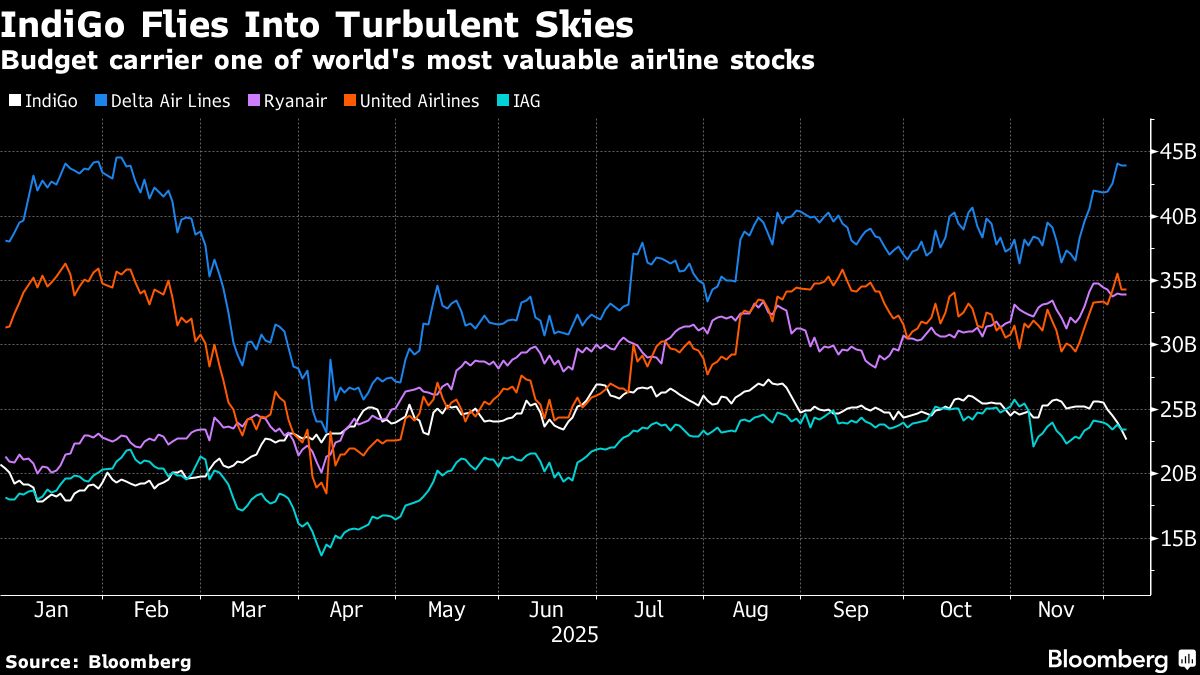
The flight cancellations pushed parent InterGlobe Aviation Ltd. down 9% last week, making it the company's worst week since Elbers appointment in 2022. Even with the drop, the shares have almost tripled since the Dutch executive took over as CEO, far outperforming the Sensex's 49% gain and an 8.4% increase in an index tracking Asian carriers.
The events of the past week, occurring just six months after an Air India crash that killed over 260 people in Ahmedabad, cap one of the worst years for India's aviation industry.
The sight of one carrier bringing national air traffic to a near-halt underscores the danger of India's reliance on too-big-to-falter industrial giants.
“This airline is supposed to be a market leader with outstanding management,” said Mark D. Martin, founder of India-based aviation advisory Martin Consulting. “This is going to be so extremely damaging to the airline. They have lost credibility.”
It's a stark fall from grace for a company that became a business school case study for its profitable, lean operations in a sector notorious for cash-burn and bankruptcies.
IndiGo's tightly-run operations are built on a rapid turnaround of flights and a strategy of sweating every asset - man or machine - to the limit. It flies only one aircraft type, Airbus A320s family jets — a standardization that cuts costs on pilot and crew training, maintenance and parts inventory.
IndiGo Standard Time
The focus is equally sharp on reducing time on the ground, with the carrier terming its punctual reputation “IndiGo Standard Time”. Flights have a four-zone system for quick boarding, and crews open all exit doors for speedier disembarking.
No efficiency is too small: flight staff have even switched to a faster method of weighing sandwiches — their top-selling onboard item— instead of counting them, said people familiar with the matter.
That's why when Airbus ordered an emergency software fix last week that resulted in flight delays and cancellations across the world, IndiGo completed the update on all of its jets within 24 hours.
This modus operandi shaved down an IndiGo jet's turnaround time to 20 or 25 minutes versus an industry average of 45 minutes. This meant it could squeeze in more and more flights over the years.
Message from Pieter Elbers, CEO, IndiGo. pic.twitter.com/bXFdqoB0Q2
December 5, 2025“IndiGo's operations are so tightly knit that one flight cancellation would impact at least six flights,” said Shakti Lumba, who was IndiGo's head of operations when it first began operating in 2006.
The carrier's ultra-optimized operations were developed when it had just 100 to 200 aircraft — less than half the size of its current fleet, Lumba said. Those now require a relook to allow for more system redundancy especially in manpower planning, he added.
Lack of Slack
The lack of slack in the system became all too apparent over the last week, as the scheduling breakdown cascaded through its operations. A flight took off with three cabin crew staff meant for another flight that then got stranded, people familiar with the matter said. One IndiGo pilot was stuck for days at his hotel in the Middle East, waiting for his return flying schedule.
Ground staff cowered from furious throngs of passengers, and could not even retrieve check-in bags that were stuck in grounded aircraft.
Indian officials are furious with the carrier, people familiar with the matter said, and have now sprung into action to quell public anger by tightening scrutiny around the carrier. It also casts a poor light on the country's aviation infrastructure that the government wants to rapidly develop.
The new pilot duty rules are on hold after IndiGo sought a two-month reprieve. Airfares were capped as tickets on rival carriers surged 10-fold. Even the state-run Indian Railways added four special trains and 116 coaches to move stranded fliers.
The situation is stabilizing: there were fewer cancellations on Saturday at about 850 and the airline said Sunday that it was “confident” operations will stabilize by Dec. 10. But observers expect the crisis to trigger some fundamental changes in the industry.
It's dangerous for one airline to have such a high market share, said Ajay Bodke, a Mumbai-based independent markets analyst.
In the US and China, the only other aviation markets bigger than India's domestic market, no carrier has a market share of more than a quarter.
“Defying government regulations announced months in advance, and now seeking a last-minute two-month reprieve to comply,” Bodke said. “This is not inefficiency. It's willful disregard.”
Essential Business Intelligence, Sharp Market Insights, Practical Personal Finance Advice, Daily Fuel, Gold and Silver Prices and Latest Stories — On NDTV Profit.