Deepening inequality is part of the milieu in which central bankers are conducting monetary policy, and they cannot afford to ignore the issue any longer.
Constitutionally, most central banks are mandated to pursue a limited set of objectives as they conduct monetary policy. Some, such as the U.S. Federal Reserve and Reserve Bank of New Zealand, have a dual mandate of price stabilisation and full employment. Whereas a majority of them, including the European Central Bank and the Bank of England, operate under a system of hierarchical mandates wherein targeting low, sustainable inflation is the principal objective followed by a broader objective of macro stabilisation, that is primarily interpreted as limiting business cycle fluctuations — measured in terms of output and employment.
However, a trend is emerging in the advanced economies where we see major central bankers reinterpreting their mandates and pushing for expansion of their conventional remits, and that too in progressive directions. Mark Carney advocated for the greater role of central banks in regulating the economic and financial risks brought by climate change throughout (and even after) his tenure as the Governor of Bank of England. He was probably the first central banker to openly talk about the risks posed by climate change back in 2015. Initially dismissed as hippy posturing, other major central bankers soon followed the suit — both in talk and action.
Now we hear similar calls to broaden the ambit of central banking in another progressive direction — addressing inequality.
Major central bankers are now increasingly discussing distributional issues.
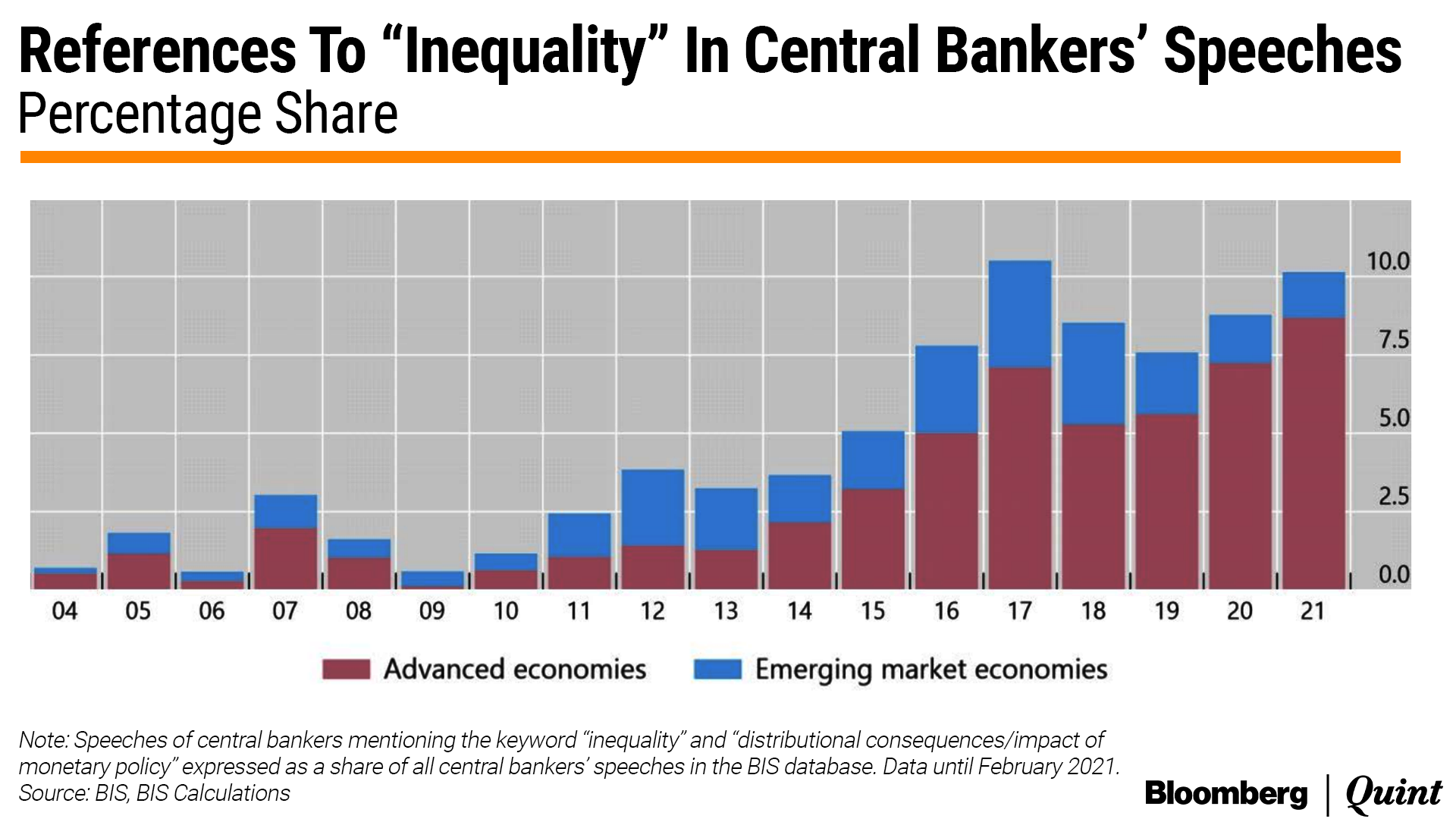
In his recent speech, Fed chair Jerome Powell noted that the U.S. economic recovery from the Covid-induced recession has been uneven — almost 20% of the American workers from the lowest earnings quartile were still unemployed after a year in February as compared to 6% for workers in the highest quartile. He further hinted that Fed's near-term monetary policy decisions will take into account employment metrics that have historically taken longer to recover from economic slumps — he was referring to Black and Hispanic unemployment, wage growth in the lower-income quartile, and labour force participation for women and individuals without a college education.
Powell reworked the Fed's monetary policy framework in August of last year by reinterpreting the bank's dual mandate to average inflation targeting and a much broader concept of full employment — that is inclusive, particularly for low- and moderate-income communities. The flexible averaging of its inflation target has emboldened the Fed to run the economy ‘hot' by keeping the policy rates ‘lower for longer' while allowing labour-market gains to reach disadvantaged and low-income communities.
It's not just Powell; his predecessor, Janet Yellen (presently serving as the U.S. Treasury Secretary in the Biden administration), often used her time as Fed Chair to lambast the rising inequality in the U.S. Mario Draghi, former president of the ECB, also pondered over the distributional consequences of monetary policy in the Euro area—between the rich and the poor, savers and borrowers, weaker and stronger countries—and so does his successor, Christine Lagarde. When it comes to inequality, ECB has always pursued an implicit objective of achieving some sort of inter-country equality in terms of supporting “balanced growth” in the Eurosystem and has often had to account for divergent economic performance/outlook for prosperous North versus struggling South.
Transmission of monetary policy to Main Street is often considered weak and unreliable in developing economies, as compared to their advanced counterparts. Nevertheless, central bankers from the developing world are joining the chorus. The governor of the Reserve Bank of India, in his recent speech, stressed on shifting the focus of monetary policy from providing systemic liquidity to its equitable distribution. However, the job of tackling inequality through monetary policy is far more complicated in a developing economy like India—where households tend to hold a significant share of their savings in banknotes and fixed income instruments.
MPC Minutes: Policy trade-offs between leaving policy rate unchanged and correcting it at some point for the negative real rates have to be considered, says Mridul Saggar. pic.twitter.com/gljqxbxc3A
June 18, 2021Households at the bottom and middle part of the distribution, whose incomes and consumption are not supported by the wealth effect of rising equity markets, might see their real incomes fall and savings unfairly taxed through negative real rates.
About ten years ago, Ben Bernanke, then Fed-chair, remarked: “With respect to inequality, I think the best way to address inequality is to create jobs…that's really the only way the Fed can address inequality per se.” That sounds almost defeatist. Indeed, central banks can't solve the problem of inequality all by themselves—its causes are too varied and mostly related to structural economic changes—but neither are they completely irreproachable/ineffectual to do something about it.
In the last decade or two, central banks have developed an unhealthy codependency with financial markets which seem to have led policymakers to believe that they have no choice other than to insulate the financial sector from the harsh realities of the real economy.Such policy choices tend to aggravate the wealth inequality (at least, in the short-run) as reflected in the stunning disconnect between Wall Street and Main Street during this pandemic. It's true that the two-way interaction between economic inequality and the conduct of monetary policy is not fully understood yet as there are several conflicting channels through which these two interact, directly and indirectly. Nevertheless, it's heartening to see these new-age central bankers at least willing, and some even committed, to tackle inequality.
Proponents of the Tinbergen Rule might argue that as a basic principle of effective policymaking, one policy instrument—in this case, the central bank — should be aimed at only one policy goal. However, it is important to recognise that a modern central bank has many tools in its kit to achieve its policy goals.
Moreover, central bankers are an innovative lot and it's likely that the economists at these major central banks will come up with new specialised tools (or innovative ways to use the existing tools) to tackle the inequality crisis, as they have done so many times in the wake of past crises — the most recent innovations being quantitative easing after 2008 financial crisis and the practice of precise forward guidance after the taper tantrum of 2013. Interestingly, the citizenry is also of the opinion that the central banks should assume a more prominent role in addressing inequality (and climate change).
It would, however, be naïve to expect that the distributional issues will find a place amongst central banks' primary mandates but one can certainly hope that going forward distributional questions will be taken into account more seriously as monetary policy is conducted.
Not so long ago, the issue of financial stability was also considered outside the ambit of monetary policy but after the financial crisis of 2008, central bankers have come to recognise that financial markets act as amplifiers of business cycle fluctuations and the severity of output losses induced by banking and financial crises can stand in the way of achieving monetary policy objectives. While most central banks do not have financial stability as a separate objective in their present policy mandates, they do treat the task of maintaining financial stability as an implicit objective of monetary policy (under their broader objective of macroeconomic stabilisation). We can expect the ‘(in)equality objective' to have a similar fate. As our understanding of the interplay between distributional issues and the conduct of monetary policy (and the real economic goals it strives to achieve) improves, we'll see more central bankers going woke.
Akash Malhotra is an economist and a Fellow at the UN Sustainable Development Solutions Network. Views expressed are personal.
The views expressed here are those of the author, and do not necessarily represent the views of BloombergQuint or its editorial team.
Essential Business Intelligence, Sharp Market Insights, Practical Personal Finance Advice, Daily Fuel, Gold and Silver Prices and Latest Stories — On NDTV Profit.