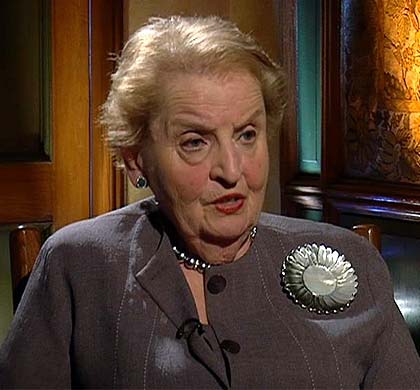
Madeleine Albright, first woman to become Secretary of State in the United States, is a major international figure in strategic circles and also heads the consulting firm Albright-Stonebridge that works across the globe in furthering American business and strategic interests. As Secretary of State under President Bill Clinton between 1997-2001, she had played a major role in South Asia. Currently on a whirlwind tour of India, she took time off to meet NDTV's Security & Strategic Affairs Editor Nitin Gokhale and spoke on a range of issues.
I definitely don't think that it's over. I think that, again, it is going through a period where the growth is not everything that the Indians expected; I have to say in comparison to the growth of most countries, 7% is a pretty good growth record. But I think that one of the things that happened was that the growth of India was maybe oversold to a certain point, which also happens, and then when it goes through a small period when things shift a little bit, there is undue doom and gloom. I have great confidence in the Indian economy and in the Indian people and their capability of working through what are some slowdowns in certain areas.
Well I think, I'm interested and glad that you asked that question, because for the United States and for what is going on in the Middle East, and for an issue that is so important to all of us, nuclear proliferation, I think that India can play a huge role.
India has been, I think, very much a leading force in making sure that there is not a proliferation of nuclear weapons, and everybody is very concerned about what is going on in Iran. We don't know what is going on and what their motivations and capabilities are. And I do think that if India wanted to, it could play an important role in terms of trying to figure out what is going on, and diffusing the problems, and making sure that Iran is not trying to have a weapons capability.
Well, what is so interesting about China is that obviously it has had a huge growth spurt and it's making more and more of an appearance on the global scene. And some people wonder what its motivations are on being part of the global scene.
Some of it has to do with the fact that they are resource hungry, they need to have energy for their growth. In many ways, in my following of China, they have been reluctant to play a global role. Very interestingly, when I was part of the UN, they didn't like to participate in any of the discussions, except for those that involved the interference of the domestic affairs of other countries. They didn't want to have anything to do with that.
So slowly they became more interested in the regional issues and now more and more globally. So, it's interesting to watch their evolution in terms of what their global role is. Also what is interesting to see, is that they are in the Fall, going to have a generation of change in their leadership, which in their case is going to be very important in terms of what that leadership sees, what its global responsibilities are.
I think that there always mixed feelings in the United States, and I know in India, in terms of how China is viewed. Is it a threat or benign? In the United States, there are discussions whether they are friends or enemies? And somebody made up a really silly word called 'frenemies', and I think that there is a little bit of both.
I think people are concerned about what it is they are doing in the South China Sea, people are concerned about their development of a blue water navy generally. On the other hand, they have been co-operative in protecting certain navel passages and dealing with piracy, which are issues that are important to India and to the United States.
I think that they clearly are a rising power that the United States has to deal with, that India has to deal with. And what is interesting is that the United States, under President Obama, has decided that it is important to sort of rebalance some of our strategies to recognise that we are a Pacific as well as an Atlantic power. And so there is going to be a lot more attention paid to the Asia Pacific.
Well, I'm an optimist, who worries a lot. But I do think it is solvable. The European Union itself is kind of an outgrowth of trying to never have the same problems that had created World War I and World War II. When an attempt for many small nations in Europe to be able to get along, and that Nationalist feelings don't arise, and that people can cross borders freely and there can be investments back and forth, so there was a real reason for the European Union and the Euro zone.
No, things are complicated. We are in the middle of a change in the international system. I don't think there is a, and I say this generally, you don't really feel that there is a lot of confidence in the institutions. It's true nationally, it's true in the United States, in terms of confidence in our Congress and a variety of institutions. There's not a lot of confidence in the regional institutions and the European Union is just one of them.
And there is some question about the role of international institutions, the United Nations, and so I think we are going through a major shift, where there are questions about the role of the Nations states, how we relate to each other and how inter-dependent we are, without having the institutional structure to work out problems. So, we all want stability, but I think that there are certain areas which make us all pretty nervous.
Essential Business Intelligence, Continuous LIVE TV, Sharp Market Insights, Practical Personal Finance Advice and Latest Stories — On NDTV Profit.