The Reserve Bank of India has brought down its key lending rate by 175 basis points in the last two years, sharply bringing down the interest rates in bank fixed deposits. For example, State Bank of India - the country's largest lender - has cut its interest rate on one-year fixed deposits by 135 basis points, according to estimates.
Falling interest rates and the income tax factor have brought down the appeal of fixed deposits for many investors, particularly for those in higher tax brackets. Interest from bank deposits is added to one's income and taxed according to the respective tax slabs.
This has increased the appeal of tax-free bonds which were issued by government-owned entities in the past few years. These bonds were a huge hit among investors who looked for a steady tax-free interest income but this fiscal year there would not be fresh issues of tax-free bonds. Since tax-free bonds are traded on exchanges, investors can buy them from secondary markets.
With the RBI expected to further cut its key lending rate, financial planners say that investors - particularly those in higher tax brackets - can consider deploying some corpus in the tax-free bonds through secondary purchases.
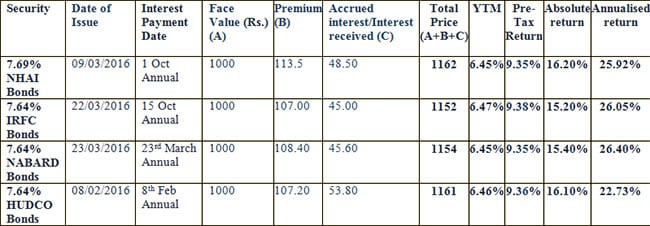
It is not surprising that the prices of tax-free bonds trading in the secondary market have witnessed a sharp rally. For example, the return in 7.69 per cent NHAI tax-free bonds, 7.64 per cent IRFC bonds and 7.64 per cent NABARD bonds have topped over 15 per cent. These bonds were issued earlier this year.
Essential Business Intelligence, Continuous LIVE TV, Sharp Market Insights, Practical Personal Finance Advice and Latest Stories — On NDTV Profit.