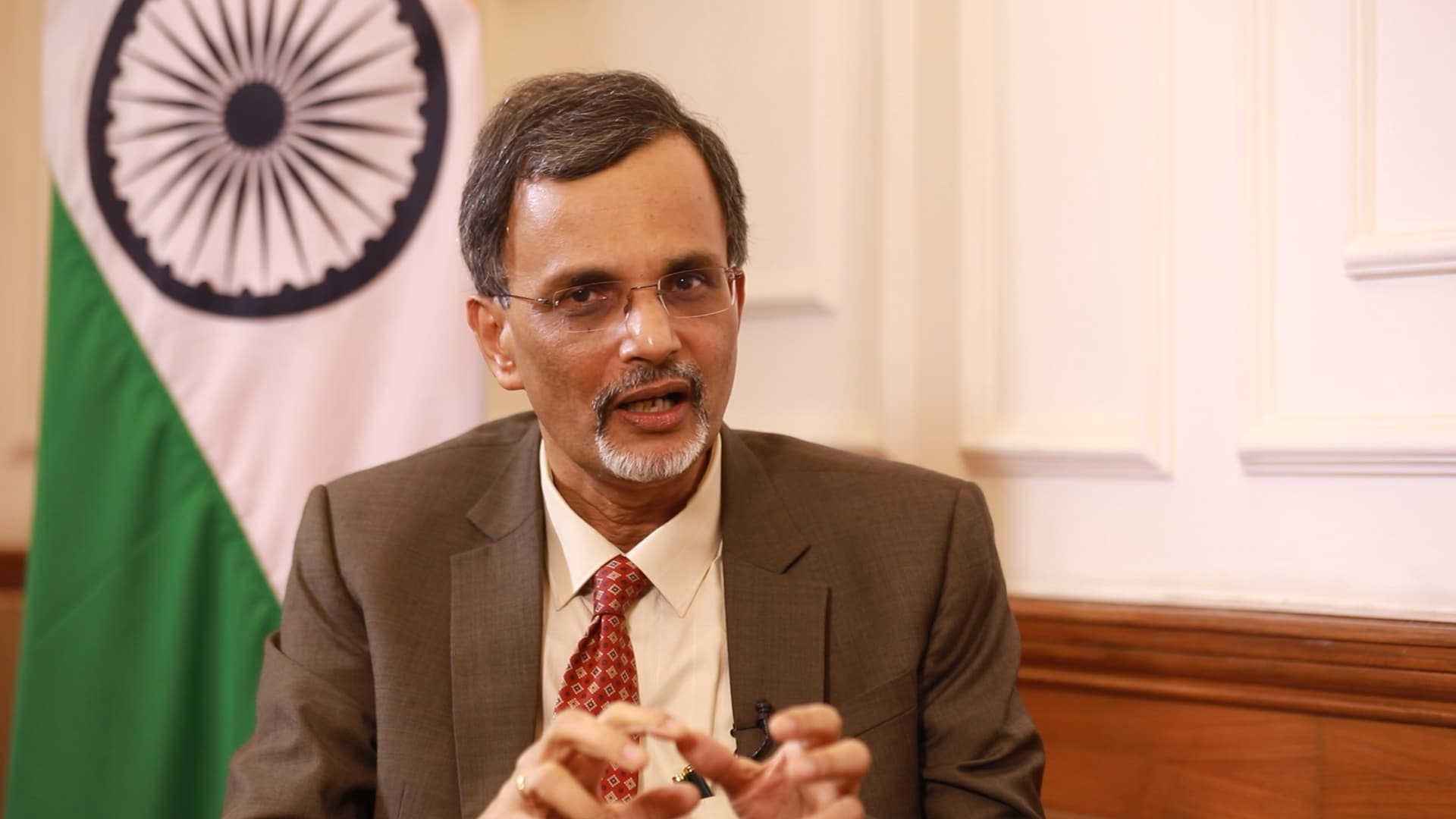
Statistical system improvement work underway and newer indices and weights will be a reality soon, according to CEA. "Greenium in India not a problem," he said. "We have a high green rating."
Private capital in India and around the world need to walk the talk on those investments, explains CEA.
The Chief Economic Advisor stated that having retail investors in capital markets is beneficial, as it represents an additional deployment of savings and is a healthy and welcome development. "The issue is the kind of capital participation…speculative trading that needs attention, " he said.
"We are not pessimistic but optimistic about growth and challenges. We feel 7% is doable, we want to be cautious hence we are projecting a 6.5-7% for FY25. 7% is eminently doable but rainfall, financial risks and global geopolitical environment are important considerations," explains CEA.
"Tripartite compact needed for sustaining growth momentum. Abandoning short termism, job creation focus, R&D investment, careful deployment of capital and energy intensive technology are needed."
"India's exposure to Chinese manufacturing inputs has risen over time. Our trade deficit with China shows a steep increase in recent times."
Two forces can deepen trade deficits with China, he said:
1) Trade diversion by the West away from China.
India's industries will be placed as intermediate suppliers between China and the West (similar to Mexico and Vietnam).
2) Drive for enhancing manufacturing capacity within the country.
Reliance on Chinese manufacturing inputs will rise.
"Apart from high-energy intensity, the impact of AI is still not understood. While GCC kind of jobs may not be affected in near-term, business process outsourcing jobs can be affected. Medical transcript reading, image creation, animation can be taken over by AI. There will be small short term impact for India but long term benefit. Indian companies have to make sure the deployment of technology does not hurt the labour and capital share of income."
"We are beginning to realise potential of digital infrastructure. ONDC has big potential to make small enterprises big players."
"The government can deregulate to help MSMEs. Threshold-based incentives need sunset clauses. Much action is required at sub-national and local level. -Deregulation is a low hanging fruit. Indian factories could hire more workers by adopting competitive per-worker space standards. Clue to sustaining growth is in the nuts and bolts of economic deregulation."
"Private sector and public have more important role to play than government. We need all hands and all approaches on the table. Agri carries huge potential for driving growth if incentives are channelled right and land allocation is done right. This is a task for state government also."
"Deviation of inflation from target is lowest in India. It should come below 5% in current year. Core inflation (which excludes food prices) is much lower."
"External debt ratio is much lower than many other countries. Weak currency must be understood in line with exposure. A weak rupee can benefit on trade front while our external debt risk is low," CEA explains
"Services export growth and story of global capability centre is well known. Remarkable growth of global capability centres seen."
"Production-linked incentive schemes as of May 2024 is gathering momentum. PLI scheme is delivering handsomely in key areas like electronics and pharma. Over 1.28 lakh crore investment reported."
"Investment being driven by private and public capex with households also pitching in. Private capex has recovered and is growing," says CEA.
"Domestic growth is very important as we have to chart our growth amid global headwinds. Economic momentum is carrying on from March. Real GDP is 20% over pre-pandemic levels."
"Historically energy transitions don’t happen in a single generation. With several countries attempting net-zero simultaneously, resource availability will be hard to come by."
"Global outlook shows global trade volume trade will be difficult to come by. We have to grab market share, trade pie may not grow. Trade protective actions have risen. Supply security dominates supply efficiency."
"This economic survey picks up from interim period in February. It focuses on area and actions we need to take," says CEA Anantha Nageswaran.
The Indian economy needs to generate 78.5 lakh annual jobs in the non-farm sector to cater to the rising workforce and productivity in the agriculture sector also needs to be improved, according to the Economic Survey 2023–24.
"In their fascination for AI and fear of erosion of competitiveness, businesses have to bear in mind their responsibility for employment generation and the consequent impact on social stability," it said, suggesting that the companies should strike a balance between labour and capital deployment.
In India's story of infrastructure development, buoyant public sector investment has had a pivotal role to play in funding large scale infrastructure projects, according to the Economic Survey 2024.
However, in order to continue on this path of building quality infrastructure, there is a rising need for higher level of private sector financing and resource mobilisation from new sources, it added.
In order to execute this, not just policy and institutional support from the central government is needed but state and local governments also have a role to play.
"Bank credit growth has sustained momentum during FY24, with broad-based growth across sectors. Credit disbursal by SCBs stood at Rs 164.3 lakh crore, growing by 20.2% at the end of March 2024, compared to 15% growth at the end of March 2023. The trend is continuing in FY25, as reflected in a 19% and 19.8% YoY growth in bank credit in April and May 2024."
Economic Survey 2024: India’s Per Capita Emissions Far Below Global Average
Production of four-wheelers grew 7.1% YoY to 49 lakh units
Production of three-wheelers grew 16.0% YoY to 9.9 lakh units
Production of two-wheelers grew 10.3% YoY to 2.15 crore units
Production of commercial vehicles rose 2.9% YoY to 10.7 lakh units
EV Sector In FY24
A total of 8.95 lakh EVs incentivised under FAME-II scheme
This included 8.04 lakh 2Ws, 76,200 3Ws and 12,400 4Ws
EVs received policy support under three schemes in FY24
Auto PLI scheme attracted investment of Rs 14,043 crore in FY24
A new India EV policy announced for global EV makers to ‘Make in India’
Auto Components In FY24
Domestic production grew at 9% YoY in FY24 vs 11% CAGR in FY20-23
Domestic consumption grew 10% YoY in FY24 vs 16% CAGR in FY20-23
Exports rose 9% YoY in FY24 vs 16% CAGR in FY20-23
Imports rose 6% YoY in FY24 vs 14% CAGR in FY20-23
"India’s external sector remained strong amidst on-going geopolitical headwinds accompanied by sticky inflation. India’s external sector remained strong amidst on-going geopolitical headwinds accompanied by sticky inflation. The moderation in merchandise imports and rising services exports have improved India’s current account deficit which narrowed 0.7% in FY24. India’s services exports grew by 4.9% to $341.1 billion in FY24, with growth largely driven by IT/software services and ‘other’ business services."
"Going forward, the RBI projects inflation to fall to 4.5% in FY25 and 4.1% in FY26, assuming normal monsoon and no external or policy shocks. ...achieving long-term price stability requires a clear forward-looking vision. ... the medium to long-term inflation outlook will be shaped by the strengthening of price monitoring mechanisms and market intelligence as well as focused efforts to increase the domestic production of essential food items like pulses and edible oils for which India has a great degree of import dependence."
"During FY22 and FY23, the COVID-19 pandemic, geopolitical tensions, and supply disruptions contributed to rising inflationary pressures globally. In India, consumer goods and services faced price hikes due to international conflicts and adverse weather conditions impacting food costs. However, in FY24, the Central Government’s timely policy interventions and the Reserve Bank of India’s price stability measures helped maintain retail inflation at 5.4 per cent - the lowest level since the pandemic."
Economic Survey 2024: More Private Sector Financing Needed To Continue Building Infrastructure
"The number of unique tax IDs registered on the NSE rose from 2.7 crore in FY19 to 9.2 crore in FY24. The enhanced participation of retail investors in the Indian capital market is hugely welcome and lends stability to the capital market. It has also enabled retail investors to earn higher returns on their savings. Most of the new retail investors are likely young and may have a higher risk appetite. It is also reflected in the interest that retail investors have shown in derivatives trading, especially expiration-day trading. While derivatives are hedging instruments, they are mostly used as speculative instruments by investors worldwide. India is likely no exception."
"The financialisation of economies has not ended well, even for advanced economies... All stakeholders – market participants, market infrastructure institutions, regulators, and the government must ensure that capital markets play their theoretically assigned role of directing savings to their most productive investments. It is not just in the national interest. It is an act of self-interest, too."
"The advent of Artificial Intelligence casts a huge pall of uncertainty as to its impact on workers across all skill levels – low, semi and high. These will create barriers and hurdles to sustained high growth rates for India in the coming years and decades. Overcoming these requires a grand alliance of union and state governments and the private sector."
Net taxes at constant prices grew by 19.1% in FY24. The tax growth was aided by reasonably strong growth at Centre and state levels. Rationalisation of subsidy expenditure also helped: Economic Survey 2024.
Economy Survey 2024 Projects India's Real GDP Growth At 6.5-7% In FY25
"Derivatives trading holds the potential for outsized gains. Thus, it caters to humans' gambling instincts and can augment income if profitable. These considerations are likely driving active retail participation in derivatives trading. However, globally, derivatives trading loses money for the investors, for the most part. Raising investor awareness and continuous financial education is essential to warn them of the low or negative expected returns from derivatives trading. A significant stock correction could see losses that are more considerable for retail investors participating in capital markets through derivatives. Investors’ behavioural response would be to feel ‘cheated’ by unseen more considerable forces. They may not return to capital markets for a long time. That is a loss to them and the economy."
"The Indian economy is on a strong wicket and stable footing. Indian economy demonstrating resilience in the face of geopolitical challenges. Private sector capital formation picked up in FY24 at a slower pace. The total number of factory jobs grew annually by 3.6% between FY14 and FY22."
Finance Minister Nirmala Sitharaman has tabled the Economic Survey 2024 in the Lok Sabha.
The Economic Survey sets the stage for budgetary decisions. It provides a factual backdrop against which budget proposals are formulated, ensuring that fiscal policies are aligned with economic realities and long-term goals. The survey's recommendations often influence policy priorities, tax reforms, expenditure allocations, and measures to stimulate economic growth and development.
On July 16, the traditional 'halwa' ceremony, marking the final stage of the preparation process for Union Budget 2024, was held at the Union Finance Ministry headquarters at North Block in New Delhi. Union Finance and Corporate Affairs Minister Nirmala Sitharaman unwrapped a huge iron wok that had halwa in it and distributed it to ministry officials.
The Economic Survey is prepared by the Economic Division of the Department of Economic Affairs under the guidance of the Chief Economic Advisor to the Government of India. The CEA leads a team of experts in compiling and analysing economic data from various sources, including government reports, surveys, and international agencies.
The document is then tabled in Parliament by the Finance Minister. Members then discuss the contents, which becomes the basis of debating the budget.
Each economic survey typically covers a wide range of topics, including:
Macroeconomic Indicators: It evaluates the overall economic health, including GDP growth rates, inflation, and fiscal deficits. These indicators provide insights into the economy's stability and growth trajectory.
Sectoral Performance: Analysis of various sectors, such as agriculture, industry, services, and infrastructure, and their contributions to overall economic growth.
Policy Recommendations: Based on economic analysis, the Economic Survey suggests policy reforms and interventions to address challenges and capitalise on opportunities.
Social Sectors: Assessment of social indicators like employment, poverty alleviation efforts, healthcare, and education, highlighting their impact on economic development.
Global Economic Trends: The survey discusses global economic developments and their implications for India, offering a broader context for economic policies.
Special Focus Areas: It may delve into specific themes, such as the digital economy, climate change, demographic trends, or structural reforms, reflecting current economic priorities.
Essential Business Intelligence, Continuous LIVE TV, Sharp Market Insights, Practical Personal Finance Advice and Latest Stories — On NDTV Profit.