- Trump raised global tariffs from 10% to 15% after Supreme Court struck down last year's tariffs
- Supreme Court ruled 6-3 that IEEPA does not authorize the president to impose tariffs
- Chief Justice Roberts said clear congressional authorization is needed for such power
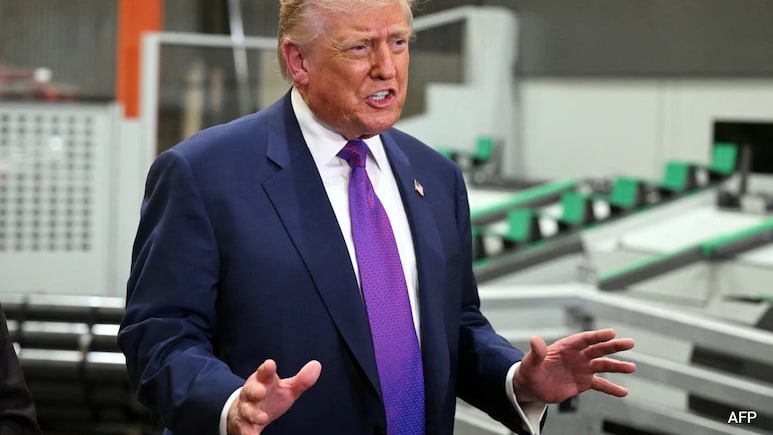
US President Donald Trump on Saturday increased global tariffs from 10 percent to 15 percent, which he had announced after the Supreme Court struck down his sweeping tariffs imposed last year.
In a post on Truth Social, Trump said that he was making the announcement “based on a thorough, detailed, and complete review of the ridiculous, poorly written, and extraordinarily anti-American decision on Tariffs issued yesterday.
However, an Indian-origin lawyer who argued the case before America's top court, said that if Trump's tariffs are such a good idea, he should have no problem persuading Congress.
Who Is Neal Katyal? Meet The Indian-Origin Lawyer Who Argued Against Trump Tariffs
"Seems hard for the President to rely on the 15 percent statute (sec 122) when his DOJ, in our case, told the Court the opposite: “Nor does [122] have any obvious application here, where the concerns the President identified in declaring an emergency arise from trade deficits, which are conceptually distinct from balance-of-payments deficits," Neal Katyal said in a post on X.
He further added, "If he wants sweeping tariffs, he should do the American thing and go to Congress. If his tariffs are such a good idea, he should have no problem persuading Congress. That's what our Constitution requires."
Also Read: $134 Billion At Stake? Brokerages Flag Refund Risks After Supreme Court's Tariff Strike Down
On Friday, the judges, in a 6-3 vote, found that the International Emergency Economic Powers Act (IEEPA) does not authorise the imposition of duties.
Increasing tariffs to 15%, Trump stated that during the next short number of months, the Trump Administration will determine and issue the new and legally permissible Tariffs, which will continue our extraordinarily successful process of Making America Great Again.
Chief Justice John Roberts, who authored the ruling, said that the president must 'point to clear congressional authorization' to justify such an extraordinary use of power.
"We claim no special competence in matters of economics or foreign affairs. We claim only, as we must, the limited role assigned to us by Article III of the Constitution. Fulfilling that role, we hold that IEEPA does not authorize the President to impose tariffs," the court order reads.
Whereas, one of the dissenting judges, Kavanaugh, argued that the tariffs were lawful.
“The tariffs at issue here may or may not be wise policy. But as a matter of text, history, and precedent, they are clearly lawful,” he wrote.
Also Read | Layoffs Are Rising In Tech, But These Skills Are Helping People Unlock Better Pay
Who is Neal Katyal?
Neal Katyal is a partner at Milbank LLP in Washington, DC. He is the member of the firm's Litigation & Arbitration Group.
Katyal has served as the former Acting Solicitor General of the United States and argued 54 cases before the top court.
In 2011, Katyal received the Edmund Randolph Award, the highest civilian honour, from the US Department of Justice.
Essential Business Intelligence, Sharp Market Insights, Practical Personal Finance Advice, Daily Fuel, Gold and Silver Prices and Latest Stories — On NDTV Profit.