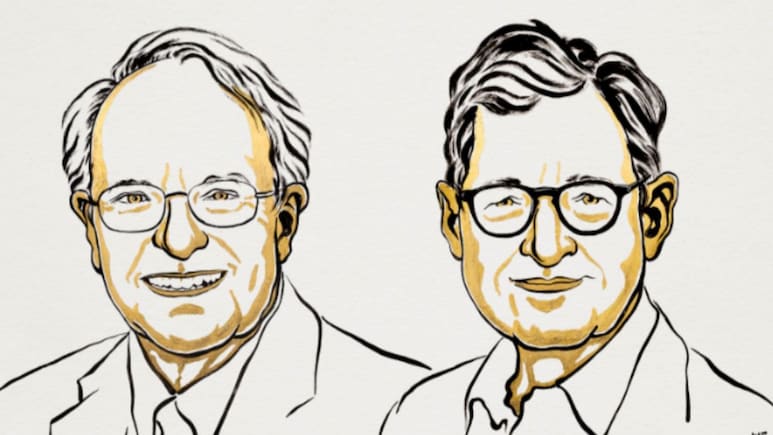
American economists Robert Hall and Michael Woodford have won the 2026 Nobel Prize in Economic Sciences for their work on the microeconomic foundations of macroeconomic stabilisation, the Royal Swedish Academy of Sciences announced on Monday.
The award recognises research that has strengthened the theoretical understanding of how governments and central banks can use fiscal and monetary policies to manage economic fluctuations and respond to shocks.
Formally known as the Sveriges Riksbank Prize in Economic Sciences in Memory of Alfred Nobel, the award carries a prize of 12 million Swedish kronor, equivalent to around $1.2 million. It is the final Nobel award announced this year.
Also Read | Layoffs Are Rising In Tech, But These Skills Are Helping People Unlock Better Pay
ALSO READ: Navi Pillay, The 2026 Nobel Peace Prize Winner, Has An Indian Connection
According to the academy, Hall and Woodford's research has helped establish a robust theoretical framework for the economic models used to assess policy decisions and stabilise economies.
“The laureates' work has provided us with a stable theoretical foundation for the models that are now used by central banks and governments around the world,” John Hassler, chair of the Committee for the Prize in Economic Sciences, said in a statement.
Their research is especially useful during unexpected economic disruptions, such as energy crises, recessions or sudden shifts in consumer spending. By studying how individual choices affect the wider economy, they have helped policymakers understand how economic shocks spread and evaluate ways to respond.
Who Is Robert E. Hall?
Robert E. Hall is an emeritus professor of economics at Stanford University. His research has covered employment, consumer spending, business cycles and economic policy, with a focus on understanding how economic decisions influence overall activity.
Hall also chaired the National Bureau of Economic Research committee responsible for determining the dates of US recessions and expansions. The organisation's assessments are widely used to understand turning points in the American economy.
His work on consumption and employment has contributed to the broader understanding of how households and businesses respond to changing economic conditions.
Who Is Michael Woodford?
Michael Woodford is an economist at Columbia University whose research focuses on macroeconomic theory and monetary policy.
His work examines how central banks influence economic activity and inflation through interest-rate decisions, policy frameworks and communication with financial markets and the public.
Woodford's research has played an important role in the development of modern monetary theory, particularly in explaining how expectations about future policy decisions can influence present-day economic behaviour.
Together, the contributions of Hall and Woodford have helped economists develop a clearer understanding of the links between decisions made by individuals and businesses and the performance of the economy as a whole.
Why Is the Economics Nobel Different?
Unlike the five original Nobel Prizes established under Alfred Nobel's will in 1895, the Economics Prize was introduced by Sweden's central bank in 1968 and first awarded in 1969.
Its formal name is the Sveriges Riksbank Prize in Economic Sciences in Memory of Alfred Nobel. Although it is presented alongside the other Nobel Prizes, it was established separately from the original awards for physics, chemistry, medicine, literature and peace.
ALSO READ: Who's Anne Carson? All You Need to Know About 2026 Nobel Prize in Literature Winner
American economists have accounted for a substantial share of recipients over the prize's history. Women, however, remain underrepresented among the laureates, with only three having received the award as of the 2026 announcement. The most recent was Claudia Goldin, who won in 2023 for her research on women's participation in the labour market and the factors behind gender differences in employment and earnings.
The 2025 Economics Nobel was jointly awarded to Joel Mokyr, Philippe Aghion and Peter Howitt for research explaining how technological progress and creative destruction drive economic growth.
The 2026 Economics Prize announcement came after the Nobel awards for medicine, physics, chemistry, literature and peace were announced the previous week.
Essential Business Intelligence, Sharp Market Insights, Practical Personal Finance Advice, Daily Fuel, Gold and Silver Prices and Latest Stories — On NDTV Profit.