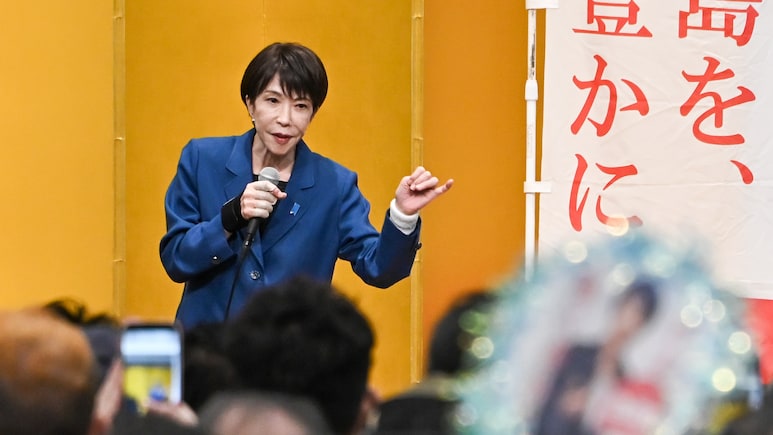
Japan Prime Minister Sanae Takaichi's resounding victory in the winter snap election has implications well beyond national politics. It holds immense importance for India's long-standing strategic relationship with Japan.
Politically, Takaichi is known for her firm nationalist stance, backing constitutional change and taking a hard line on China and North Korea, while strongly advocating the preservation of Japan's traditional social order. At the same time, she has built a reputation as a policy-focused technocrat, particularly on economic security and Japan's digital overhaul.
While many Japanese politicians begin engaging with India only after taking office, Takaichi's interaction with New Delhi predates her rise to national leadership.
Also Read | Layoffs Are Rising In Tech, But These Skills Are Helping People Unlock Better Pay
During her stints as communications minister in 2015 and 2017, she held talks with Prime Minister Narendra Modi on areas ranging from the digital economy and smart cities to cybersecurity. She has also repeatedly underscored India's importance in the Indo-Pacific, describing it as a key democratic and technology partner in diversifying global supply chains.
Also Read https://www.ndtvprofit.com/world/japan-elections-pm-modi-greets-sanae-takaichi-on-lower-house-win-10971081
In off-the-record briefings cited by Japan's press, she has described India as a pivotal element of Tokyo's economic security framework, with a focus on semiconductors, telecom networks and critical minerals.
According to The Diplomat, the diplomatic groundwork she inherited when she became prime minister was already well established. Under former PM Shinzo Abe, whose engagement with India was notably close, cooperation evolved from major infrastructure ventures to more ambitious strategic undertakings, including the Asia Africa Growth Corridor and Vision 2025 linked to the Free and Open Indo-Pacific.
That said, New Delhi should view Takaichi's leadership as an extension rather than a carbon copy of the Abe era. Her focus is more inward-looking and openly security-centric, with a clear emphasis on prioritising Japan's national interests. India's approach, therefore, will need to rest on practical convergence and advancing common goals while safeguarding its own strategic autonomy, reported The Diplomat in December 2025.
According to an East Asia Forum analysis published in November 2025, Takaichi is expected to return to many of the cooperation pillars emphasised during the Abe years, particularly with partners such as India. Her open endorsement of the “Free and Open Indo-Pacific” framework and her advocacy of a “quasi-alliance” with New Delhi point in that direction. Known for her tough stance on China and a nationalist, Japan-first worldview, she is likely to see India as a reliable counterweight to Beijing's growing assertiveness.
The analysis on East Asia Forum said several policy areas are set to shape Japan–India ties under Takaichi's leadership. Her more forceful approach is expected to back defence modernisation and broaden Japan's security partnerships beyond its alliance with the United States, placing India, Australia and South Korea at the centre of Tokyo's strategic outreach.
This approach builds on existing cooperation, including the joint development of the Unified Complex Radio Antenna mast, which has strengthened naval stealth and communications, and points to the scope for deeper collaboration, potentially through ventures in India's Defence Industrial Corridors.
Her tenure as economic security minister provides Takaichi with a solid foundation for advancing cooperation with India on strategic economic issues. This includes strengthening supply chain resilience, developing semiconductor capabilities and addressing techno-economic risks across the Indo-Pacific.
In this area, her policies are expected to build on the direction set by her predecessor, Shigeru Ishiba, under the ‘Joint Vision for the Next Decade' agreed with Prime Minister Modi at the 15th India–Japan Annual Summit in August 2025, as per the East Asia Forum.
Essential Business Intelligence, Sharp Market Insights, Practical Personal Finance Advice, Daily Fuel, Gold and Silver Prices and Latest Stories — On NDTV Profit.