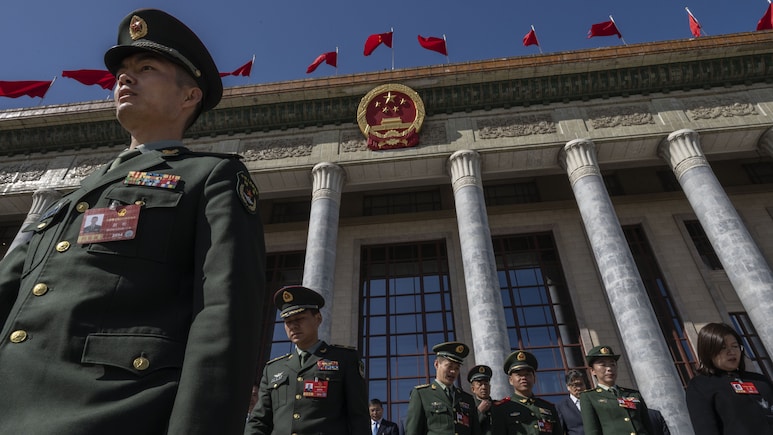
The Chinese military has developed hypersonic glide vehicles that can launch air-to-air weapons, an advancement meant to threaten high-value targets such as command-and-control aircraft thousands of miles away.
The breakthrough is part of a larger effort by China to use its missile arsenal — the world's largest at more than 3,150 ballistic weapons — for nearly every military task, according to a person with direct knowledge of the matter. Meanwhile, the US is struggling with supplies of crucial air defense missiles and long-range strike weapons after six months of war with Iran.
China also added air-to-air capabilities to some hypersonic cruise missiles and built anti-ship capabilities into several types of missiles, said the person, who asked not to be identified because of the sensitivity of the information.
Such weapons would pose a serious threat to US air operations during a conflict with China. Support aircraft such as tankers, airborne warning-and-control planes and even flying command posts such as the E-4B Nightwatch are meant to operate far from combat.
A hypersonic glide vehicle deployed from a DF-17 missile could travel about 1,500 miles (2,414 kilometers) — just short of the distance from China to the US territory of Guam, a major military site. The DF-27 missile has a maximum range of about 5,000 miles, putting Hawaii in range.
Hypersonic glide vehicles, or HGVs, are warheads that can maneuver in the atmosphere on their way to a target, extending range and complicating interception. No other country is known to operate weapons that combine an HGV with air-to-air missiles.
A report from the US Air Force's China Aerospace Studies Institute this year said, without providing details, that China's missile modernization efforts “increasingly prioritize the ability to inflict coordinated, system–level damage across an adversary's operational architecture.”
To be sure, using what is essentially a ballistic missile to attack a distant aircraft is costly, difficult and risky.
The travel time of a ballistic missile — 20 minutes or more at maximum range — means that targeting information must be extremely precise. That long “kill chain” of getting distant sensor information to the missile makes operations easier to disrupt.
Ballistic missiles also can be mistaken for a nuclear attack. This so-called discrimination problem complicates the weapon's use, especially during an all-out war, when it may inadvertently provoke a nuclear response.
China appeared to ramp up missile production last year by the most since Xi Jinping became president in 2013, Bloomberg reported in May, mapping out the sector's finances for the first time.
China's long-range PL-15 air-to-air missile saw combat last year, when India and Pakistan had a brief conflict. Pakistan said it used the weapons to shoot down several Indian aircraft.
The Pentagon estimates China had at least 3,150 ballistic missiles and 300 ground-launched cruise missiles as of 2024. Those represent increases of 147% and 50%, respectively, from 2015, when the US started disclosing such estimates.
Long-range air-to-air weapons are considered key to any future conflict. The US developed the AIM-174B from its RTX Corp. SM-6 air defense missile; its exact range is classified but the ground-launched SM-6 has a range of 250 miles or more.
On Saturday, the US Navy said it was testing the AIM-424 Malice air-to-air missile from RTX unit Raytheon Co., which it said had a range of more than 300 miles.
The Lockheed Martin Corp. AIM-260 missile, which is in production but not yet in service, is also expected to have extremely long range. MBDA Missile Systems Services SAS' Meteor, widely used in Europe, is ramjet-powered and can hit targets more than 100 miles away.
(This story has not been edited by NDTV staff and is auto-generated from a syndicated feed.)
Essential Business Intelligence, Sharp Market Insights, Practical Personal Finance Advice, Daily Fuel, Gold and Silver Prices and Latest Stories — On NDTV Profit.