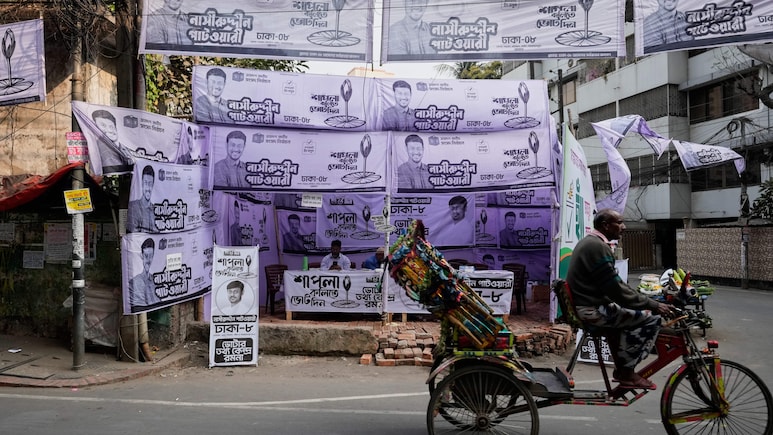
About a year and a half after violent protests that led to the ouster of then prime minister Sheikh Hasina, Bangladesh is all set to vote in a crucial national election.
An intense poll campaign came to an end on Tuesday morning, with voting slated for Thursday. Read on to know how elections work in Bangladesh, what is at stake, and who seems to have an edge in the polls.
A Brief Overview
Also Read | Layoffs Are Rising In Tech, But These Skills Are Helping People Unlock Better Pay
The voting, across a total of 42,761 polling centres in 64 districts for 300 parliamentary constituencies, will commence at 7:30 a.m and will be concluded at 4:30 p.m.
According to the Election Commission of Bangladesh (ECB), there are 127,711,793 registered voters, aged 18 and above, as of Oct. 31, 2025. These votes include postal ballots within and outside the country.
This is the first election in the country wherein a postal ballot has been facilitated. This unprecedented move will benefit about 15 million overseas workers of the country.
The “unicameral” legislature of the country, the Jatiyo Shangsad or the House of the nation, has 350 constituencies, with each constituency holding a single-member seat.
Voting, however, is used to elect only 300 of these members, while the rest of the 50 seats have been kept reserved for women. The women's seats are to be allocated to the parties post-election in due proportion.
The Litmus Test
This election has the world turned towards Bangladesh, watching in anticipation, given that the last held election in the country was called “not free and fair” by the Opposition as well as the international observers.
The election was held in January 2024. Sheikh Hasina returned to the office for the fifth consecutive term, and the main opposition party, Bangladesh Nationalist Party (BNP), boycotted the elections, alleging a crackdown on Opposition figures.
July of the same year saw student protests in the country against a conventional job quota system, which Hasina tried to suppress, brutally killing over 1,400 people across the country, and leaving over 20,000 injured, according to International Crimes Tribunal.
Hasina fled to India, and an interim government is being led by Nobel Laureate Muhammad Yunus.
Notably, Hasina has been convicted, in absentia, of crimes against humanity and sentenced to death by the ICT in Dhaka. India has refused to extradite Hasina, further straining the already sour ties between the two countries. Political activity has remained banned for Hasina's Awami League Party.
This election, the experts say, will serve as a litmus test for change in the country.
ALSO READ: India-Bangladesh Reset? Why US Is Pushing To Mend Ties After Sheikh Hasina's Ouster
Security Concerns
More than 50% of the polling stations have been declared as risk-prone in the country. The risk has been categorised as “high” and “moderate” for around 24,000 polling stations.
In Dhaka alone, 1,614 out of 2,131 polling stations have been declared risk-prone.
Around 1.57 lakh police personnel will be directly involved in the conduct of polls, with an additional 30,000 police personnel supporting them. CCTV footage and over 25,000 body-worn cameras will be used to monitor the polls.
Referendum
Bangladesh is also eyeing a referendum, outlining a roadmap for constitutional amendments, legal changes, and the enactment of new laws, in accordance with the July National Charter 2025, drafted by the caretaker government.
Main Parties
Bangladesh Nationalist Party (BNP): This political outfit is a major stakeholder and leads a coalition of 10 parties. It is presently headed by Tarique Rahman, the son of the late prime minister Khaleda Zia.
Rahman remained in exile for 17 years, after he escaped to London in 2008, amid a “politically motivated persecution”. Ziaur Rahman, his father, founded the party in 1978. The party maintains that Bangladeshi Nationalism remains at the heart of their politics.
Jamat-e-Islami
Commonly referred to as the JIB, Jamaat presently is an 11-party amalgam. This party has been a close ally of Rahman's BNP, and has the National Citizen Party (NCP) in their fold, a group formed by students who protested against Hasina.
JIB is led by Shafiqur Rahman and comes with a pre-partition legacy. It was founded in 1941 by Abul Ala Maududi while India was still under British rule.
Non-Allied
A breakaway party, from the JIB-alliance, the Islami Andolan Bangladesh and the Jatiya Party—a Hasina ally of the past—will be contesting elections independently.
What To Expect?
The fight is neck-to-neck, as per a survey by the US-based International Republican Institute. The institute published a report in December 2025, putting BNP's support at 33%.
Jamaat, as per the survey, was not far behind with 29%.
Though the results are traditionally declared the next day, the ECB has said that the vote count may take longer this time around as it involves both the parliamentary poll and the referendum.
Essential Business Intelligence, Sharp Market Insights, Practical Personal Finance Advice, Daily Fuel, Gold and Silver Prices and Latest Stories — On NDTV Profit.