Can Fujifilm’s Nura Transform Healthcare With AI-Enabled Preventive Screening?
How do you create a use case for your products while taking elements from your culture to build a new line of business? Japanese conglomerate Fujifilm still makes photographic films but also has a huge business in healthcare, life sciences and electronics. Fujifilm provides solutions for diagnostic imaging—CT and MRI systems that today come with AI layers to deliver better outcomes. In 2021, the company established Nura with Indian firm Dr Kutty's Healthcare to offer high-quality medical checkups, supported by Fujifilm's medical devices. With the increasing focus on AI across industry sectors, Fujifilm and Nura are now pitching their AI-enabled checkups, reports and process as a key differentiator in the healthcare space with their USP being an in-depth health screening delivered in less than 120 minutes.
According to Masaharu Morita, founder and program director, Nura – AI Health Screening Centre, India was their first global expansion outside Japan. India was chosen because of the size of the market here and growing awareness of preventive healthcare through regular health screenings, which according to him is at the core of healthcare philosophy in Japan and a key reason behind the country's higher life expectancy.
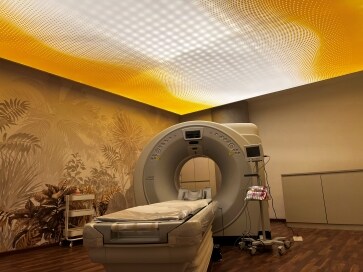
But private hospitals and diagnostic centres already do a roaring business in such health check-ups. According to Morita, what sets Nura apart is its 120-minute, AI-enabled offering. This, in a setting that is more tranquil Japanese Zen garden combined with sterile medical, as compared to a standard medical facility. With soft-spoken medical professionals, soothing piped music in the rooms where various tests are done, and even a comfortable kimono that ‘guests' wear during the process—Nura uses hospitality lingo and refers to customers as guests. Every part of the experience is thoughtfully and deliberately designed to finish everything within 120 minutes as customers move from one medical check-up or test to another in a calm yet clearly Japanese influenced, precision-driven environment. Even the final report is delivered by a doctor using a large touch screen as the customer sits across the table—digital interfaces simplify medical data into engaging visuals. Rather than pages of medical reports, Nura customers can explore images of their organs, body composition and health projections.
But where does AI come in and how does it make a difference? According to Morita, at the heart of Nura's process is Fujifilm's ultra-low-dose CT technology combined with AI-assisted imaging and a streamlined workflow. "Our legacy in high-quality scanning and image processing allows us to train AI systems with decades of imaging data. AI doesn't replace doctors, it empowers them. The AI system acts as a powerful assistant that helps specialists detect minute irregularities that might otherwise be missed during routine checks," he explains.
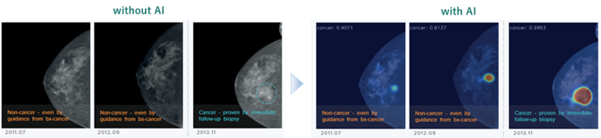
How AI enhances accuracy and detects irregularities that might be missed by the human eye. (Image: Nura)
An example illustrates how AI can significantly enhance accuracy in breast cancer screening. Mammogram images in the 'Without AI' picture show how subtle signs of early-stage cancer were initially interpreted as non-cancerous, even with professional review and biopsy guidance. Over time, the lesion developed and was later confirmed as cancer through a follow-up biopsy. When the same mammogram sequence was analysed using an AI-powered detection system, intelligent algorithms identified a small area of concern as a suspicious region that required further examination. The system assigned a high probability score for cancer, prompting doctors to review it more closely. It can be then verified through biopsy. Essentially, AI processes the scan and compares them to similar scans in Fujifilm's vast library of imaging data. This enables Nura to sharpen the low-dose image and identify anything abnormal that that might be missed by the naked eye. The Fujifilm systems keep getting better at such predictions as they continue to gather, classify, and examine large amounts of medical images.
Recognising that India is a value-conscious market Nura has tried to keep pricing around health check-up packages offered by other leading players. Morita pegs the screening cost at roughly ₹50 a day, which according to him makes it comparable to what many Indians spend on small daily conveniences
Since launch Fujifilm and Dr Kutty's Healthcare have expanded Nura centres to Bengaluru, Delhi, Mumbai, Hyderabad, and Calicut. Fujifilm has now expanded Nura beyond India and currently operates 11 centres globally: besides the five Indian centres there are six international centres across Mongolia, Vietnam, South Africa, Dubai and Thailand. By Q1 next year the company aims to scale its footprint in three major India metros. Morita says the aim is build a healthcare network with 100 centres worldwide by 2030. Morita adds that the Nura program is designed to be flexible and can be adopted by larger national healthcare players as well. “Fujifilm and Dr. Kutty are aligned in supporting such collaborations to broaden access to preventive screening. The long-term vision is to establish a network of dedicated preventive care centres that blend Japanese precision with trusted local healthcare partnerships.”

-
One Battle After Another: India's Corporate Dynasties Battle For Control

2026 could go down as Corporate India's year of succession wars, governance battles and family fault lines.
-
Rs 50-Lakh Gold In Bank Locker, Rs 3 Lakh Of Protection: The Gap Most Families Don't Know About
The RBI ties a bank's liability to the annual locker rent and families who want to insure their jewellery face a separate question about how to prove what was inside.
-
The More Food Turns Into Fuel, The Harder It Is To Read Agricultural Markets | The Reason Why
A policy designed to reduce dependence on imported fuel can create new pressures elsewhere in the food economy.
-
Your iPhone Costs 12 Grams Of Gold, A Car About 100. What Does Your Life Weigh?
Measured in rupees, almost everything looks more expensive than it did a generation ago. Measured in grams of gold, a lot of it has become cheaper.
-
Gold Is Rs 22,000 Cheaper Than A Month Ago. Should You Buy Amid The Wedding Season?
Gold's potential slide to $3,500 could save around Rs 4,700 per 10 grams, but a soft inflation print could just as easily push prices back up. One way to split the risk is to buy in parts, some now and the rest after the Fed's Dec. 9 decision.
-
AI Agents Are Gaining Power. Who Governs Them?
Artificial intelligence agents promise to transform productivity by moving machines from assisting decisions to executing them. But as organisations delegate greater authority to these AI-agents, they must first establish who controls that authority and who remains accountable when things go wrong.
-
Why Swapping Your Old Gold Can Trigger A Rs 5 Lakh Tax Bill, And How You Can Avoid It Legally
Swapping old gold for new is taxed as a sale and a fresh purchase. Getting your own gold remade can cut most of that bill, though it has its own costs.
-
The AI Trade is Done. The Real Opportunity for Investors Starts in 2027 | Unhedged Position
As pureplay AI stocks plunge and circular, capex-led financing unwinds, 2027 is set to be a year of reckoning for AI companies. Yet the bust clears the way for a better opportunity for investors in 2027 -- shifting the spotlight from AI builders to the companies using AI.
-
Leadership As Mission: Why The Age Of AI Demands More Human Leadership
Debjani Ghosh examines how AI is changing leadership, arguing that its success must be measured by its impact on people and the accountability of those guiding its use.
-
We May Need Another Tukaram Mundhe To Fight Air Pollution | The Reason Why
Developers may install basic measures such as sprinklers and green nets, resume work, and continue violating rules when this equipment stops working.









