Scan to Download
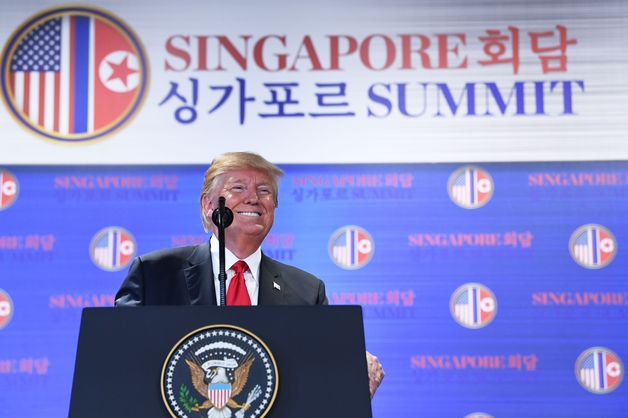
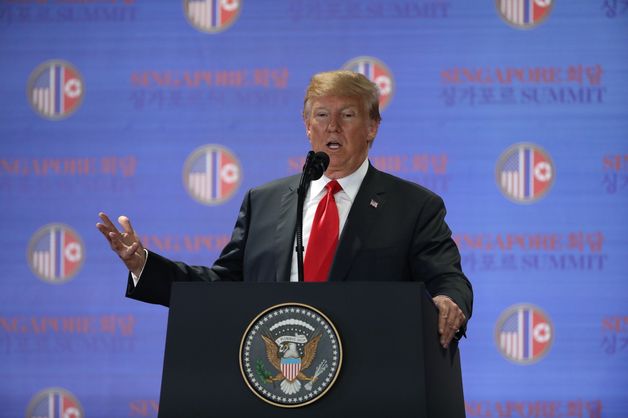
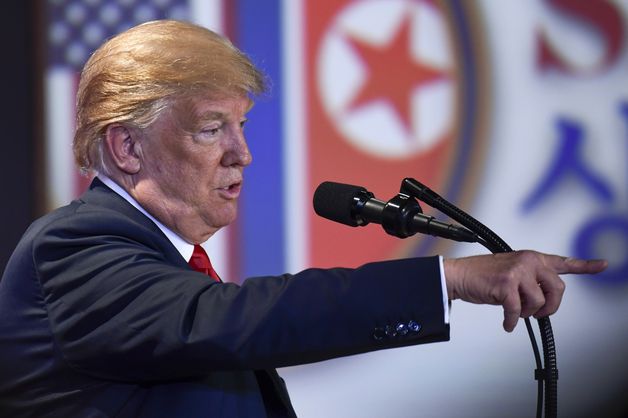
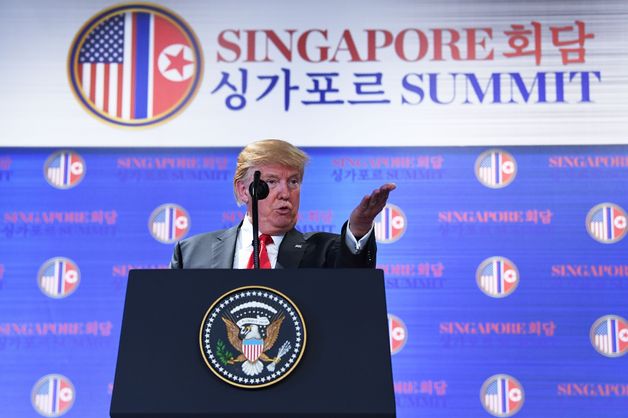
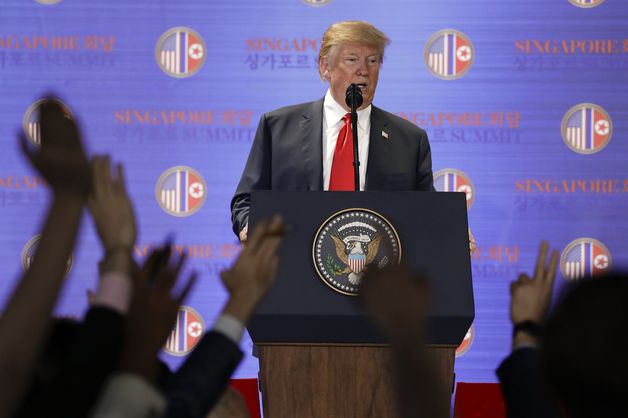
Trump told reporter in his news conference that while North Korea has committed to denuclearize, "in the meantime, the sanctions will remain in effect." Click on the image to play the video clip. (Bloomberg Terminal subscribers only)
Surprised to learn the film that was shown right before the press conference was actually made in the U.S. Perhaps Trump's team thought Kim would be pleased to see himself as the star of a blockbuster film?
Kim's father, the late Kim Jong Il, was famously obsessed with movies and is credited with making several of his own. While the younger Kim has shown some interest in arts and culture, I'm not aware if he has a particular preference for film.
Oddly he congratulates "everybody in the room," including the journalists, for their participation in what Trump regarded as a momentous meeting in world history.
And that's it. Trump wrapping up and saying he will now be taking "it easy." He's got a long flight home.
South Korea media asking questions, but not whether their president was aware in advance that Trump was going to pull the pin on joint military drills (even if we don't know how long that might be for). Trump does say he's sent the document from today's meeting to Moon Jae-in and predicts "he'll be very happy."
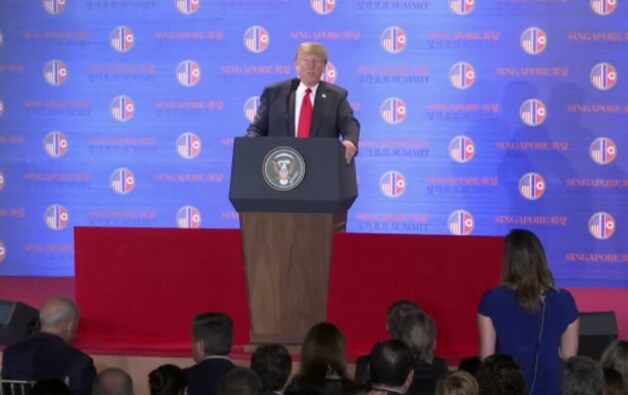
This has been a free-wheeling press conference closing in on a full hour. The president and his top aides believe this is a forum that suits him well - it allows Trump to exhaust questions, and he's comfortable behind the lens. With the president set to embark on a long trip home, the White House has to hope that he's done enough to satisfy the questions about the agreement and meeting.
Trump appears to be enjoying the repartee here with the reporters.
I'm scratching my head as to which G-7 country Trump thinks doesn'ttake advantage of the U.S., given how he said "virtually" every one does. Canada wouldn't count, thanks to the milk quotas and tariffs, as we've learned. It may be the U.K., which is the only G-7 country to have a trade deficit with the U.S. Even Italy manages a surplus, which in Trump's view might qualify as taking advantage.
A questioner refers to Trump as "leader of the free world," though after the recent G-7 crack-up, it's hard to imagine western European leaders referring to Trump as the captain of the team. It does feel like we're in a new, different era -- a multipolar world, no more hegemon, for now.
Read more in the story from my colleague Andy Sharp here.
Trump takes a page out of Mario Draghi's ECB playbook, saying he'll do "whatever it takes" to make the world a safer place. Draghi had a more readily identifiable resource when it came to saving the euro though -- bond purchases.
Trump, thinking from a real estate perspective, notes North Korea has "great beaches -- you see them when they test" weapons. Instead, they could have hotels and condos on said beaches. Could the Trump Organization be an early-mover investor? But not sure if it is the immediate economic model Kim would be thinking of in terms of a careful opening up to the outside world.
Markets and business as yet aren't on board with Trump's optimism about opportunity in North Korea.
Our friends at the Markets Live blog, including Mark Cudmore, have been saying all day that the summit isn't a markets story -- in part because investors need to see more substance before throwing money around on North Korea bets.
Here's a Bloomberg headline for the ages:
TRUMP SEES GREAT POTENTIAL FOR CONDOS IN NORTH KOREA
Trump indicates he has intelligence to suggest that North Korea has a "very substantial" nuclear arsenal. It's the second time Trump has hinted at conclusions drawn by the U.S. intelligence community during today's press conference, earlier saying that American spy agencies had used heat signatures to identify the major missile engine testing site Kim reportedly agreed to destroy.
Trump is citing his uncle, who he says was at MIT for "forty years." Links to his view that once you reach a certain point on denuclearization, you can't go back. Would be interesting to see how that gels with nuclear experts who've said it's very hard to guarantee it is irreversible. Trump also says North Korea already has a "very substantial arsenal."
To add to Justin's earlier point, maybe the difference for Trump between a North Korea nuclear-disarmament deal and the Iran nuclear-disarmament deal is that he didn't negotiate the Iran one.
We're going on almost an hour for this press conference, which is a relatively rare opportunity for reporters to lob questions directly to the president (having become even less frequent in the age of social media).
According to tallies by White House historian Martha Joynt Kumar through the first nine months of Trump's presidency, Trump held just one solo press conference and 17 jointly with foreign leaders. Today's format is a bit of an interesting hybrid, given that Kim isn't taking questions but the press corps is much larger than back home at the White House.
Trump the dealmaker on how he can get Kim to keep his word:
1) "Can you ensure anything?"
2) "All I can say is they want to make a deal. That's what I do."
3) "I know when someone wants to make a deal, I'm great at it."
Away from Trump's briefing, Japan Prime Minister Shinzo Abe says he deeply respect U.S. President's efforts and adds:
Trump asks his press secretary Sarah Huckabee Sanders if he can keep going with questions, even if it means he may take off later than expected. Gets a question on next steps, and replies: "We're getting together next week to go into the details," with staff including Secretary of State Pompeo and security adviser Bolton. But he won't commit to a more detailed timeline.
Returning the remains of the American war dead is definitely a step in the right direction and can be construed as a gesture of goodwill on the part of Kim Jong Un. But it's also a safe gesture for Kim to make, one that doesn't cause security concerns for allies in the way that halting the military exercises will.
Trump suggests that the meeting between Secretary of State Pompeo and North Korean officials could happen next week. That's the first concrete deadline we've heard from the president, and a benchmark for if these talks are going to continue their momentum after today.
Questions turn to the recent G-7 summit in Canada, where Trump, having agreed to a communique with other leaders, dis-endorsed it after criticism from Canadian PM Justin Trudueau at the host's closing press conference.
Trump insists it was a "very good meeting" while talking about how the U.S. is being taken advantage of on trade. And he says on Airforce One from Canada to Singapore he saw Trudeau saying he would not be pushed around on trade. "You can't do that,'' Trump says. ``But he learned. That's going to cost a lot of money for the people of Canada."
The ending of joint exercises with South Korea (for now) could potentially be seen as a further reduction in America's engagement in Asia. First, Trump abandoned TPP. Then he came to an APEC summit in Vietnam with the message that everybody needs to go it alone. China has meantime been trumpeting its Belt and Road Initiative to deepen ties across the region, and building facilities in the South China Sea. It's clear to countries like the Philippines who's here to stay, and who's potentially departing.
Trump now speaking about trade as he answers a question about relations with allies.
Trump makes reference to the vulnerability of Seoul if there was not an agreement with Kim to defuse the nuclear tensions. Says Seoul has 28 million people "and it's right next to the border. It's right next to the DMZ."
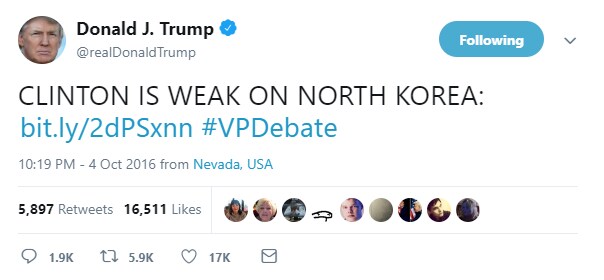
For Trump's criticism of Hillary Clinton as being weak on North Korea during the campaign, again it is pretty easy to imagine enormous criticism from Republicans if it had been a President Clinton who had agreed to end joint military exercises with one of America's closest allies in Asia!
The halting of military drills in South Korea also could shake Japan quite a bit. The Japanese constitution has, since the aftermath of its defeat in World War II, essentially dictated that Japan rely on its allies for security. That has made the U.S.-Japan alliance such a critical component of the ups and downs in Asia-Pacific security.
Kim Jong Un must be very happy about stopping the military drills, as it was one of the things that very reliably attracted North Korea's ire every time they took place. Even after their stance toward South Korea and the U.S. warmed somewhat after recent improvements in relations, North Korea would always revert back to their previous angry tone when it came to the war games.
Very curious to hear what South Korea will say about this.
This does sound more and more like a long-term negotiating process has been established here. What they used to call "confidence building measures" being agreed to in the early stages. U.S. will stop joint military exercises. That's easy. North Korea will return what American bodies it can find from the 1950-53 Korean War. Again, not a difficult step.
It may not be until 2019 or later until we know whether the real deal will be achieved -- end of nuclear weapons on the Korean peninsula, and removal of barriers to trade and investment for North Korea.
"They got a meeting. But only a person that dislikes Donald Trump" would say he agreed to a big commitment, Trump says.
Trump adds, to items already in the written agreement today, the release of three American hostages as an additional matter that North Korea gave for their part. Also said that for seven months, North Korea hasn't conducted missile or nuclear tests.
It's truly remarkable that a U.S. president is arguing that military exercises with South Korea are "provocative" and not worth the expense of sending bombers on a six-hour flight from Guam. This is a dramatic change in longstanding policy, and is going to create hard questions for leaders at the Pentagon.
Trump circles back to the cost of the U.S. military drills in South Korea and says it's a factor in calling a halt. Seoul, he says, contributes but not enough. "The war games are very expensive, we pay for a big majority of them. We fly in bombers from Guam, to practice and drop bombs all over the place and then go back to Guam. It's very expensive."
Not sure how well that will go down in Seoul, where the government strongly favors talks but also relies heavily on a U.S. military presence as a deterrent to Kim's regime.
Trump's refusing to put a timeline on just about anything here: nuclear verification, a follow-up summit in Washington or Pyongyang, or the exchange of diplomats between the U.S. and North Korea. That underscores that leaders didn't appear to settle on a concrete timetable for future negotiations.
A curious headline -- the sanctions will come off when North Korea's nuclear weapons aren't a problem? And we know denuclearization will take a long time... So could they come off before total destruction of North Korea's arsenal?
This is reminiscent of Bank of Japan stimulus exit-policy discussions and whether they could taper before hitting 2% inflation!
A Rough Guide to North Korea's Many Promises to Abandon Nukes
Trump's demonstrating his penchant for "whataboutism" as reporters press him on the human rights issue. After initially saying he just briefly discussed his concerns, Trump then claimed he "pretty strongly" brought up the issue. And in a comment unlikely to satisfy many human rights activists, Trump said that while it was a "rough situation" in North Korea, "it's rough in a lot of places."
Trump's risk here is that he spent months describing North Korea as uniquely oppressive to its people, and now seems to be downplaying those concerns.
The presumption would be that South Korea's president, Moon, who has sought better ties with North Korea, had signed off on Trump committing to end military exercises with the U.S. But given this is Trump and he's unpredictable, it would need verifying.
Will he go to Pyongyang? Yes at "a certain time." And at an appropriate time invite Kim to the White House. "He has accepted." Trump then alludes again to more coming (as Justin notes, to Kim doing or saying more once he's home), saying there were things that were agreed after the statement was signed. That's very much Trump's style as a dealmaker.
"I brought it up, absolutely" -- there's Trump's reassurance for the Japanese re: abductions. "Things will be happening."
Imagine if President Obama had agreed to end war games with U.S. ally South Korea in order to keep negotiating with North Korea! There would have been major blow-back from Republicans. The adage about Nixon going to China comes to mind. Because Nixon had built his career as a virulent anti-Communist, he could avoid political blow-back from negotiating with China.
Oh there we go -- at least one "Chairman Kim" reference from Trump. That confers more respect on the North Korean leader than "leader," which has always been the U.S. norm.
Pressed again on human rights in North Korea, Trump says it was discussed, "relatively briefly" compared to other topics. He also says Kim is a "much different president, in all fairness."
Trump Says Kim to Return More Than 6,000 American War Dead
Question on whether human rights was discussed. Trump says yes, then segues fast. He says what was also discussed "in great detail" was getting the return of the remains of prisoners of war from the Korean war. Spending a few minutes on the topic, he says Kim agreed "so quickly and so nicely."
Wondering if the president has asked for some sort of verifiable show of good faith from Kim - could explain why he's been harping on this point. Unclear what exactly that could be, but as Trump has revealed, there appears to be a number of side agreements reached beyond the scope of the document signed between Kim and Trump earlier today.
One possibility is the POW/MIA issue that the president is currently discussing.
"You never know. We never know." Trump called it a "very fair question" about why, after decades of North Korean promises made and broken, he can trust Kim on denuclearization this time. But he said he thinks Kim will "start that process right away" when he lands back home.
Again, for a good timeline of the whirlwind in North Korea negotiations, check this out later.
The halt of U.S. and South Korean joint military exercises is a significant concession, and is going to immediately prompt questions about whether this will harm U.S. defense readiness, and what the president got in exchange.
Trump defended the move by saying the so-called "war games" were "provocative" and costly -- a complaint he's frequently had about U.S. mutual defense efforts across the globe.
Asked about how he's going to ensure Kim does give up his nukes (given the lack of specifics in today's statement), Trump says repeatedly "we're going to have a lot of people there" and that there will be "complete denuclearization." Again he doesn't give any details as to what will happen next to get on that path.
The halt of U.S. and South Korean joint military exercises is a significant concession, and is going to immediately prompt questions about whether this will harm U.S. defense readiness, and what the president got in exchange.
Trump defended the move by saying the so-called "war games" were "provocative" and costly -- a complaint he's frequently had about U.S. mutual defense efforts across the globe.
Trump says the U.S. will halt war games in South Korea. But it's unclear if he just means the latest joint drills, or future drills and, if so, for how long.
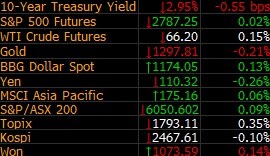
An ever, ever so slight move higher in the yen on the news that U.S. Sanctions will remain in effect on North Korea. Still, at about 5 pips, it's hardly noticeable.
Trump Says U.S. Won't Be Reducing Troop Numbers in South Korea
Trump Says U.S. Stopping War Games in South Korea
Trump says Otto Warmbier, the University of Virginia student who was detained for almost a year and a half in North Korea and died shortly after returning home, "did not die in vain," and that his case actually helped propel the process toward these talks. He called Otto's parents "friends" of his.
Very key that sanctions are remaining in effect. Would have been more difficult for Trump to justify overturning what has been his own policy (with latest penalties imposed as recently as February). Instead, he's drawing contrast to other U.S. administrations.
Trump stresses that Kim "wants" denuclearization. Experts evaluating the progress of these negotiations will be interested in getting more details about exactly what Trump is referring to.
Trump-Kim Summit: Donald Trump On 'Finer' Details Of The AgreementTrump Kim Summit | U.S. President Donald J. Trump address the media on the 'finer' details of the agreement. #BQLive Follow all updates on the blog: https://goo.gl/KSTnVr
Posted by BloombergQuint on Tuesday, June 12, 2018
Sanctions will remain in effect, Trump says. He didn't say under what conditions they might be lifted.
Trump Says Sanctions on North Korea Will Remain in Effect
Trump says Kim told him North Korea is already destroying a major missile engine testing site. He says it was not in the statement that was signed today, but Kim told him afterward.
Trump also praises Chinese President Xi Jinping for his role in bringing North Korea to the table. That's even as he has a bit of a dig at Xi over the North Korea-China border, which is a key conduit for trade into Kim's regime. He says Xi closed up the border but "maybe a little less so over the last few months, but that's ok."
Trump said he'll be talking to South Korean President Moon Jae-in right after this press conference.
"This isn't another administration that never got it started and therefore never got it done," says Trump of North Korea talks.
Trump keeps repeating that the document was very "comprehensive," which is not really the consensus opinion. But the president is looking to set the narrative, painting this as a "very historic day" and thanking Kim for a "bold step." Without a tangible new gain to point to, Trump is speaking about the long and bloody history of the Korean conflict to underscore the significance of today's thaw.
As well as the shout out to Singapore, Japan PM Shinzo Abe gets a nod from Trump; he says Abe "wants what is right for Japan and the world" and is a "good man." Japan, as Michelle pointed out in several posts today, may not be happy with the lack of discussion at the summit about Japanese abducted by North Korea decades ago.
Trump and Kim Signed Something in Singapore. Here's What It Says
Trump takes a moment to give credit to the host country, sending "warmest wishes to every citizen of Singapore."
It might be the "Little Red Dot," but Singapore has won the world's attention in hosting the summit with intensely challenging logistics. Prime Minister Lee told local media earlier this week that summit costs would add up to about S$20 million ($15 million) for Singapore (about half for security) though he added that the city state was willing to pay it.
(For those new to Singapore, zoom in on your Google Maps to find it nestled at the bottom of the Malay peninsula, just over a degree north of the equator.)
Trump says the video was given to Kim, and "captures what could be done."
This is a high-stakes moment for President Trump. He's facing a lot of questions about the success of a summit he's billed as possibly changing the course of history, and will have only this chance to defend and explain an agreement already being interpreted as paltry before getting on a plane for a full day.
Trump will be looking to emphasize the historic nature of the summit itself, and cast the concrete achievements as significant in and of themselves.
With most media accounts of the agreement focusing on the scant details and fluid deadlines, former Trump national homeland adviser Thomas Bossert is pushing back on social media. In a series of posts, the former WH official says the success of the summit "is already staggering" and that today's agreement is a "HUGE step toward peace."
That Kim committed in writing to work toward denuclearization "has massive implications," Bossert writes, while allowing that the "entire peninsula" language is a "significant point we will have to unpack later."
If you were holding out hope for a secondary document that put some meat on the bones of the document signed by Kim and Trump, we have some bad news for you.
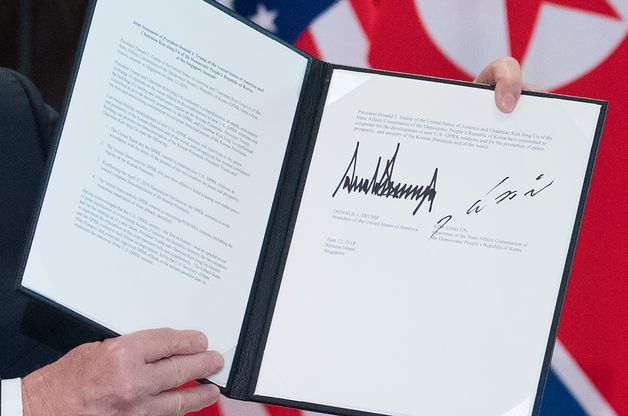
A White House official has confirmed to my colleague Jennifer Jacobs that the document seen in the photograph is all that was produced out of today's meeting.
As we wait for Trump's press conference -- which looks like starting in about 40 minutes -- here is another CATCHUP of today's historic summit in Singapore:
Well, we've blown past the 2:30 p.m. Singapore time (2:30 a.m. D.C. time) President Trump cited for his media availability. According to CBS News reporter Mark Knoller, the briefing is back to its originally scheduled 4 p.m. time - that's in about 45 minutes.
Of interest later today may be what plane Kim uses to fly back to Pyongyang.
Defying speculation that he would use a private North Korean jet -- a Russian model rarely used since the 2000s -- Kim flew to Singapore in a Boeing 747 operated by Air China.
Analysts say this is sign of China's influence, and also shows North's concern about the safety of the old jet. South Korea's Yonhap News just reported that the Air China flight Kim used has left Beijing and is headed to Singapore, citing website flightradar24.
“This is Pyongyang’s preferred language on the nuclear question, not Washington’s.”
Secretary Pompeo: The “V” matters. The “V” matters. We are going to ensure that we set up a system sufficiently robust that we’re able to verify these outcomes. And it’s only once the “V” happens that we’ll proceed apace. Right? That’s what’s been missed before. You know, we can go back to Reagan, “trust but verify.”
Just spoke with FM Kono & FM Kang to provide a brief readout of today’s meeting btw @POTUS & Chairman Kim at #singaporesummit pic.twitter.com/YRHgvf0V94
— Secretary Pompeo (@SecPompeo) June 12, 2018
One question other interested parties will have: Are we invited?
The signed document commits to further meetings led by U.S. Secretary of State and a "relevant high-level DPRK official." It's unclear at this point what role others -- South Korea, China, Japan foremost -- will play in helping move these agreements forward. Hard to see much heft behind agreements that don't include those regional parties, but it's worth asking how Trump will approach group talks since his habit is to go it alone.
One interesting omission from the statement -- it mentioned "complete denuclearization," but not the other two parts of the "CVID" favored by U.S. officials: Verifiable, and irreversible. North Korea's preferred language has always been the former. It's another sign Kim got his way on at least part of the document.
Trump said he and Kim formed a "special bond" today, and hopefully it proves to be a strong foundation for gradually achieving denuclearization and peace.
However the U.S. also has "special relationships" with Canada and the U.K., both of which have hit a bit of a difficult patch, so nothing is a given.
All that said, this isn't a worst-case-scenario for Trump. Had Kim refused to commit to denuclarization on paper, the meeting could have proven a major embarrassment for the American delegation. Instead, the White House can point to that concession - rhetorical though it may be - as a victory the president was able to achieve.
A few other items missing from the document: any mention of the human rights situation in North Korea, or reference to the issue of Japanese abductees that Trump promised to raise at the meeting. There's also no indication of a possible peace treaty between North and South Korea - an important symbolic gesture that Trump repeatedly hinted was possible in the lead-up to the summit. The most important thing to watch in the coming days is how committed both sides are to the follow-on negotiations between Pompeo and representatives from the North Korean side. The U.S. Secretary of State is expected to remain in the Asia Pacific region after Trump departs to discuss the meetings with partners in China, Japan, and South Korea.
Points 1) and 2) seem focused on the need to have a new era of relations between the U.S. and North Korea. Some of the language after the points is about plans for further negotiations, led by Secretary of State Mike Pompeo and "a relevant high-level" North Korean official, at the "earliest possible date."
Point 4) refers to a commitment to recovering remains of prisoners of war from the Korean war, and those MIA.
With (hopefully) just minutes until some answers, here are a few burning questions about what the two leaders just signed:
A bit more from the portions we can make out (using zoom): It says the two leaders agree that the establishment of a new relationship between the U.S. and North Korea will contribute to the peace and prosperity of the peninsula. There were four points on the page. Point 3) I already mentioned.
We can see a copy of at least one page of the "comprehensive" document signed by Kim and Trump that was snapped by photographers as Trump held it up. It says that North Korea agrees to stand by its declaration from the South Korean summit to move towards CVID -- complete, verifiable, irreversible denuclearization.
North Korea pledged to work toward ‘complete denuclearization'.
Kim won't appear at the press conference scheduled for later, so Trump will be the only one to explain the agreement and take questions. For North Korea's own take on the events of today, it looks like we'll have to wait until the state-run media issue their reports -- usually a day or so later.
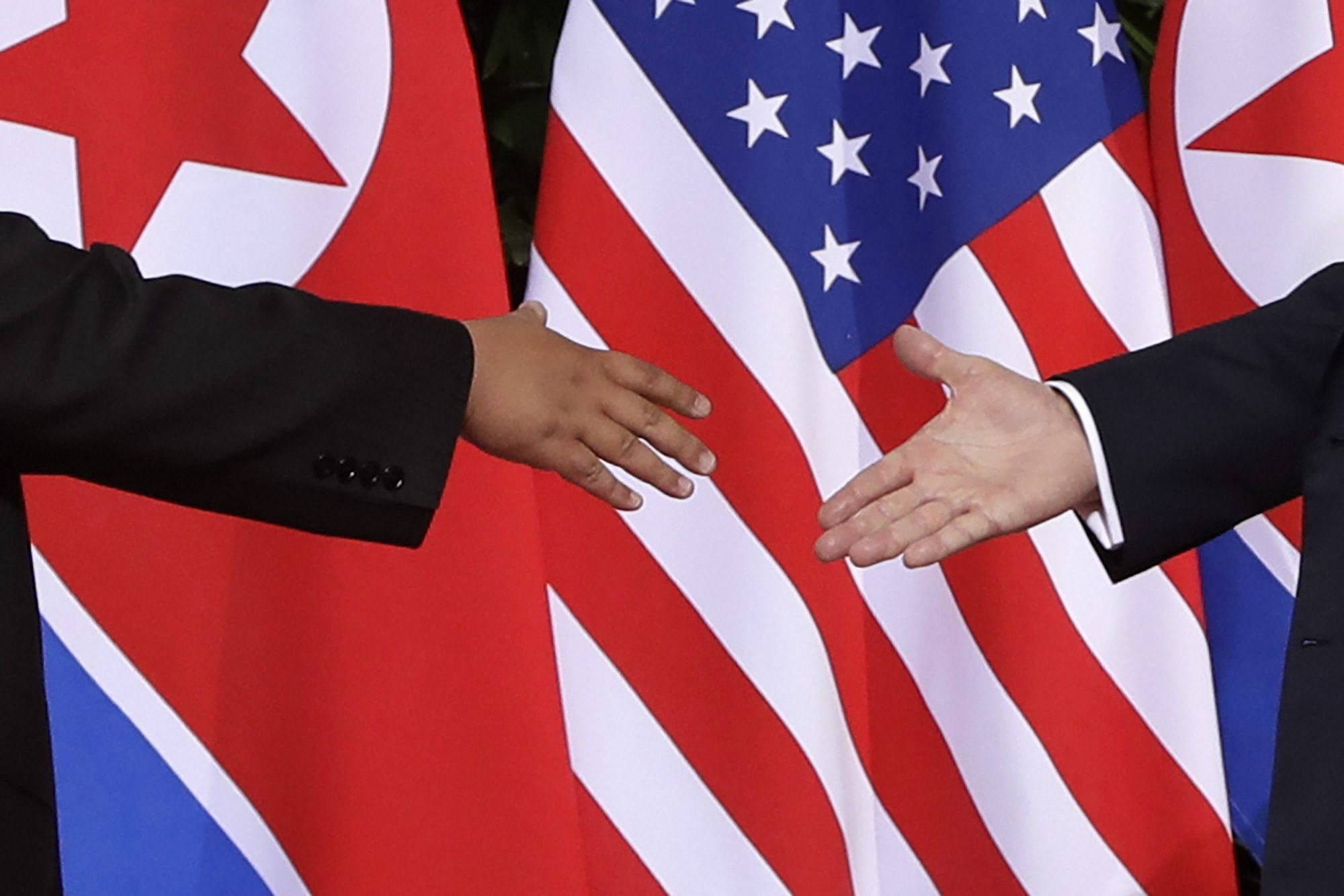
There was quite a contrast in Trump's high praise for Kim on a personal level ("very talented," "great personality and very smart," and so on) to Kim's language. The most Trump got from him was a thank you for the summit happening. It's probably reflective of cultural differences, but it also struck me as another sign of Kim being a little low key through the whole thing. Trump had to ask him several times if he had anything to add, and it was Trump who reached out each time to shake hands.
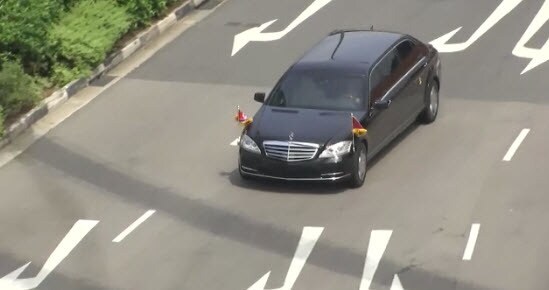
Kim's motorcade is now arriving back at the St. Regis, our reporter on the ground there, Sharon Cho, reports.
Also interesting to contemplate what Trump is envisioning when he says he'll meet "many times" with Kim in the future. We know the president is extending an invite to come visit Washington. But would he consider a similar trip to Pyongyang? Another possibility is a trilateral summit with South Korea on July 27 to mark the anniversary of the Korean War armistice signed on that day in 1953, according to South Korea’s Chosun Ilbo newspaper.
The substance of the agreement is especially important because Trump has delivered Kim a major propaganda victory. Not only was Kim recognized as an equal on the world stage, worthy of a lavish summit and elaborate ceremony with top officials from the United States, but the president went out of his way to praise his intellect, empathy, and love of country. That's a major win for a brutal dictator who has long struggled to gain a foothold on the international stage, and the big question is what the U.S. president got in return.
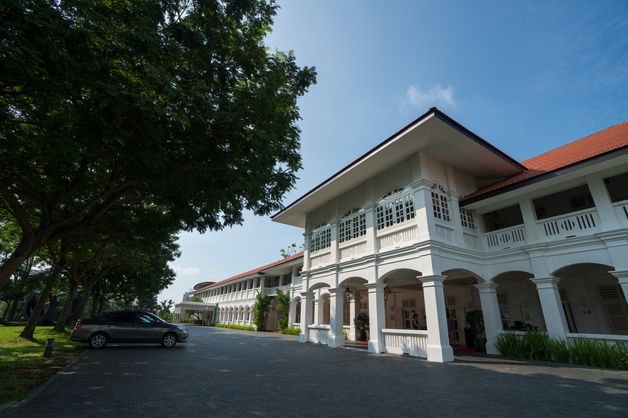
North Korea's Kim Jong Un left Capella Hotel
Trump's comment that Kim "loves his country" reminds of how he's read other leaders that might not have had as welcoming a reception from another U.S. president. We've heard former Trump adviser Steve Bannon talk in depth about the president's affection for President Xi Jinping, for instance, because of how Trump sees Xi look out for his own.
The perception of Kim making North Korea great again, of course, is at odds with the prevailing tone of the long-time U.S. take on what goes on inside the Hermit Kingdom.
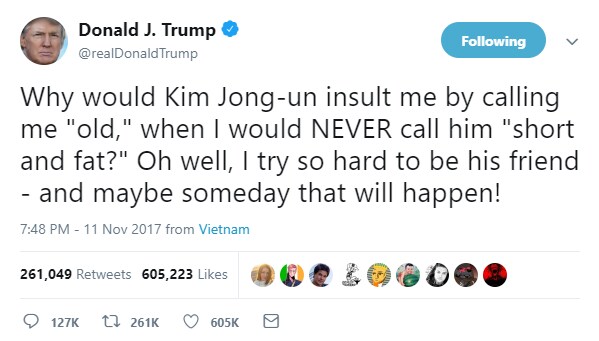
It's worth taking a step back and noting how far and how quickly this relationship has turned. Less than a year ago, Trump mocked Kim in a speech to the United Nations as "Little Rocket Man" and poked fun at his weight and height on Twitter. Today, he fawned over the North Korean leader as "a very talented man" who "loves his country very much." The question now is if that major rhetorical shift has resulted in substantive policy change.
For those looking for reasons to be skeptical, I bring your attention to the president's answer to a shouted question about whether North Korea had agreed to denuclearization. Trump said the sides were "starting that process very quickly" - which could be interpreted either way.
While the market reaction is essentially zero at this point -- the yen is practically unchanged since the document signing -- the deal to keep on talking arguably removes a layer of geopolitical risk from global assets. Now investors can go back to worrying about Fed and ECB tightening, along with trade wars.
That slightly tentative look returned to Kim's face as they stood up and a reporter lobbed a question. He probably really isn't used to this kind of situation.
The Kospi index has dropped back into slightly negative territory, with 12 minutes of trading remaining.
Trump Says Relationship With North Korea to Be Very Different
Trump says he and Kim developed “very special bond”.
Next up is Trump's briefing, which he said just now been brought forward to 2.30 p.m. Singapore time. Though he also said "in about two hours." We're hoping to get a peek at the document before he speaks. The truth of today will be in the nuts and bolts of the document.
Biggest news so far is probably that Trump will "absolutely" invite Kim Jong Un to the White House. That would be arguably even more historic than meeting here in Singapore. It seems that they have established something like the Cold War era Reagan-Gorbachev type of relationship -- to keep on talking, keep on making incremental agreements.
Trump is raising expectations here, saying the meeting went "far better" than anyone could have expected and noting news reports skeptical these talks would garner real progress. Trump said last week that a sign the talks had gone well would be the extension of an invitation to Kim to visit Washington - which Trump offered at the tail end of his remarks. Still, it's hard without seeing the document itself to tell how hyperbolic the excitement expressed by the U.S. president was.
Of course we still have no idea what is actually in the documents they just signed...
More handshakes, a smile from Kim and a pat on the back from Trump. Applause in the room. Trump says "our whole relationship with North Korea and the North Korean penisinula is going to be a very different situation than it has been in the past." He speaks of a "special bond" and thanks Kim for his goodwill and work. "It's an honor to be with you."
Kim flashed a very bright smile when Trump faced him and said thanks.
Trump Said It Worked Out Far Better Than Anyone Expected
Trump Thanks Kim, Says It's `Fantastic'
Reporters asking questions of Trump and whether the statement is a deal is to secure denuclearization: "we're starting that process quickly, very very quickly," Trump says. Then says reporters need to wait "a little while" for further details.
Trump notably demurs when reporters ask if he brought up Otto Warmbier, the University of Virginia student who nearly one year ago was brought back to the United States from North Korea in a coma.
Trump's comment - that this is a "comprehensive document" - is the yardstick by which this will be measured. Diplomats, investors, and just about everyone else worldwide will be interested in how significant the leaders' agreement is. Kim has pledged that this will usher in "major change," and Trump says it begins the process of denuclearization "very quickly"
Trump invites Kim to say something in response. Kim pauses before speaking. He calls it a "historic meeting" where they "decided to leave the past behind." He adds (through the translator) "the world will see a major change." And he thanks Trump for making the meeting happen. They shake hands and sign.
“At this historic meeting today we have decided to leave the past behind and sign this historic document. The world will see a major change.”
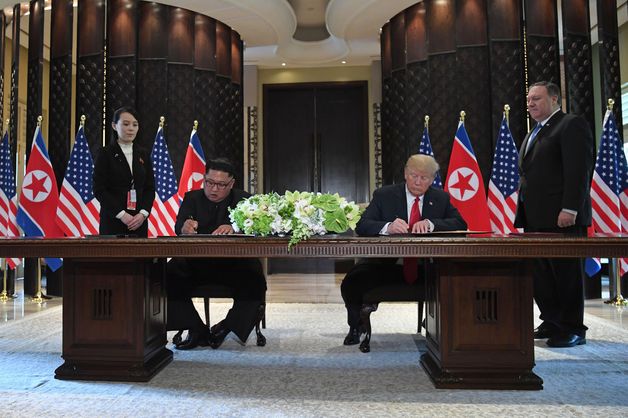
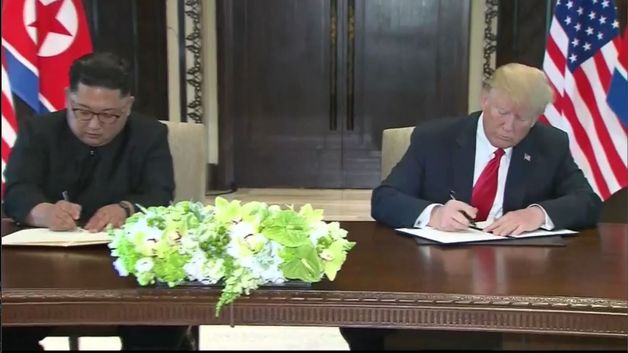
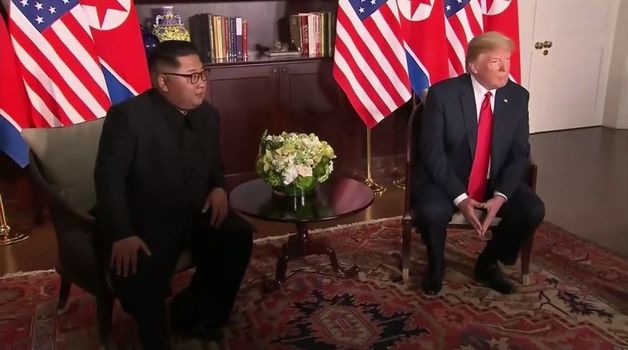
They sit down. Trump says "we are signing a very important document, a pretty comprehensive document and we've had a really great term together, a great relationship." Translator is telling Kim what Trump said. Kim is nodding.
Trump says it's pretty comprehensive document.
Trump: We’re signing a very important document.
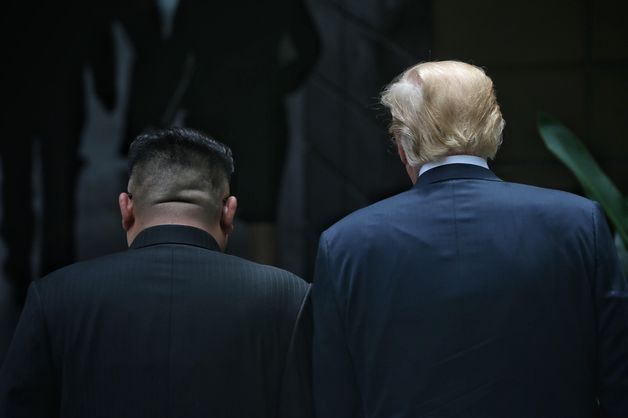
Trump and Kim are here, walk in side by side.
As we wait on the leaders, hundreds of journalists (just a portion of the thousands of reporters in Singapore to cover the summit) are loading into buses to head over for Trump's post-meeting news conference, tentatively slated for 2.5 hours from now.
Heading into the event:
The room has been brought to relative order, officials have cleared out of the way, and we are waiting for the doors to open and the leaders to walk in. We seem to be getting close.
White House aide Stephen Miller, who has been absent thus far from the meetings, has joined the festivities, according to Jennifer Jacobs. Miller's portfolio is largely focused on domestic issues - including immigration - but he's a top speechwriter for Trump, and was reportedly a key writer on Trump's address last year to the South Korean parliament in which the U.S. president detailed North Korean atrocities in graphic terms.
A North Korean official just walked over to the desk, picked up a black pen (for Kim?), inspected it with white gloves and carefully wiped it with a cloth. Several times. The pen has Donald Trump's signature on it in gold.
An agreement to keep on talking is probably the least-impactful result from a market standpoint.
U.S. media have been ushered into a room with a table and two chairs. White House chief of staff John Kelly and national security adviser John Bolton are among those in the room. No word yet what this event will be, but could be the "signing" that Trump referred to earlier.
“While the recent improvement in ties between the U.S. and North Korea has helped to reduce one of the major tail risks facing the region, a major breakthrough’’ at the summit is “unlikely.’’
Chang spoke in an interview yesterday with Bloomberg TV's Yvonne Man. Bloomberg terminal subscribers can see it by clicking the image below; to see it on the web, click here.
Even the Black Panther Has a View for the Trump-Kim Summit
This strange episode is classic Trump: the president has built up reality-show suspense for the unveiling of this still-to-be-explained agreement, right after this commercial break. It remains tough to read the waters here. On the one hand, the president was effusive, praising their progress as "really very positive" and calling the meeting "fantastic."
On the other, it's possible this document does little beyond pledge to continue working together on tough-to-solve issues. We'll see if the next session provides clarity - and if separate meetings between the two leaders and their aides slows any of the momentum claimed by Trump.
Weird scene - after a few minutes of chatting, the two leaders appeared to split off in separate directions. Still no indication of when or where the unexplained signing ceremony will occur.
Trump won't say what they are signing, but that it will be "top of the line."
Trump says the leaders are "going for a signing" and they'd announce what they're signing in a "couple of minutes." The meeting was "really fantastic" and made "a lot of progress," Trump says.
More conversation. The leaders are huddled next to a door with aides and translators, discussing something (possibly what the arrangements are to sign whatever they are planning on signing). Just spotted Trump's ultra-hawkish national security adviser John Bolton being in the thick of it, addressing Kim directly.
Trump briefly showed Kim his limo -- known as "The Beast," which travels with him. He opened the door and Kim had a peek inside.
We've seen this throughout from the body language: Trump being the more chatty, with Kim mostly listening and offering more smiles. Seems to be a smart play for Kim if he's trying to please Trump, who cannot stand to be upstaged.
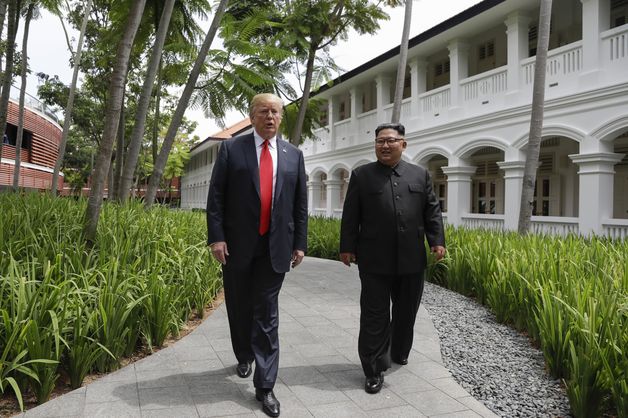
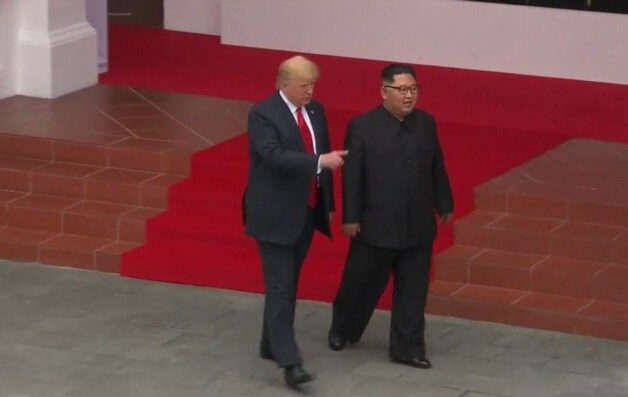
Kim and Trump are back out from lunch and walking through the courtyard of the hotel.
South Korea's KBS TV is reporting that lunch is over and the two leaders are taking a stroll in the Capella.
The video we were provided was via the Singapore government camera allowed into the lunch. There was also an official White House photographer - but no members of the U.S. media - in attendance. There have been grumblings throughout the media that the White House didn't secure the customary full access for the American press. As with everything at today's summit, the press access has been carefully negotiated for weeks.
Trump and Kim have seats opposite each other at lunch. Trump gestured to Kim across the table with his hands out as if to say "after you," to sit down. Trump also said a few words as people waited to sit down; it was hard to make it out, but we heard him telling the photographers to make sure to get a picture where everyone looked "nice and handsome."
Press access has been more limited than usual today, and the lunch was no exception. The White House pool wasn't invited in for the top of the lunch meeting. From the brief video, Trump talks to the photographers in the room, joking he wants a "beautiful picture" so he could look "handsome."
And lunch has started. We saw footage of Trump and Kim standing in front of chairs at a long table. It's unclear though when it actually began.
Yonhap, the South Korean news agency, is reporting that the lunch has started, but it's really not clear at this point. Trying to establish more details. Certainly if the meeting is going, it's run over by about 10 minutes.
Another potential implication is if these talks result in North Korea releasing people Japan says were abducted from its shores over the decades. It's an emotive issue in Japan, and Prime Minister Abe has repeatedly pressed Trump to push on this. A release of abducted Japanese could help Abe, who's been struggling in the polls. He faces a leadership contest in the ruling party in September.
We're all Googling "Oiseon," which is a Korean stuffed cucumber and is on the menu for lunch. The vegetables are filled with meat (according to Wiki, chicken or beef, plus onion and seasoning) and then steamed. Hopefully not a dish that goes soggy -- we're already a few minutes into overtime for the group meeting to end and the lunch to start.
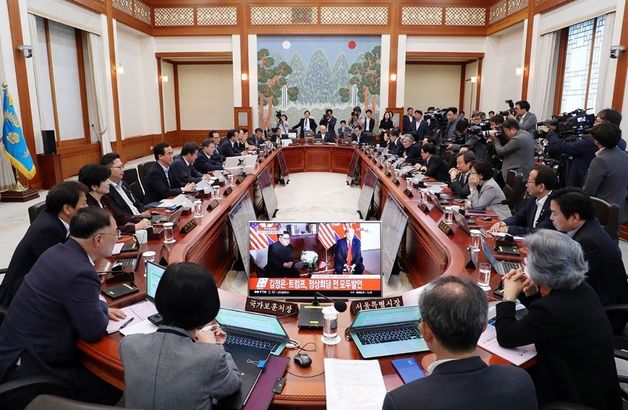
South Korean cabinet members watched the Kim-Trump summit live on TV ahead of the regular cabinet meeting this morning in Seoul, according to the presidential office website. President Moon said he had a sleepless night yesterday, and the unification minister said he doesn't have any projections for summit results but is just ``praying''. Another presidential secretary said attention to tomorrow's local election seems to have fallen because of the summit.
It probably changes his approval ratings in the U.S. I’d imagine. That might be important for the mid-term elections in November.
The menu may demonstrate that while the summit is a historic moment bringing together the leaders of North Korea and the U.S., some big differences (including culinary ones) remain. Trump is a notoriously picky eater, and is likely to stick to the Americanized dishes on the menu, like the shrimp cocktail, beef short ribs, Haagen Dazs ice cream, and chocolate tart. But the offerings for the main courses include Chinese and Korean options as well. If reporters catch Trump snacking on the green mango kerabu with fresh octopus, a breakthrough may be closer than any of us expected!
The working lunch will open up to additional top aides.
On the U.S. side, that means Press Secretary Sarah Sanders, U.S. Ambassador to the Philippines Sung Kim (who we've talked about already), and Matt Pottinger, the National Security Council adviser for Asian Affairs, will join the existing group to dine with the North Koreans.
The North Korean delegation will now add No Kwang Chol, Minister of People’s Armed Forces, Choe Son Hui, Vice-Minister of Foreign Affairs, Han Kwang Sang, Director, Central Committee of Workers’ Party of Korea, as well as Kim Jong Un's sister, Kim Yo Jong.
We've got the lunch menu! Here's what the two leaders will be dining on when they transition from their current meeting to the next session (looks pretty good!):
Starters
Main course
Desserts
North Korea has vast mineral reserves, maybe worth $6 trillion, according to a 2013 estimate by the North Korea Resources Institute in Seoul. It’s also home to what might be the world’s single-biggest rare earth deposit, a crucial element for electronic car engines and many high-tech gadgets the South is so good at churning out.
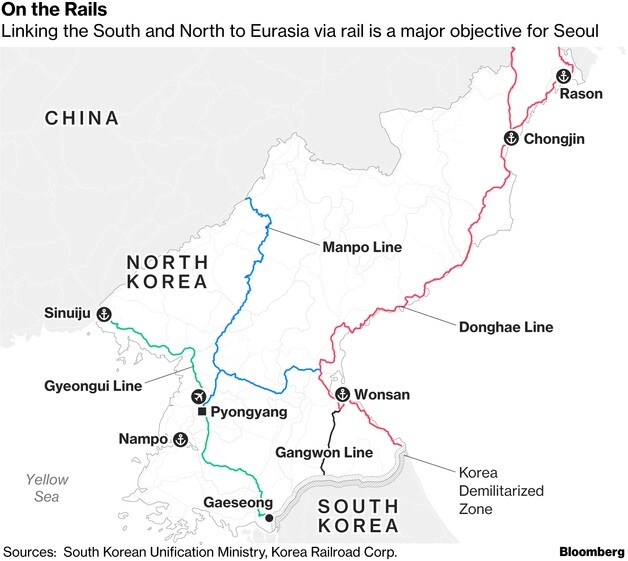
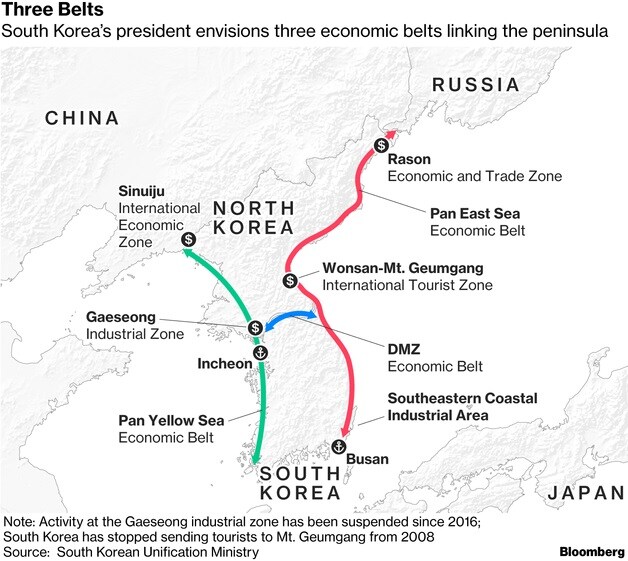
Reopening rail links and roads could help the North make use of those assets -- it could also use its minerals as collateral to get funding to develop its economy, according to Lee Yoon-sok, a researcher at the Korea Institute of Finance in Seoul.
I feel the way I did as I paced in front of the delivery room the day my daughter was born.It doesn’t matter whether you’re a boy or a girl.I just hope you’ll give a big healthy cry as you come into the world.
A minor amendment to the sci-fi quote from earlier, via our poolers. The translator, interpreting for Trump as Kim spoke, said, "Many people in the world will think of this as a (inaudible) form of fantasy … from a science fiction movie."
“The road toward the goal of a nuclear-free peninsula and realizing regional peace and prosperity is bound to be a bumpy one that requires patience and wisdom.’’
Some comment crossing from China's state news agency Xinhua:
Let's see if there is more to come - China's influence looms over this summit, albeit there are no direct representatives here.
Former South Korean foreign minister Yoon Young-kwan's take on the summit so far is the body language was friendly, though the hard conversation hadn't yet started on CVID (complete, verifiable, irreversible denuclearization).
Yoon tells Bloomberg TV a "great" result would be: Roadmap and timetable for CVID by 2020, economic aid and security guarantee for North Korea, and a declaration of an end to the Korean war.
But as we've noted in prior posts, all of that from a meeting of a few hours after decades of distrust and war threats is a very tall order indeed.
Two big takeaways from this second meeting:
Trump to Kim: I look forward to working on it with you
Kim says "I believe this is a good prelude for peace." Trump responds: "I do, too." Looking Kim right in the eye, he says "we will solve it, we will be successful." So the first meeting seems to have gone ok at least, and they are pushing on with the more detailed conversation now.
Trump says ''it will be done'' before thanking Kim and the attending press, motioning for the latter to exit.
N. Korea Kim: I believe this is good prelude for peace
Working together, we will solve big dilemaDonald Trump, President, U.S.
After that brief stroll they are sitting down for the expanded meeting. Trump reaches across the table to shake Kim's hand yet again. Very hard to hear what his comments but Trump talked about "working together" to get a deal.
More smiles from Kim than Trump in balcony appearance.
Trump and Kim headed for a short walk (to clear the air? Clear their heads?) before the expanded meeting with other officials. Mind you, it's a pretty muggy day to be walking around in suits.
Trump and Kim are walking down the colonnade of the hotel. Trump briefly addresses reporters and says the pair have an "excellent" relationship as they walk down the balcony.
Top Twitter trends in South Korea as of 9:30 a.m. Singapore time:
Trump Upends G-7 With Eruption at Trudeau Comments
If a deal on denuclearization is clinched, then trade could be next on the agenda. Did you know that North Korea is among the very few places on Earth where you can't get Coca-Cola?
Also, the U.S. exported $3,000 worth of `recorded media' to North Korea last year, U.S. International Trade Data show. That may fall within the purview of `information material' that's among the items exempted from trade sanctions, according to the Department of the Treasury's Nov. 2016 update on North Korea sanctions program.
South Korean stocks ARE in the green, but the Kospi index's 0.3 percent climb is in line with gains in the rest of Asia.
The MSCI Asia Pacific Index is up 0.1 percent right now, the Hang Seng has opened up by about the same, and Japan's Topix index is gaining 0.4 percent.
It's important to remember as we watch the theatrics play out that real lives are impacted by these events, especially in North Korea and China's border regions with the country.
I recently visited Dandong, the main crossing point into China from North Korea. Optimism was brewing there despite Donald Trump's on again, off again attitude in the run up to this summit.
Video clips of a meeting between Chinese President Xi Jinping and Kim are being broadcast on a continuous loop on a giant screen on the banks of the Yalu River -- and real estate agents are playing the same video to prospective clients.
The city's economy has taken a hit since China agreed to enforce harsher UN sanctions against North Korea last year. But in recent weeks house prices have surged on the expectation that North Korea might finally open up.
Residents on the border say sanctions are still being upheld, but they're hopeful change could be coming soon.
“It was not an easy journey to come to this point. We’ve had the past that stopped from advancing and wrong behaviours and practices sometimes hid our eyes and ears, but we’ve overcome those and eventually come to this point.”
President Donald Trump and Kim Jong Un took a historic first step toward ending decades of enmity between the U.S. and North Korea, here is a CATCHUP of today's summit so far:
For Kim that was a fairly novel moment. He's used to all media being very stage managed. Recall the poor North Korean photographer who got in the way of Kim's wife in a hallway during the South Korean summit; he was roughly shoved aside by his dear leader with a look of terror on his face.
Now, for the first time we know of, Kim took a shouted question from a reporter. Trump perhaps acknowledged to Kim how surreal it must be for him, saying as the media filed in: "They never stop."
It's quite a breathtaking moment to see the two leaders together. It is quite a different scene from a year ago, when a full-blown conflict seemed nearer than ever as North Korea continued to test missiles, prompting Trump to make his “fire and fury'' threats.
Kim also says "we have been fettered by the past,'' hinting at the history of mistrust between North Korea and the U.S. after the Korean War, which ended in a ceasefire.
Kim Jong Un says the summit is taking place because “everything has been overcome'' and that "ears and eyes'' have been shut until now by what he describes as wrong practices.
So stepping back a little now that the initial, and historic, talks are underway: early signs were positive. Both leaders were warm in their initial greetings, and signaled a readiness to have a dialogue. While odds of a sweeping agreement to denuclarize the Korean peninsula remain long, it does appear the leaders will at the very least hear one another out. We'll know more based on how long this meeting - scheduled for 45 minutes - lasts.
A reminder -- Trump has said several times he will know "within minutes" if Kim is serious about the talks, and about giving up his nuclear arsenal. So let's see how long they stay in the room together!
Funny how this compares to a typical Oval Office photo spray. Understandably given the first meeting and uncertainty of the outcome, the two leaders' eyes were focused on darting through the crowd rather than further glances at each other.
At the beginning of the meeting, Trump poked fun at reporters hurrying in to capture the beginning of the summit. That's a favorite move of the president's in almost any setting. Interestingly, former President Barack Obama pulled the same move when meeting Trump in the Oval Office for the first time.
Trump opens the remarks, saying "I think we're going to have a great discussion." Kim replies through a translator, saying there are many obstacles that have been overcome to get to this point. Trump replies, "that's true," leans over and shakes hands again.
Kim says, we're here today after overcoming many obstacles.
The bigger bets were on a more stern, stoic expression from Trump, which was not the case. We've talked about how the sternness would have signaled a need not to give too much away to the North Korean leader at the start.
Somewhat surprising that Trump had a much more serious demeanor when he was welcomed by host Singapore Prime Minister Lee Hsien Loong yesterday. (And his official portrait has the same feel to it.)
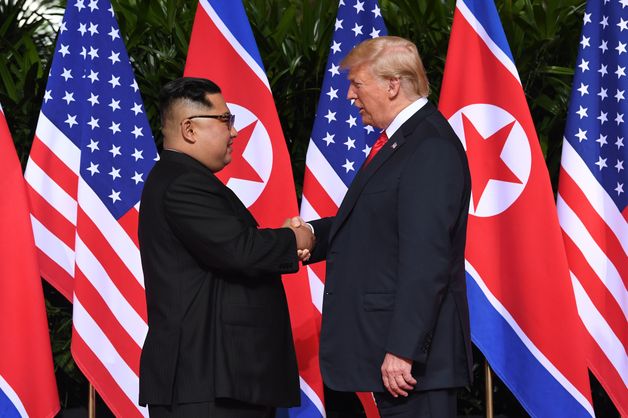
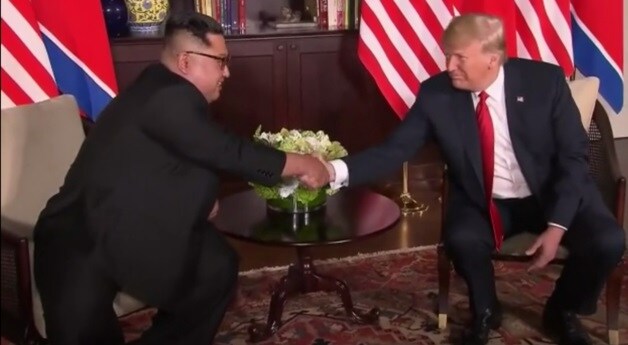
There was a brief exchange on the balcony as they walked off, and a flash of smile from both of them. There was silence during the handshake other than the click of cameras and one shouted (and unanswered) question -- what do you hope to accomplish, sir?
Noting that Trump did not offer a wide smile, though was gracious toward Kim - touching the world leader on the shoulder, pointing him toward the exit from the stage. The two leaders then went to chat briefly on the side of the stage, where they shook hands again - and had a translator to interpret.
Interesting that Trump seemed to be saying a lot to Kim, who usually needs the aid of a translator (who was not at his side for the handshake).
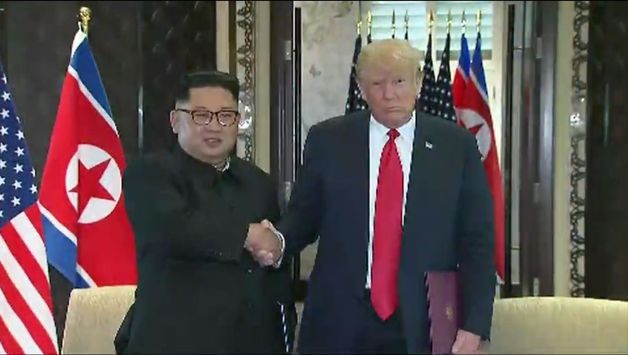
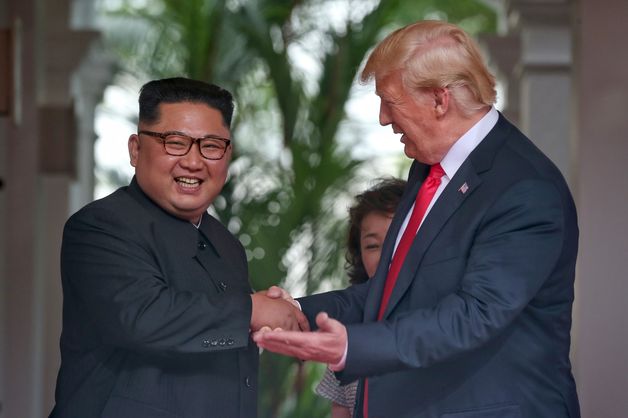
Well that was about 15 seconds all up: After a few sober seconds of handshaking, they stood next to each other, unsmiling, for photos, before Trump nudged Kim on the arm and they walked off together to their meeting room.
Kim's smile was wiped away as soon as the two turned toward the cameras.
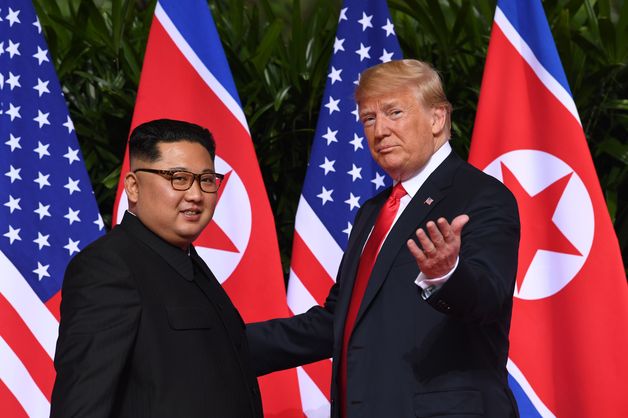
Trump put his left hand on shoulder of Kim, who was slightly smiling.
Trump, Kim Express Optimism on Path to Peace as Summit Kicks Off
More broadly, markets are having a lazy start to Tuesday trade in Asia, with U.S. index futures little changed, Japanese stocks up -- just -- and the dollar on top when it comes to currencies. Will the historic handshake be enough to shake that reverie?
The classic barometer of risk, Japan's yen, is near a three-week low right now.
Traders in Seoul's financial markets remain calm, waiting to see what this epoch-making meeting can produce. The Korean won is down 0.2%/USD largely in line with other regional currencies that retreated as the dollar strengthens. The Kospi's steady amid dwindling trading volume, while local bonds edged up.
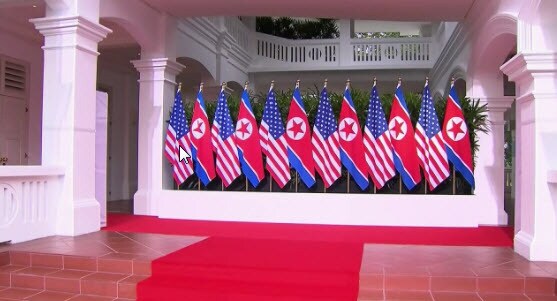
Now Trump is getting out of his car and walking in. No smile either. Both of them are sending the message that they mean business. The backdrop for the "handshake" moment is a dozen flags, a mix of the U.S. and North Korea.
Kim Jong Un walks into the hotel carrying a file tucked under his left arm and a pair of glasses in his right hand. His sister, Kim Yo Jong, had walked in moments earlier with a group of other high-ranking North Korean officials. Choe Son Hui, a North Korean vice foreign minister whose blustery comment caused Trump to cancel the summit temporarily last month, followed Kim into the hotel.
Here is a quick CATCHUP as we wait for Trump and Kim to kick off the historic summit.
A serious-looking Kim steps out onto the carpet to walk into the Capella Hotel, accompanied by a bunch of officials and generals. Even if he has had a win just by securing the meeting with Trump, today is still a big day for the young leader.
Odd to see the North Korea flag side-by-side with the U.S. flag.
It's been strange for me as a South Korean throughout this summit preparation to see the playful ways Singaporean establishments have been jumping onto the summit bandwagon. It's jarring and unfamiliar to me to see the North Korean flag jauntily adorning hamburgers and cocktails. It is still illegal in South Korea to display that flag except under very limited circumstances.
Even at the Pyeongchang Winter Olympics this February where the two Koreas sometimes competed as a unified team, individuals were barred from bringing North Korean flags into the venues, according to Yonhap News.
In addition to having a lot at stake, China has to contend with the volatile personalities on display here and what that might mean for its interests in Asia.
I spoke yesterday with Paul Haenle, a former China director on the U.S. National Security Council who now heads the Carnegie-Tsinghua Center in Beijing. He told me that the Chinese "recognize that when you have an unconventional president like Trump who is unpredictable there is a chance that a dramatic improvement in North Korea's relations with the U.S. could take place which would undermine China's influence."
Ultimately, China would rather see the summit fail than see its interests threatened, Haenle said. President Xi and his colleagues are no doubt watching nervously.
Here are some of the things that could be on the table at the meeting, and what might come of the talks:
1) A declaration of an end to the Korean War (which is still technically a truce) -- still, it might be odd to declare the war over in Singapore, and it needs China and South Korea to sign off. So there might be a broad statement on the desire to bring a formal end to the war, with a formal ceremony in the future, perhaps at the DMZ.
2) A security guarantee for Kim -- North Korea has long sought this from the U.S. in order to talk about its nuclear weapons. Trump has indicated he’s willing to look at it. But even a written guarantee may not mean much in the end. Just look at what happened in Libya, and Trump’s decision to rip up the Iran nuclear accord.
3) The U.S. military presence in North Asia -- Kim has indicated he wants the U.S. to pull back troops from South Korea (it also has soldiers in Japan). But the U.S. has said it has no plans to do so, and such a move would certainly worry Seoul. The U.S. also has missile defense systems installed in South Korea.
4) Economic aid -- Kim will likely press for an easing of sanctions in response to the goodwill he’s shown so far. It’s a bit up in the air what Trump may promise on this front given he’s eased off his “maximum pressure” maxim. Still, other senior U.S. officials have said that to get sanctions relief, North Korea has to show moves towards denuclearization.
5) Inspections -- the U.S. is pressing for a specific timetable from the North Koreans, including allowing inspectors in to look at its arsenal. Expect North Korea to kick that one into the long grass, perhaps suggesting it is something to be decided at future talks.
6) More talks -- one positive sign from the summit would simply be an agreement to keep talking. Both North Korea and the U.S. have signaled that as a possibility.
North Korea Set to Mothball Nuclear Site, Suspend Missile Tests
The stakes are high for Kim, though for Trump they are arguably even higher. Kim gets a win just by showing up – the prestige and recognition on the international stage he has long craved. Trump needs to come away with some sort of progress plan or deal on North Korea’s nuclear weapons to claim a victory. While Kim may promise big, we’ll go through the nuts and bolts on what he actually agrees to do.
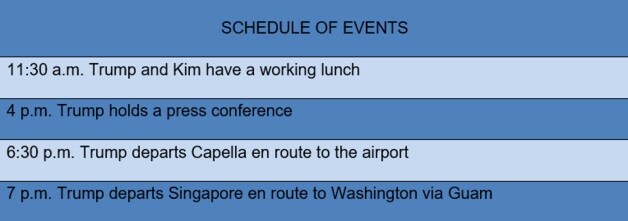
Here's the run-of-show released by the White House for today's festivities. Officials have warned us that this schedule could prove fluid, depending on how events transpire, but this is the preliminary plan in Singapore time (which is exactly 12 hours ahead of DC/NYC, so just flip the am and pm for the conversion):
Essential Business Intelligence, Continuous LIVE TV, Sharp Market Insights, Practical Personal Finance Advice and Latest Stories — On NDTV Profit.