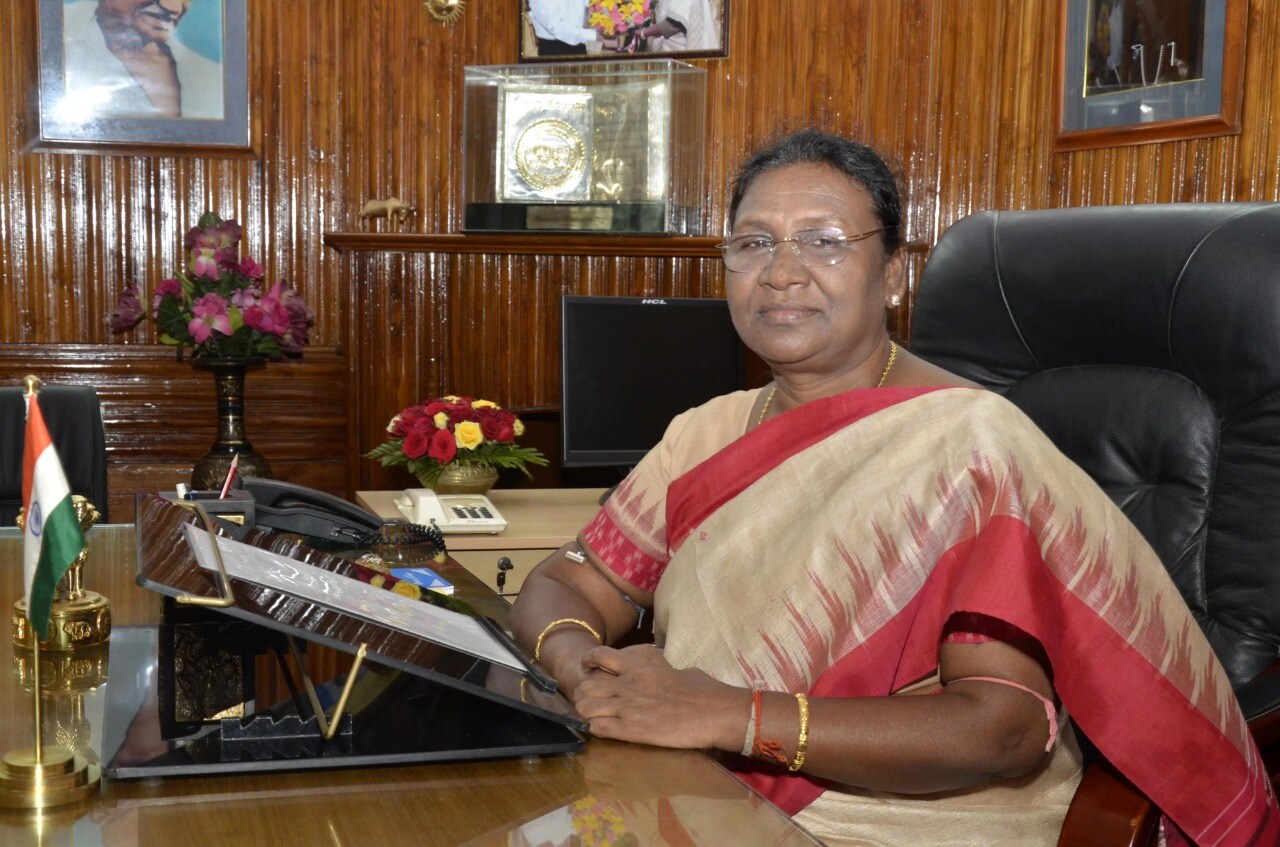
→ The July election for president of India is a formality as NDA candidate Droupadi Murmu is a clear favourite.
After a high-pitched battle in the recently concluded Rajya Sabha elections where the Bharatiya Janata Party sprung a surprise and outwitted the opposition, the electoral battle shifts to the presidential polls that will be held on July 18.
The National Democratic Alliance has announced former Jharkhand Governor Droupadi Murmu as its candidate, looking to elect the first tribal and second woman as president of India. A 13-party section of the opposition led by the Indian National Congress, Left parties, as well as the Trinamool Congress, Dravida Munnetra Kazhagam, and Samajwadi Party, have chosen former union minister and ex-BJP leader Yashwant Sinha to take on Murmu.
The Election Process
In India, a president is elected indirectly by members of state legislative assemblies and members of the Rajya Sabha and the Lok Sabha. In this 2022 round, the electoral college comprises of 543 Lok Sabha MPs, 233 Rajya Sabha MPs (excluding the nominated members), and 4,033 MLAs across the country.
The total value of votes of MPs for this election is pegged at 5,43,200 and that of MLAs at 5,43,231, taking the total electoral college votes to 10,86,431. 50% of votes are accounted for by the union (Lok Sabha and Rajya Sabha MPs) and 50% by the states (MLAs) to ensure fair representation.
A candidate requires a simple majority to win these elections, which is 50% of votes polled plus one vote. Party whips are not enforced and electors can vote according to their conscience. So, there is scope for cross-voting.
Bypolls are scheduled on June 23 for three Lok Sabha seats (2 in Uttar Pradesh and one in Punjab) and seven Vidhan Sabha seats (four in Tripura, one each in Jharkhand, Andhra Pradesh, and Delhi). All three Lok Sabha seats were held by anti-BJP parties: SP and AAP. Of the seven Vidhan Saba seats, three were held by BJP, three by anti-BJP parties (CPI(M), AAP and JVM), and 1 by a pro-BJP regional party (YSRCP).
Six Rajya Sabha seats are vacant: four from Jammu & Kashmir as the assembly there has been kept in abeyance, and one each in Karnataka and Maharashtra. Six Vidhan Sabha seats are vacant in state assemblies, four in Gujarat and one each in Maharashtra and West Bengal.
The Baseline Numbers
While the BJP-led NDA has a large majority in the Lok Sabha, in the Rajya Sabha it doesn't have a simple majority. Out of 30 states and union territories that have a chief minister, NDA has governments in 18 states, the Congress-led UPA in five states and seemingly non-aligned regional parties in the seven states of West Bengal, Kerala, Telangana, Andhra, Odisha, Punjab, and Delhi.
Most of the non-aligned regional parties heading governments in these states are anti-BJP like Mamata Banerjee's Trinamool Congress K Chandrashekar Rao's Telangana Rashtra Samithi, Arvind Kejriwal's Aam Aadmi Party, and the Left Front led by the Communist Party of India (Marxist).
Naveen Patnaik's Biju Janata Dal and Jagan Mohan Reddy's YSR Congress have helped the BJP pass important legislation in the Rajya Sabha where the NDA lacked a majority on its own.
In terms of strength, the 108 NDA MPs account for 46.4% of the Rajya Sabha (excluding nominated members) and its 335 Lok Sabha MPs form 61.7% of the lower house. 1,771 NDA MLAs across the country are 43.9% of the state assemblies' strength. Meanwhile, 55 UPA Rajya Sabha MPs are 23.6% of the upper house, and its 90 Lok Sabha MPs being 16.6% of that house. Their 1,122 MLAs represent 27.8% of the state assemblies strength.
Unlike the BJP's clear advantage in the Lok Sabha, in the Rajya Sabha as well as state assemblies the consolidated strength of the UPA plus other anti-BJP parties is either equal to or higher than the BJP's strength.
In terms of vote share, NDA stands at 49.1%, marginally short of magic figure, UPA plus anti-BJP parties at 43.5% and pro-BJP parties at 7.2%.
Taking The NDA Candidate Over The Line
The Biju Janata Dal has 21 MPs and 114 MLAs with 31,686 votes or 2.9% vote share. Draupadi Murmu's roots in Odisha make it easy for Naveen Patnaik's party to back her.
Congratulations Smt #DraupadiMurmu on being announced as candidate of NDA for the country's highest office. I was delighted when Hon'ble PM @narendramodi ji discussed this with me. It is indeed a proud moment for people of #Odisha.
The YSRCP has 31 MPs and 150 MLAs with 45,550 votes or 4.2% vote share. Andhra Pradesh Chief Minister Jagan Reddy espouses the cause of Dalits and tribals, so is seen favourable to Murmu's candidacy.
Together, these two would boost Murmu's vote share to 56.2%.Hearty Congratulations to Smt Draupadi Murmu Ji on being nominated as a candidate for the Presidential Election by NDA. Hon'ble PM Sri @NarendraModi Ji rightly said that you will be a great President of our nation. Our best wishes to you, Madam. pic.twitter.com/D06u2QB8Aw
At The Margins
Tensions have emerged again between off-and-on allies JD(U) and BJP in Bihar. If the maverick JD(U) chief Nitish Kumar decides to not back the NDA candidate and throws his weight behind his erstwhile Janata Dal colleague and Bihar compatriot Yashwant Sinha instead, NDA's vote share reduces to 46.9%, but the BJD and YSRCP would still carry it over the majority mark to 54.0%.
Political developments in Maharashtra this week have added a fresh twist to the presidential election math. Rebel Shiv Sena MLAs could vote for the NDA candidate adding another 3,000-5,000 votes, 0.3%-0.5% vote share, offering the BJP a further buffer.
Parties like the Shiromani Akali Dal, Bahujan Samaj Party, Telugu Desam Party did not participate in opposition meetings, and could also abstain or back Murmu given her historic candidacy as the first tribal and only the second woman who would be president.
Other smaller parties and independents at the states level could also back the NDA candidate, along with some cross-voting by non-NDA MLAs, in a bandwagon effect of the side seeing carrying momentum into victory. In that scenario, the JD(U) votes alone would be enough to secure a majority for Murmu, even without the support of the BJD or YSRCP.
To sum up, the 49.1% vote share estimated for Murmu is a conservative number, and could increase by a few percentage points on account of:
Victory in bypolls
Support from Shiv Sena rebels
Parties like SAD, BSP, TDP
Some smaller non-NDA parties and independents
Scheduled Tribes MPs and MLAs across parties
Women MPs and MLAs across parties
Cross-voting within UPA and anti-BJP group MPs and MLAs
All this points to Droupadi Murmu comfortably ahead in what is largely a symbolic fight.
*NDA includes BJP, AIADMK, JD(U), SDF, RPI (A), AGP, PMK, TMC (Moopanar), NPP, MNF, UPPL, Independents.
*UPA includes INC, RJD, DMK, IUML, NCP, Shiv Sena, MDMK, JMM, Independents.
*Anti-BJP group includes AITC, AAP, TRS, SP, BSP, SAD, AIMIM, CPI (M), CPI, Kerala Congress (M), TDP, Independents.
*Pro-BJP group includes YSRCP, BJD, Chhattisgarh Congress (Jogi).
Amitabh Tiwari is a political commentator, strategist, and consultant advising political parties and leaders. He was a corporate and investment banker.
The views expressed here are those of the author and do not necessarily represent the views of BQ Prime or its editorial team.
Essential Business Intelligence, Continuous LIVE TV, Sharp Market Insights, Practical Personal Finance Advice and Latest Stories — On NDTV Profit.