Wrestling Federation of India President Brij Bhushan Sharan Singh, accused of sexual harassment by seven women wrestlers including a minor, has said, “It's evident since the beginning that their motive is politics, not (my) resignation.” The wrestlers' protest is certainly political but not in the way Singh seems to be implying.
The story of Indian sport has always been a two-pronged political story—fighting the patriarchy and escaping from abject poverty.
All sport is political—the feminine experience of it certainly so. Women have fought to take part, even dressing up as men. We have fought against slurs and entry barriers imposed by families, villages and countries, and then again, for good training conditions, equal pay and the right to be safe as we pursued our dreams. In addition to muscle, the Phogat sisters gained confidence and the ability to fight political battles in the mud pit that Mahavir Phogat dug to teach his young daughters and nieces to wrestle.

Some have been forced to take the lead such as Rachael Denhollander, the first survivor to speak up against U.S. gymnastics team doctor Larry Nassar who assaulted hundreds of minors; Serena Williams for improving rules around the protection of rankings of new mothers; and Duttee Chand for speaking up about her sexuality. Muhammad Ali gave up everything to take a position against the Vietnam War. Like Ali, the wrestlers have said they want to throw their medals into a river.
The recently announced equal pay for men and women in Indian cricket didn't happen in a vacuum. Nobody would have thought to make it happen if there wasn't a global conversation that began decades ago with Billie Jean King demanding equal prize money and players such as Venus Williams and Megan Rapinoe building on this history, inspiring women across the world. Just as African American athletes have been at the forefront of U.S. sports' political battles, caste battles continue to be waged on our sports fields.
Even the history of sport's most strait-laced global jamboree—the Olympics—is littered with political events. Like 1984, the year women first ran the marathon, an event that had been around since 1896. They were considered too weak to do so before.
It was only in 2012, with the addition of boxing, that women competed in all the sports on offer. That was also the year MC Mary Kom won a bronze medal. She may have lived that historic moment but Kom has completely avoided being part of this moment unfolding in India. Women's sport is about passing the baton of rights built with sweat and sacrifice, and Kom has failed her compatriots miserably. Additionally, while many prominent athletes have tweeted their support, I can't think of any sports star who has stood alongside the wrestlers at Jantar Mantar. I'm counting on Neeraj Chopra to change that.
I watched on as a bystander for many days, thinking this will end. But this image has killed me inside. These are India's daughters, who stood on podiums and waved our flag proudly, now being dragged on the floor with the same flag. #WrestlersProtest pic.twitter.com/Av2u2Y3sMd
You know the Jesse Owens story but the annals of Olympic history contain lots of women-centric political highlights too. Czech gymnast Vera Caslavska looked away as the Soviet flag was raised for another winner on the podium in 1968. She was protesting the Soviet invasion of her country that had forced her to train in the forest using potato sacks as weights and logs as beams. Australian Aboriginal athlete Cathy Freeman lit the torch in Sydney 2000; and in Tokyo 2021, shot putter Raven Saunders, black and gay, held her arms above her head to make an X that represented “the intersection of where all people who are oppressed meet”. Meet me at the X, she said later on Instagram.
View this post on InstagramIn recent times, it's only gotten more political. “In this latest movement of athletes fighting for justice, Colin Kaepernick was the first to step out on a ledge,” writes author Devin McCourty in Taking a Knee, Taking a Stand, which traces the tradition of African American dissent in sport.
When professional footballer Kaepernick kneeled during the national anthem in 2016, his country was startled. He announced he was not going to stand up “to show pride in a flag for a country that oppresses black people of colour”. It was a response to multiple police killings of unarmed black men. He didn't play in the National Football League after that.
Yet, something has changed. Across the world, sportspersons are finding it easier to speak up. A Barcelona-based football club unanimously voted to define themselves as “anti-fascist, anti-racist, anti-homophobic, anti-sexist, and anti-bullying”. Athletes and former athletes are speaking up for refugees; schoolchildren; and limb-difference people. 'I can't breathe' tees made it to NBA courts which now have a list of permitted social-justice messages. In 2020, Black Lives Matter was printed on the court for every game.
दरिया अब तेरी ख़ैर नहीं,
बूँदो ने बग़ावत कर ली है
नादां ना समझ रे बुज़दिल,
लहरों ने बग़ावत कर ली है,
हम परवाने हैं मौत समाँ,
मरने का किसको ख़ौफ़ यहाँ
रे तलवार तुझे झुकना होगा,
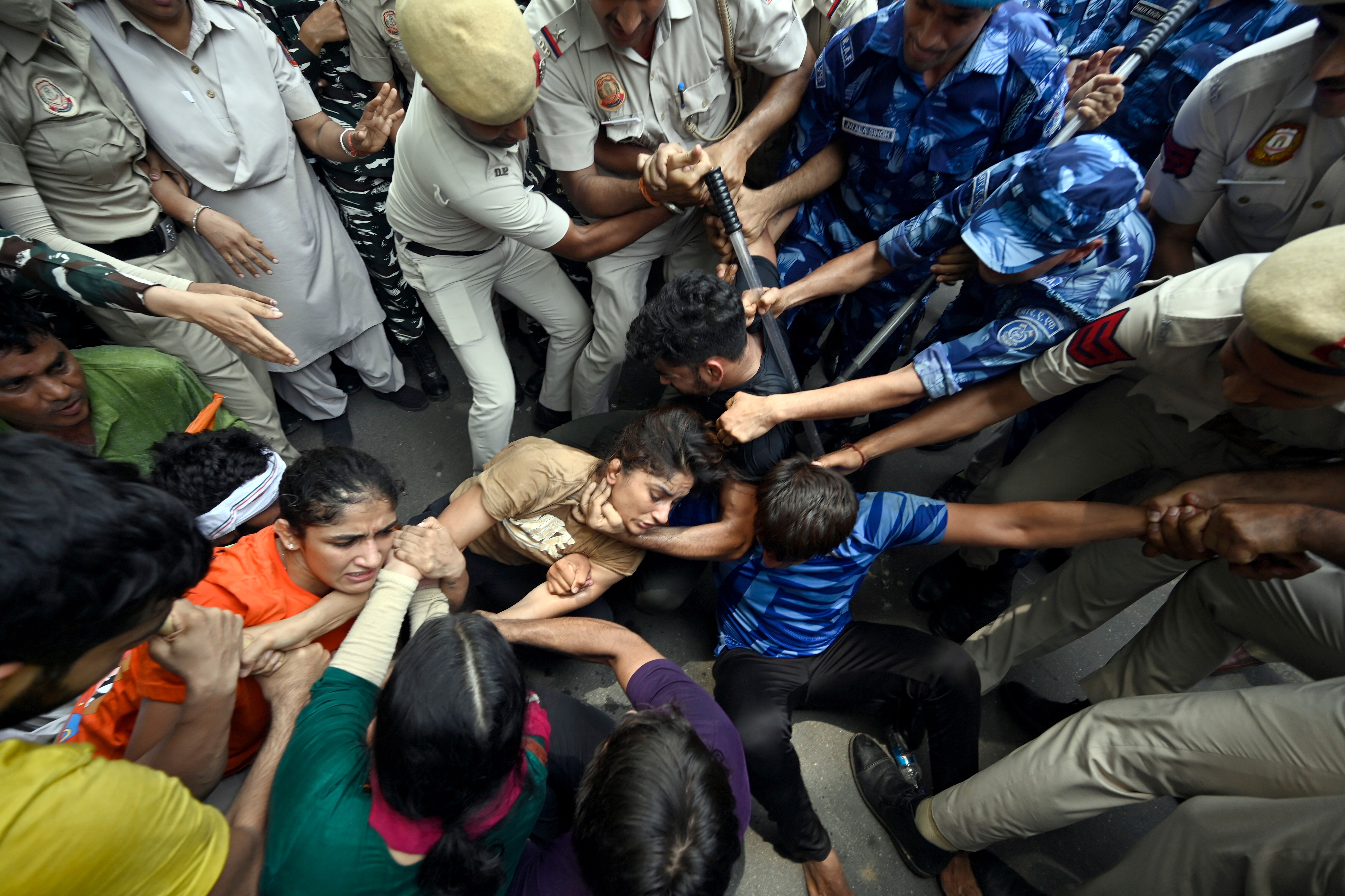
गर्दन ने बग़ावत कर ली है॥ pic.twitter.com/a5AYDkjCBuSee the photograph above of Phogat sisters Vinesh and Sangeeta resisting arrest on the 36th day of protest at Delhi's Jantar Mantar? Vinesh lies protectively over her youngest cousin as security forces try to haul them away. Between them is a flagpole with the tricolour. Shot by AFP's Sushil Kumar Verma, it captured an unforgettable moment in Indian sport, one where the country's top athletes refused to back down even when faced by the state's might.
As our wrestlers stake their international careers on the fight against sexual harassment, I am hopeful that we will some day look back on this picture and remember it as a milestone moment. Hopefully, their sacrifice will change the course of history.
Priya Ramani is a Bengaluru-based journalist and is on the editorial board of Article-14.com.
The views expressed here are those of the author and do not necessarily represent the views of BQ Prime or its editorial team.
Essential Business Intelligence, Continuous LIVE TV, Sharp Market Insights, Practical Personal Finance Advice and Latest Stories — On NDTV Profit.