- Indian equities fell with Nifty 50 slipping below 22,400 amid foreign selling and technical weakness
- Nifty breached key support levels of 22,500 and 22,400, showing persistent market volatility
- India VIX rose 7.5%, indicating increased market volatility and investor fear of sharp swings
Indian equities fell on Monday, with the Nifty 50 slipping below 22,400 as persistent foreign selling, a broken technical support and nerves over the central bank's latest rupee measures weighed on sentiment.
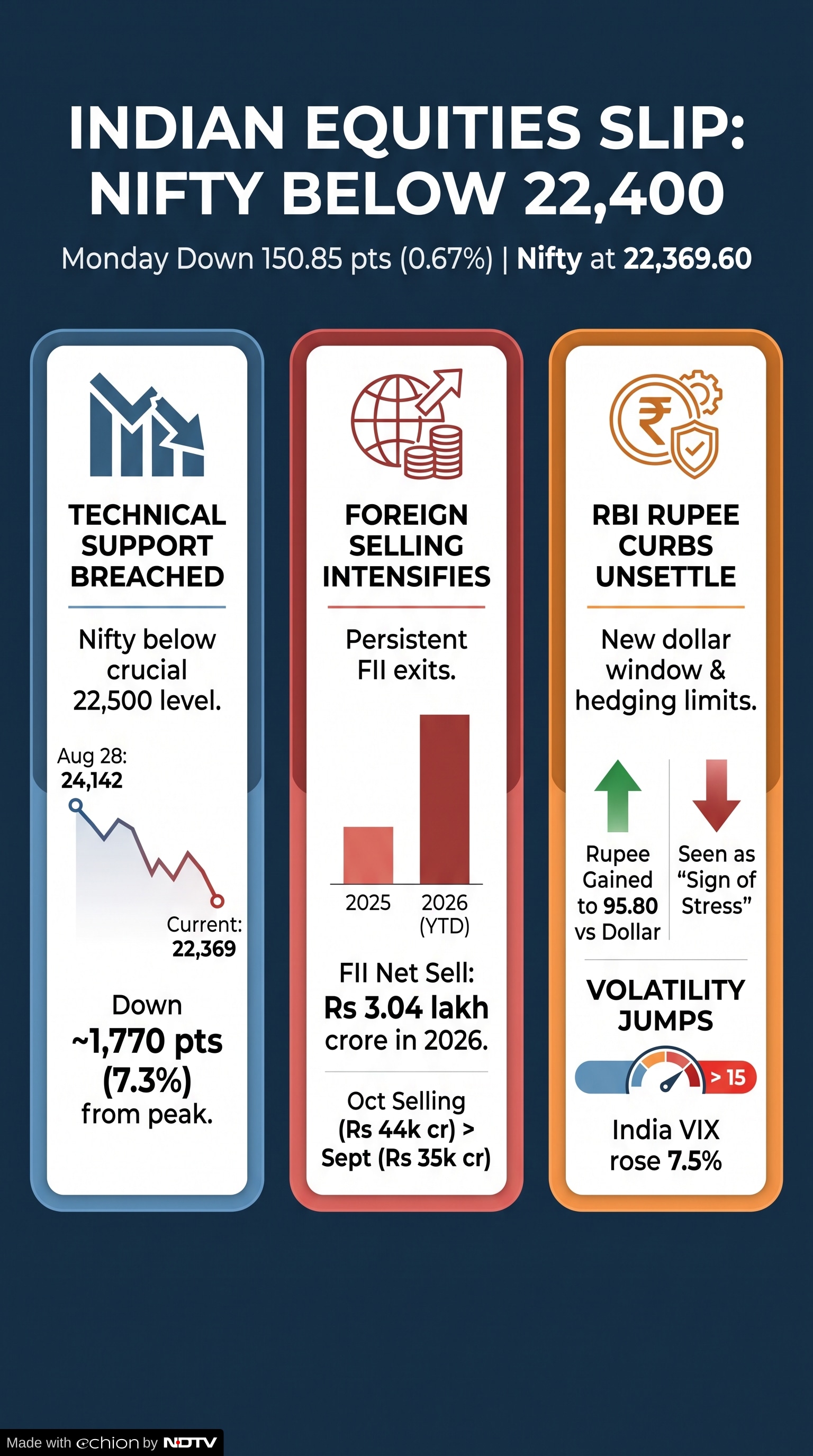
The Nifty was trading at 22,369.60 in afternoon trade, down 150.85 points or 0.67 per cent from Friday's close of 22,520.45. The index opened higher at 22,593 and touched a high of 22,651 before turning lower, giving up about 280 points from that peak. The Sensex fell more than 1,000 points from its day's high of 72,884 in late-morning trade, with heavyweights and large-caps bearing the brunt of the selling. At 1:45 pm, it was trading 0.84% lower at 71,860.17.
Here are three reasons the market is down.
Also Read | Layoffs Are Rising In Tech, But These Skills Are Helping People Unlock Better Pay
1. Crucial Support Level Breached
The first is technical. WealthMills Securities' director for equity strategy, Kranthi Bathini had said earlier on Monday that the market could not afford to give up 22,500. “The previous low can't be violated, and the markets need to maintain 22,500,” he told NDTV Profit. The index has since slipped through that level, and then below 22,400.
Bathini said this is part of a pattern. “Markets are volatile, and they have been breaking support levels every time,” he said. “In the last few weeks and months, the 24,000 support also got violated, and 23,000 also got violated.” The Nifty is now about 1,770 points, or roughly 7.3%, below its August 28 close of 24,142.45.
Foreign selling is the backdrop. Foreign institutional investors (FIIs) have sold a net Rs 3.04 lakh crore of Indian equities in 2026, per NSDL, nearly double the Rs 1.66 lakh crore pulled out in all of 2025. October's selling of Rs 44,166 crore has already topped September's Rs 35,861 crore, with FIIs selling Rs 12,944 crore on Thursday and Rs 3,569 crore on Friday. Domestic institutions bought Rs 10,703 crore and Rs 4,743 crore on those days, but that cushion has not stopped the index from giving up level after level.
Bathini said the exit is not unique to India. “Money has been exiting several emerging markets relentlessly,” he said, adding that India lacks the “wow factor” needed to attract hot money while global equities chase momentum.
2. Rupee Curbs Unsettle Traders
The second trigger is the Reserve Bank of India's latest push to stabilise the rupee. Over the weekend, the central bank opened a dollar window for public sector oil marketing companies, effective Monday, to take their dollar demand out of the spot market. Analysts estimate this shifts $11-12 billion of monthly demand to the RBI.
It also cut the limit for hedging without an underlying exposure from $100 million to $5 million, and asked dealers to hold 20 per cent of the rupee value of certain derivative contracts above $2 million with the RBI.
The rupee responded, gaining about 91 paise to 95.80 against the dollar in early trade from Friday's close of 96.71. Equities did not take the same comfort.
Markets are reading the curbs as a sign of stress. Nomura's Sonal Varma told NDTV Profit that the measures announced by the central bank signal its discomfort with further rupee depreciation. She cautioned that the interventions could slow the pace of the currency's decline without necessarily reversing the underlying trend.
Some traders also worry about how often policy is changing. “Such flip-flops impact the credibility and often lead to a larger reaction in asset prices, as compared to what would have been,” a trader with a primary dealership told Reuters.
The rupee matters for equities because a weaker currency eats into the dollar returns of foreign investors. The curbs also come after the RBI raised the repo rate by 25 basis points last week, while the US 10-year Treasury yield topped 5.3% to hit its highest level since 2002.
ALSO READ: Three Packages, One Year, Rupee Still 4% Weaker: Can RBI's Hedging Curbs Break The Pattern?
3. Volatility Index Jumps
The third signal is coming from the options market. India VIX, the market's fear gauge, rose 7.5 per cent on Monday, moving above the 15 mark. It had been as low as 11.79 on August 11.
The index tracks the volatility traders expect in the Nifty over the next 30 days, based on options prices. A rising VIX means investors are paying more for protection against sharp swings, which usually accompanies falling prices and points to short-term weakness.
The unease is not confined to large-caps. Bathini said headline-driven pressure has also made midcaps and smallcaps more volatile.
For the coming days, analysts are watching geopolitics, especially the Middle East, along with crude oil and the earnings season. Investors are also awaiting September inflation data, which could shape expectations on rates and the rupee.
ALSO READ: RBI Curbs May Support Rupee, But Oil Prices Remain A Risk: Nomura's Sonal Varma
Essential Business Intelligence, Sharp Market Insights, Practical Personal Finance Advice, Daily Fuel, Gold and Silver Prices and Latest Stories — On NDTV Profit.