Ola Electric Shares Settle Nearly 20% Higher On Improved Business Prospects
.web.webp?downsize=1010:568 "Ola Electric Shares Settle Nearly 20% Higher On Improved Business Prospects")
Ola Electric is charting an ambitious growth trajectory, backed by key advancements and strategic targets. Despite a fall in revenue and the widening of loss, the shares of the company saw a significant surge.
The company has commenced in-house production of its advanced 4,680 cells, with deliveries for vehicles utilising these cells anticipated to begin around the Navratri festival.
For the financial year 2026, Ola Electric projects strong volume guidance, expecting to deliver between 325,000 and 375,000 vehicles, alongside revenue guidance ranging from Rs 4,200 crore to Rs 4,700 crore. By the end of the financial year 2026, the company aims to achieve an automotive gross margin of 35% to 40%, benefiting from Production Linked Incentive, or PLI, schemes.
Ola Electric Mobility Q1 FY26 Highlights (Consolidated, YoY)
Revenue down 49.6% to Rs 828 crore versus Rs 1,644 crore (Bloomberg estimate: Rs 735 crore).
Ebitda loss at Rs 237 crore versus Rs 205 crore (Bloomberg estimate: Rs 287 crore).
Net loss widens to Rs 428 crore versus Rs 347 crore (Bloomberg estimate: Rs 452 crore).
The company's inventory spiked to Rs 153 crore from Rs 12 crore. New product introductions, including the Gen 3 Scooters and Roadster bikes, have reportedly been well-received in the market. Ola Electric has also developed in-house solutions for rare earth magnets and Anti-lock Braking System, or ABS. As of June 2025, the company maintains a cash balance of Rupees 3,197 crore.
In the first quarter of financial year 2026, Ola Electric recorded a revenue of Rs 828 crore, with Electric Two-Wheeler, or E2W, deliveries reaching 68,192 units. A positive development in its financials is the gross margin improving to 25.6% and the automotive segment achieving positive Ebitda in June 2025.
Ola Electric Share Price Spike
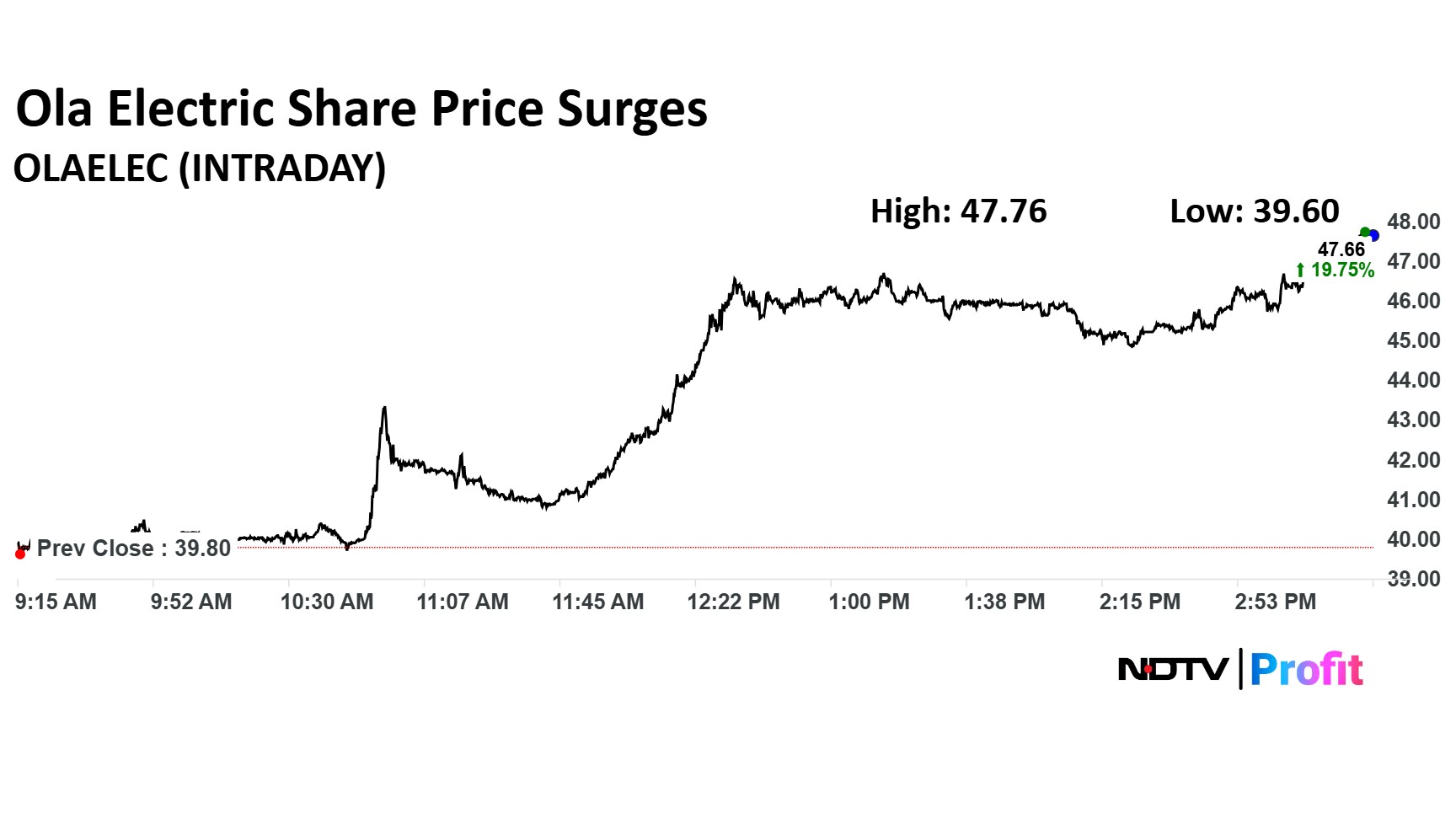
Shares of Ola Electric rose over 20% on improved business prospects. It pared the gains only marginally to settle 19.75% higher at Rs 47.66 apiece.
Out of eight analysts tracking the company, three maintain a 'buy' rating, two recommend a 'hold,' and three suggest 'sell,' according to Bloomberg data. The average 12-month consensus price target implies a potential downside of 5.5%.

-
'Never Seen This Level Of Negativity': Sandeep Tandon Says The Next Rally May Be Closer Than You Think

Veteran investor Sandeep Tandon says foreign selling is easing, large-caps are due a comeback and mid-caps are crowded, while he turns positive on gold, power and pharma this Diwali.
-
Indians Stay With Family, Not In Hotels | The Reason Why
India still lacks enough clean, reliable and affordable hotels for budget-conscious travellers.
-
The Economic Imperative: Analysing The Material Driving Force Behind India-Canada Strategic Reset
This economic complementarity is further reinforced by deep institutional investment ties and talent mobility, which form the bedrock of the bilateral framework.
-
Medicine Pricing: Where Must Profit Stop?
India must confront excessive margins, hidden incentives and regulatory gaps that threaten the integrity of medicine.
-
Why Amazon And Flipkart Are Struggling To Beat Meesho In India's Smaller Cities
With 274 million users and lowest-cost logistics, Meesho is defending its value commerce crown against giants like Amazon and Flipkart.
-
High US Salaries, No Green Card Certainty: The Financial Calculation Facing Indian H-1B Families
The suspension of PERM processing at eight technology employers does not cancel existing H-1B visas. What it does is force a question many Indian families have been avoiding: is the US salary worth tying your career and family plans to one employer?
-
Swiggy vs Eternal: Food Delivery's Two Rivals Are No Longer In The Same Race
Eternal is building a private AI assistant, dark.ai. Swiggy is still working out how to make Instamart pay, with an operating loss of Rs 895 crore in the July-September quarter while Blinkit stayed profitable.
-
Where You Live Shapes How You Get To Work | The Reason Why
Two-wheelers are the most popular way to get to work in India, accounting for nearly 43% of workplace commutes.
-
Unhedged Position: Can India See An Indonesia-Style Time Correction?
The Nifty is trading below levels it first clocked in 2024. Is there, then, as I have suggested in the headline, potential that the current time correction drags on painfully for the next three-five, even ten years?
-
Navigating Friction And Energy Realities: An Analysis Of Marco Rubio's October Visit To India
Occurring at a critical juncture marked by stalled trade negotiations and escalating geopolitical pressures over global energy supplies, the visit offers a profound window into modern US-India relations.










