- South Korea's Kospi index fell 6.2% due to a sell-off in AI chip stocks on Tuesday
- SK Hynix and Samsung Electronics dropped over 7%, heavily impacting the Korean market
- China's CXMT plans new memory tech challenging Korean dominance by end of 2026
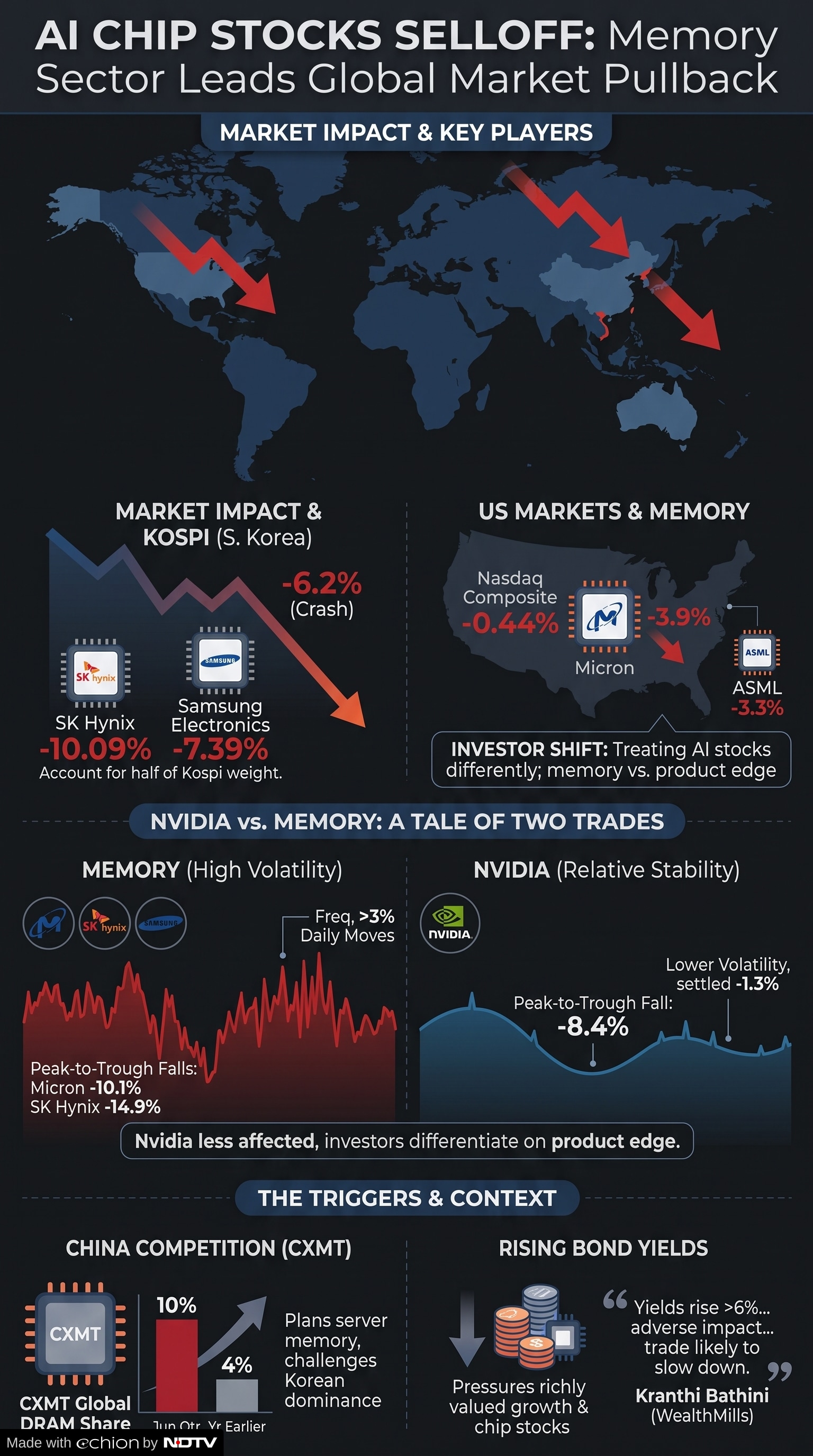
A deep sell-off in AI chip stocks hit various equity markets around the world, with South Korea's Kospi index crashing 6.2% to 5,988.41 on Tuesday, after falling as much as 7.4 per cent during the session.
SK Hynix and Samsung Electronics, two key Korean chip players who account for more than half of Kospi's weightage, fell 10.09% and 7.39%, respectively. In Japan, the Nikkei fell about 2.5%, with chip equipment maker Tokyo Electron down 7.25 and SoftBank down 8.5%.
The fall followed a weak Monday on Wall Street. Micron dropped 3.9% to $989.04 and the Nasdaq Composite lost 0.44%, dragged down by chipmakers. Nvidia fell too, but by far less, as its scrip slipped by 1.3% to $226.32.
Also Read | Layoffs Are Rising In Tech, But These Skills Are Helping People Unlock Better Pay
That gap is the story. Investors are no longer treating every AI-linked chip stock alike.
Why Memory Took The Hit
The trigger was China's ChangXin Memory Technologies (CXMT), which said it plans to launch server memory modules using a more compact cell design before the end of 2026. The move would take on a segment where Korean chipmakers are strong.
CXMT's share of the global DRAM market rose to 10% in the June quarter from 4% a year earlier, Counterpoint Research data showed. The design reportedly works around US curbs on advanced lithography tools.
Analysts say the threat is still far off. CXMT has not disclosed specifications or yields, and Morningstar's Jing Zhewei said there will likely be a meaningful gap between unveiling a product and making it at profitable yields.
The market reaction to the development, say analysts, is more about positioning. “Investors are looking for excuses to take profit on AI-related stocks that have outperformed this year, especially memory stocks,” UBP's Vey-Sern Ling said, as quoted by Quartz.
The selloff was not limited to memory. ASML fell 3.3%, and Infineon and STMicroelectronics about 5% each on Monday. But memory and the companies tied to it took the worst of it.
Nvidia's Calmer Ride
The numbers over the past ten weeks show why. Since August 3, Nvidia's shares have traded in a range of about 16%, from a low of $206.64 to a high of $239.24 on October 6. Micron's range was about 32%, from $829.50 to $1,097.39.
Nvidia had a daily move of more than 3% on 6 of the 49 trading days to October 12. For Micron it was 17 days. In Seoul, SK Hynix moved more than 3% on 21 of 45 sessions and Samsung on 18, based on closing prices from StockAnalysis.
The worst peak-to-trough fall in that period was 8.4% for Nvidia against 10.1% for Micron, 14.9% for SK Hynix and 12.3% for Samsung. After Tuesday, SK Hynix is about 23% below its September 21 high and Samsung about 19% below its September 23 high.
Returns were not that different. Nvidia rose 9.5% over the period to October 12 and Micron 19.2%. The difference was the ride. Nvidia is about 5% below its October 6 peak after Monday's slide, even as the memory names slipped further.
| Stock | Low to high | Range | Days with a move above 3% | Worst peak-to-trough fall |
|---|---|---|---|---|
| Nvidia | $206.64 – $239.24 | ~16% | 6 of 49 | −8.4% |
| Micron | $829.50 – $1,097.39 | ~32% | 17 of 49 | −10.1% |
| SK Hynix | 1,420,000 – 1,868,000 won | ~32% | 21 of 45 | −14.9% |
| Samsung Electronics | 230,000 – 285,500 won | ~24% | 18 of 45 | −12.3% |
| Stock | Aug 3 to Oct 12 | Mon, Oct 12 | Tue, Oct 13 | Below recent high |
|---|---|---|---|---|
| Nvidia | +9.5% | −1.3% | n.a. | −5.4% (Oct 6 high) |
| Micron | +19.2% | −3.9% | n.a. | −9.9% (Oct 1 high) |
| SK Hynix | +2.4% | −4.5% | −10.1% | −22.8% (Sep 21 high) |
| Samsung Electronics | +4.6% | −4.4% | −7.4% | −18.7% (Sep 23 high) |
ALSO READ: AI Trade's Weak Link Isn't Chips, It's Debt: Who Is Most Exposed If Yields Keep Climbing
The Yield Factor
Rising yields are part of the backdrop, though not the whole explanation. WealthMills Securities' director for equity strategy Kranthi Bathini said AI stocks have come under pressure as bond yields rise. The US 10-year Treasury yield was around 5.21% on Tuesday, close to last week's 24-year high of 5.36%.
“If yields rise beyond 6%, it's going to have an adverse impact on global equity universe, including the US stock market. The stocks that have seen momentum in recent period, particularly the chip stocks, will come under pressure and the trade is likely to slow down,” Bathini told NDTV Profit.
Higher yields hit all richly valued growth stocks. What separates them, as Tuesday showed, is how exposed each business is to a rival's move.
For the markets, the next test is whether the memory rout feeds into earnings. Investors will look for any sign that China's push is already affecting prices and market share. For now, the market is treating AI as two trades: those with product edges that are hard to copy, and those that investors fear can be.
ALSO READ: Yields At 2002 Highs: Is 6% The Line That Could Shake Global Equities, And Who Gets Hit First?
Essential Business Intelligence, Sharp Market Insights, Practical Personal Finance Advice, Daily Fuel, Gold and Silver Prices and Latest Stories — On NDTV Profit.