
Crypto's latest downturn looks different on the surface. There are no spectacular scandals, no bankrupt exchange, no regulatory crackdown. Yet for the industry's biggest trading platforms, the damage is starting to look uncomfortably familiar.
Bitcoin is down more than 35% since an October crash from record highs. But for exchanges like Coinbase Global Inc., Gemini Space Station Inc. and Bullish, the hit has been far steeper. Trading volumes — the core engine of their business — are plunging, dragging share prices down 40% to almost 60% over the past three months and forcing analysts to slash expectations. Coinbase, Gemini and Bullish didn't return requests for comment.
The pressure point is simple. Most crypto exchanges generate the biggest chunk of their revenue from transaction fees. When trading activity dries up, earnings drop. At Coinbase, fourth-quarter trading volume may have dropped 40% from a year earlier to $264 billion, Clear Street analyst Owen Lau estimates. January activity trended even lower, putting the quarter's run rate so far on pace to come in at less than half of last year's level, he said.
For investors who use crypto stocks as proxies for digital-asset growth, the message is more than uncomfortable: Even modest price declines can translate into outsized revenue pain when traders step away altogether. This past weekend's collapse of Bitcoin to below $80,000 appears to make the odds of broader investor exodus greater and even more agonizing.
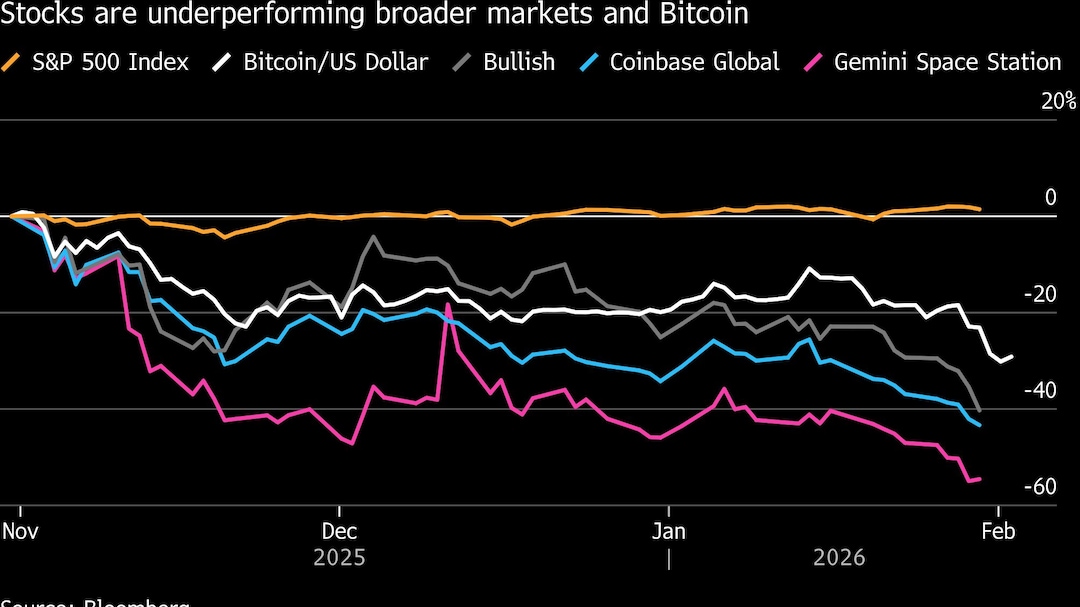
When prices are rising, more people trade because they're afraid of missing out, said Peter Christiansen, director of digital assets equity research at Citigroup. But “if you get headwinds to that, it is hard to build momentum,” he said.
As of late, crypto stocks were also impacted by investors shifting away from risk assets in broader equities markets amid concerns about the impact of rising artificial intelligence costs, higher geopolitical uncertainty and a general rotation away from technology.
Bitcoin shed nearly 11% in January, marking its fourth straight monthly decline — the longest losing streak since 2018, during the crash that followed the 2017 boom in initial coin offerings. Its latest slump comes amid broad market unrest, with gold continuing to fall Monday after suffering its biggest plunge in more than a decade at the end of last week.
Because of the crypto slump, Gemini's profitability is likely to be pushed out, analysts said. While it was supposed to get near break-even in 2027, that's likely to be delayed to 2028 or so, said John Todaro, an analyst at Needham & Co.
Bullish, which is focused on institutional clients, is likely to see January trading volumes down about 28% year-on-year, said Lau. Shares of Bullish fell around 2% on Monday, while Coinbase dropped 2.9% and Gemini slipped almost 6%.
“In terms of where I think we are in the current cycle, probably about 25% of the way through,” said Laurens Fraussen, a research analyst at Kaiko. “We're currently about three months in since our peak, so I'd estimate another six to nine months to go before we see a notable recovery.”
What makes this cycle unusual is not the severity of the volume slump — history shows crypto winters routinely gut activity — but the absence of a clear trigger beyond the abrupt end of exuberance. The 2018–2019 collapse followed the bursting of the initial coin offering boom amid a regulatory crackdown. The 2022–2023 downturn was defined by industry failures, from Terra-Luna to Three Arrows Capital to FTX. This time, there has been no equivalent shock, though many traders are still licking their wounds after the October crash, which triggered record mass liquidations.
Still, there's retail inertia. Progress on long-promised US crypto market-structure legislation has stalled, leaving exchanges and institutional investors stuck in regulatory limbo. Until that uncertainty clears, many traders appear content to wait on the sidelines — a dynamic that has prompted some analysts to describe the current phase as a bear market rather than a full-blown crypto winter.
The numbers, however, are beginning to blur that distinction. Despite the proliferation of spot Bitcoin exchange-traded funds and years of infrastructure buildout, trading activity is contracting in a way that's comparable to prior downturns, such as the late 2021-2022 cycle, according to data from Kaiko.
The difference this time is behavioral: rather than fleeing in panic, as they wonder when the next shoe is going to drop, traders are simply disengaging.
While some are migrating to decentralized crypto exchanges for leverage and speed, broader retail attention has drifted toward trendier frontiers — from AI tokens and prediction markets to gold, sports betting and small-cap tech.
For some major exchanges, the blow is cushioned because they have also diversified their businesses into areas such as digital-asset custody, prediction markets or trading stocks. But the cushion only goes so far.
Unlike past winters triggered by internal breakdowns, this slowdown may end not with a new shiny crypto trend, but with Washington legislation. The crypto and banking industries are scheduled to meet at the White House later Monday to hash out a compromise on a Senate market-structure bill.
Until then, crypto exchanges are learning that even without a crisis, a market can grind to a halt — and the trading fee model is among the first to feel the pain.
ALSO READ: Bitcoin's Break Below $80,000 Signals New Crisis Of Confidence
Essential Business Intelligence, Sharp Market Insights, Practical Personal Finance Advice, Daily Fuel, Gold and Silver Prices and Latest Stories — On NDTV Profit.