HDFC Bank Ltd. is currently in violation of India's Foreign Direct Investment (FDI) Policy, but it's not clear who's to blame for that. Or what the repercussions on the bank will be. Maybe none. But this situation and another one narrated later in this story, tell a tragicomedy tale of how India's FDI policy is administered.
On Thursday, February 16, 2017, the Reserve Bank of India (RBI) removed HDFC Bank from its ‘ban list' due to a reduction in foreign ownership of the bank.
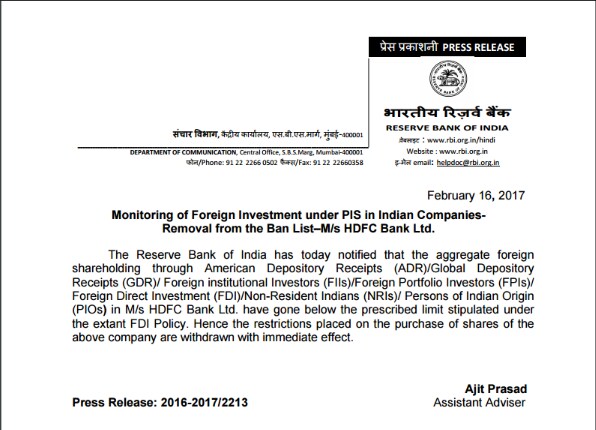
As a result, Friday onwards foreign portfolio investors (FPIs) could purchase HDFC Bank's shares from the open market if they so wanted. Evidently there were many who wanted to, because the stock opened trade on Friday morning at Rs 1,435 per share, 8 percent higher than the previous closing price.
HDFC Bank's shares hit a 52-week high, surpassed the market capitalisation of Reliance Industries Ltd. and were enjoying a tremendous surge in volume traded, when RBI suddenly shut down the party.
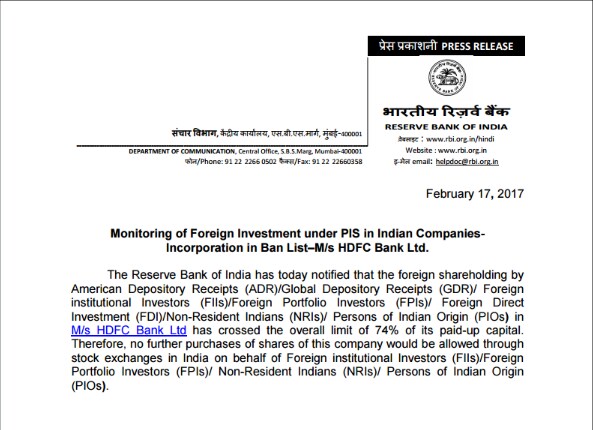
A little after 1p.m., a notice on RBI's website said foreign shareholding in HDFC Bank had “crossed the overall limit of 74 percent of its paid-up capital” and therefore no further purchases by foreign investors would be allowed through stock exchanges in India.
Soon after, HDFC Bank's shares dropped 3 percent and continued to decline to close the day at Rs 1,377 per share.
HDFC Bank slips more than 3% from intraday high after FPI investment limit exhausted. pic.twitter.com/NFGDXsfAKw
It is not clear if foreign investors stopped buying immediately after RBI posted the notice on its website. Anecdotal information gleaned from market participants suggests foreign investor purchases continued for a short period even after the RBI notice, simply because not everybody was aware that RBI had shut the foreign purchase window.
It is also not clear what will happen to those trades now. Will RBI permit their settlement, even though doing so is against the law as it will mean foreign shareholding in HDFC Bank will exceed the foreign investment limit of 74 percent in banks, as laid out in the government's FDI policy?
Also, in such a case who is to be held liable for the breach of limit and how will HDFC Bank restore foreign investment to below the 74 percent limit?
If RBI doesn't permit the excess trades to be settled then do they devolve on the brokers? Why should brokers bear a monetary loss for no fault of theirs?RBI did not respond to emails sent by BloombergQuint, inquiring about the process, the breach of the foreign investment limit and the liability. HDFC Bank also refused comment.
But a news report in the Business Standard newspaper suggested that on Friday RBI called an emergency meeting with custodians to discuss the situation.
The ‘ Window' Of Opportunity
So what is this foreign purchase trading window all about, when and how does it get activated and then de-activated?
Here is how it usually works, as explained to BloombergQuint by a senior banker working at a custodian bank and also detailed on the RBI website.
The company informs RBI when foreign investment in its shares falls below the limit prescribed by FDI policy - let's call it the foreign investment limit hereon.
If the foreign shareholding in the company drops to up to 2 percent below the foreign investment limit, RBI puts the company on a ‘caution list'. That is, any further share purchases by foreign investors can take place only with prior permission from RBI.
The foreign investor writes to RBI seeking such permission and RBI when granting it specifies a time period, usually two to three days, within which the purchase must be made.So when on the caution list, the possibility of new foreign investment in a company exceeding the mandated limit is nil, as each purchase has to be cleared by RBI.
But when foreign shareholding in a company drops by more than 2 percent below the FDI policy limit, RBI removes the company from its ‘ban' list and allows foreign investors to buy the company's shares from the open market.
Chances are high that foreign purchases might exceed the foreign investment limit in the case of companies, such as HDFC Bank, where foreign investor demand is huge, and where the foreign investment opportunity is limited, say just 2-4 percent before the mandated limit is hit. That's exactly what happened on Friday.
This happens often said the senior banker, terming it as an operational issue, not a policy one. He said intra-day monitoring of trades is neither feasible nor practical. It requires sophisticated software to determine real time foreign investment levels and stop foreign purchases just before the foreign investment limit is hit.
He also said that the company, in this case HDFC Bank, would not be in trouble with RBI because the company has no control over any of this.
But that was not quite true in the Ujjivan Financial Services Ltd. case.
The Ujjivan Case
In October 2015, Ujjivan Financial Services, a micro-finance institution, received in-principle approval from RBI to launch a small finance bank. As an non-banking finance company (NBFC), Ujjivan was permitted 100 percent foreign ownership. But to be eligible for a small finance bank license, it needed to limit foreign shareholding to 49 percent or below. So the company did an initial public offer in 2016 and listed on May 10. It succeeded in reducing the foreign shareholding to below 49 percent.
But to its luck, foreign investors continued to purchase its shares in the open market and foreign investment in the company climbed back to well above 50 percent. That put in jeopardy the process of getting a small finance bank license. Ujjivan was in a fix - it had to convince some foreign investors to sell their shares, so that the license process was not disrupted.
Ujjivan's founder Samit Ghosh told BloombergQuint in a phone interview, that it was very difficult to convince foreign investors who had just bought shares to sell them, so the company turned to older foreign investors for help. But that was no cake walk either.
We had to go through a very difficult time.Because once you do an IPO there are lot of restrictions on who can buy orsell, there is a one year lock-in on existing shareholders. But there was apossibility that there could be trades between the locked-in shareholders. So weactually tried to convince some of our existing foreign investors who werelocked-in, to sell to domestic parties who were locked-in too. So that's how wesomehow were able to bring it down to below 49 percent.Samit Ghosh, MD and CEO, Ujjivan Small Finance BankIt took Ujjivan 3 months to convince those foreign investors to sell. And the transactions had to be done “bit by bit” given their size.
Ghosh noted that RBI was very supportive through the process, understanding that the situation was not of Ujjivan's making nor in its control.
In November 2016, RBI issued a Ujjivan a license and its small finance bank was launched in February 2017.
The foreign investment problem had been resolved without causing much delay, but, Ghosh said “It added a lot to our anxiety levels”.
Back To the Present
Despite the increase in foreign investment Ujjivan was never in violation of any law as at that point in time it was still an NBFC and permitted to have 100 percent foreign ownership. For the same reason RBI could not force the unwinding of any trades in its shares, making it the company's job to reduce foreign shareholding or jeopardise its small finance bank license.
In contrast, HDFC Bank is currently in violation of the law, by RBI's own admission. To remedy that, some trades will have to be voided, and that's going to cost someone, maybe dearly.
Dharmesh Mehta, managing director and chief executive officer of Axis Capital, said in an email conversation that, “it is impossible to perfectly time the closure of the FPI limit as the public disclosure of the FPI holding in any company is not on a daily basis but as per the last shareholding pattern declared, which can be outdated. So it's impossible for the FPI buyer to know how much it can buy before the limit is breached”.
Mehta's of the opinion that permission based buying should be applied by RBI earlier, instead of at the current two percent limit. But only if approvals are granted immediately due to price sensitivity. The better solution, he said, is a more efficient online monitoring system.
The entire process should be automated and monitoredon a daily basis. It should be one agency which should monitor this on a dailybasis and to expect RBI to monitor the same on a daily basis is not fairto RBI and should be moved to another agency, maybe the Stock Exchanges as the FPI limit guidelines are well laid out and trading takes place on the exchange, sothey can take immediate action. It's time India resolves this processimmediately and plugs the loopholes in the system. With so much FPI investmentin the country such volatility is not good for Indian capital markets' imagein the world.Dharmesh Mehta, MD and CEO, Axis CapitalEssential Business Intelligence, Continuous LIVE TV, Sharp Market Insights, Practical Personal Finance Advice and Latest Stories — On NDTV Profit.