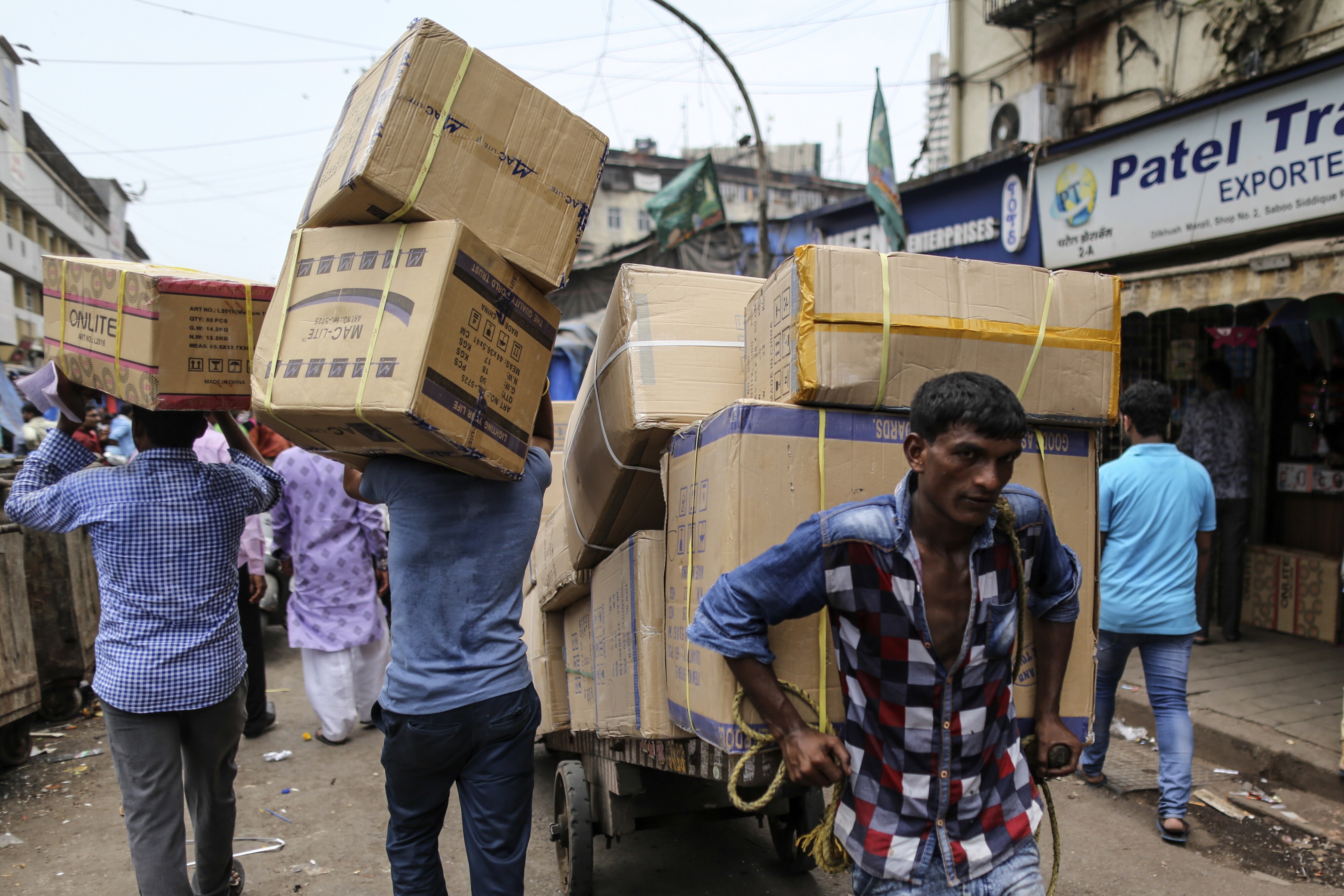
The government is considering easing the proposed Electronic Way bill requirement under the Goods and Services Tax (GST) by increasing the threshold limit of supplies from Rs 50,000 and limiting it to ‘evasion prone' commodities, a senior finance ministry official told BloombergQuint.
An ‘evasion prone' commodity will be selected based on risk parameters decided by the GST Council, said the official on condition of anonymity.
It will make more sense to use e-way bills for high-value products that will help in capturing tax evasion, Amit Sarkar, head-indirect tax at BDO India, told BloombergQuint.
E-way bills would then be needed for items like cement, aerated drinks, tobacco and mobile phones.Amit Sarkar, Head-Indirect Tax, BDO India
A committee of officers is also considering excluding movement of goods within a state from e-way bill ambit, the official quoted above said.
The Central Board of Excise and Customs' draft rules on e-way bills require registered entities to provide information relating to any goods worth more than Rs 50,000 that they intend to move within or outside a state. The details have to be entered in a prescribed format on the GST-Network (GSTN) portal.
The draft rules authorise the tax commissioner or an officer empowered by him to intercept any vehicle to verify the e-way bill or the number for inter- and intra-state movement of goods.
Various industries have demanded an increase in the threshold from Rs 50,000.
Also Read| GST: Government Forms 18 Sectoral Groups To Resolve Industry Issues
Fund For Profiteering Recovery
The GST Council will also discuss the anti-profiteering measure in its next meeting on Sunday, including the contours of an agency that will be tasked with its implementation.
According to another official in the finance ministry, the aim is to check profiteering based on the complaints it receives. If an entity is found not passing on the benefits of tax cuts to consumers, the profiteered amount will be calculated based on estimates available, and will be deposited in a consumer welfare fund as the amount cannot be returned to consumers, the official said. It's still at ideation stage, and, if finalised, will need GST Council's approval.
One such fund, set up by the department of revenue in the finance ministry, is operated by the ministry of consumer affairs, food and public distribution.
Whether a new fund will be created or the existing one will be used is yet to be decided.
Also Read| GST: The Curious Case Of Perquisites For Employees
Essential Business Intelligence, Continuous LIVE TV, Sharp Market Insights, Practical Personal Finance Advice and Latest Stories — On NDTV Profit.