Where You Live Shapes How You Get To Work | The Reason Why
Two-wheelers are the most popular way to get to work in India, accounting for nearly 43% of workplace commutes.

Imagine starting your workday with a breeze on a ferry. In Kochi, that is possible. In Pune or Delhi, your commute looks very different. In Mumbai, office-goers squeeze into local trains, while Bengaluru's traffic can turn a short journey into a long one. Across India, these trips are different.
The Ministry of Statistics and Programme Implementation's Household Travel Survey 2025–26 shows us how different they can be. It's an extensive dataset covering travel for work and education. In this piece, we will look at commuting to work.
From Walking to Two-Wheelers: The State-Level Picture
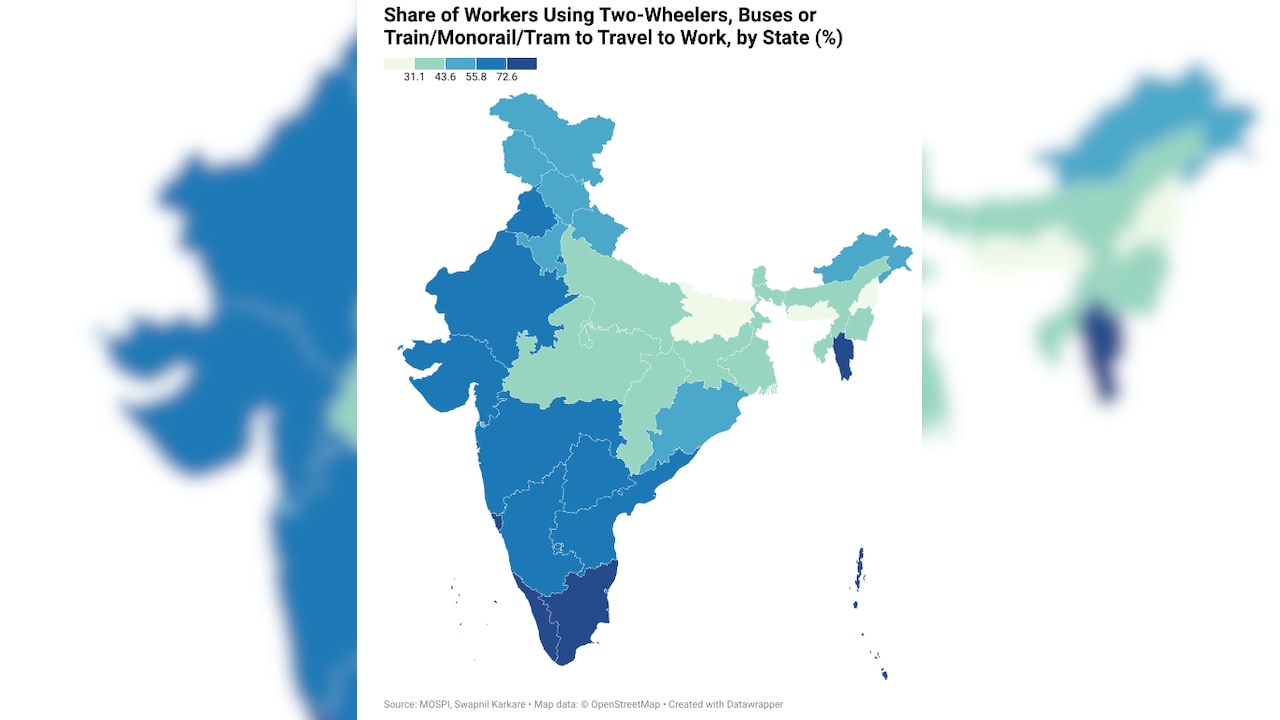
Two-wheelers are the most popular way to get to work in India, accounting for nearly 43% of workplace commutes. Puducherry stands out, with 93% of workers using them, followed by Mizoram (76%), Lakshadweep (72%), Goa (65%) and Telangana (62%).
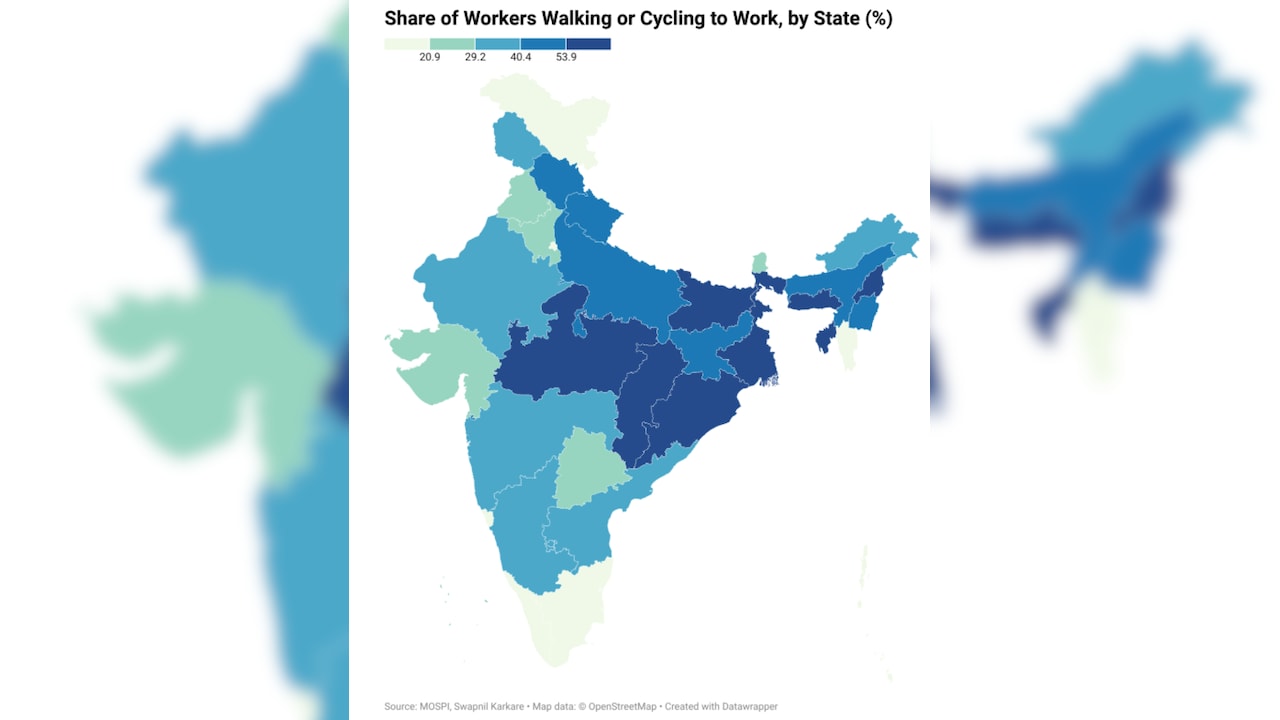
But in Nagaland and Meghalaya, the story changes. Less than 10% used two-wheelers. Instead, most walk to work. Nearly 72% of workers in Nagaland and 68% in Meghalaya do so, compared with the national average of 28%. The pattern again flips in Puducherry and Goa, where walking accounts for less than 1% and just 4% of workplace commutes, respectively.
Also Read | From Oil To Mangoes: The Hidden Economics Of Everyday Life | The Week In Whys
A surprising number of people use bicycles to work, particularly in the East. West Bengal accounts for 36% of such workplace trips, followed by Bihar (30%). Then, in some southern states, buses play a bigger role. For instance, one in five Keralites and one in four Tamils use buses. But the national average for buses is hardly 7%.
Rail, monorail and tram use is notable only in Maharashtra (11%) and West Bengal (9%), versus 2% nationally.
These patterns show why India's commuting needs cannot be addressed with a single transport model. Note that the data only includes travel above one kilometre.
A Divide Between North/East and South/West
Looking at the state-wise data, we can spot patterns quite easily.
In North and East India, around 31% of workers walk to work and another 18% cycle. Together, these two modes account for nearly half of workplace commutes. In South and West India, the combined share is one-fourth. I have considered only large states and excluded Himalayan, north-eastern, and all union territories.
The pattern reverses when it comes to two-wheelers. They account for 53% of workplace commutes in South and West India, compared with 38% in North and East India. This suggests a greater reliance on motorised personal transport in the southern and western regions, while walking and cycling remain much more prominent in the North and East.
Public transport also plays a bigger role in South and West India. Buses account for 11% of workplace commutes, compared with 4% in North and East India.
However, shares of auto-rickshaws (6%) and cars (3%) are more or less similar across these regions, close to their national averages.
The broader picture is that workers in North and East India are more likely to reach work on foot or by bicycle, while those in South and West India rely more on two-wheelers and buses.
Final Take
The regional divide raises a simple question. Does the way you travel to work decide what jobs you can take? Or does your job decide how you get there?
In the South and West, workers hop on scooters or buses to get to work. In parts of the North and East, many walk or cycle. There's a limit to how much a person can walk or pedal. But using scooters and public transport to reach faraway offices and factories isn't a big problem.
There could be a couple of angles that we can explore. Jobs in cities like Mumbai and Bengaluru may be far from where workers can afford to live, forcing them to travel by scooter or bus. But that doesn't necessarily mean these cities are better planned or that workers can easily walk to work. Something else could be at play.
Income, for instance. If you earn well, spending on a scooter or daily bus fares may be manageable. If your work pays little or is irregular, that money may be harder to spare.
So, which comes first? Do people walk because they can't afford to travel farther? Or do they spend less on travel because the jobs available nearby are all they can find? And what happens when a new factory or office opens? Can local workers get there easily, or will the commute keep some of them away?
The survey doesn't give us all the answers. But one thing is clear: having well-paying, formal jobs nearby matters, and so does the ability to reach the ones farther away.
Also Read | The Annoying Station Experience Every Commuter Knows Too Well | The Reason Why
Disclaimer: The views expressed in this article are solely those of the author and do not necessarily reflect the opinion of NDTV Profit or its affiliates. Readers are advised to conduct their own research or consult a qualified professional before making any investment or business decisions. NDTV Profit does not guarantee the accuracy, completeness, or reliability of the information presented in this article.
-
High US Salaries, No Green Card Certainty: The Financial Calculation Facing Indian H-1B Families

The suspension of PERM processing at eight technology employers does not cancel existing H-1B visas. What it does is force a question many Indian families have been avoiding: is the US salary worth tying your career and family plans to one employer?
-
Unhedged Position: Can India See An Indonesia-Style Time Correction?
The Nifty is trading below levels it first clocked in 2024. Is there, then, as I have suggested in the headline, potential that the current time correction drags on painfully for the next three-five, even ten years?
-
Navigating Friction And Energy Realities: An Analysis Of Marco Rubio's October Visit To India
Occurring at a critical juncture marked by stalled trade negotiations and escalating geopolitical pressures over global energy supplies, the visit offers a profound window into modern US-India relations.
-
India Exports Capital. Why Not Export Trusteeship?
The big question, then, is whether India can build an institution that global borrowers, investors, banks, and lawyers can trust, even without an Indian connection.
-
France's Economy & Politics Are In Crisis | The Reason Why
Let's look at how the French economy and politics evolved under Nicolas Sarkozy, Franois Hollande and Emmanuel Macron.
-
You May Inherit The Business. You Must Earn Its Credibility.
Succession tests the founder's ability to share authority as much as it tests the next generation's readiness to assume it.
-
Signing Deals Is One Thing; Making Them Work Is Another | The Week In Whys
Sometimes, things don't turn out as planned. Indian companies have lost some bids to rivals, some projects won't produce until 2030.
-
FOMC Wall, PERM Suspension, Hospital Stocks | Talking Points This Week
A PERM suspension would directly affect green-card sponsorship rather than H-1B visas, so the near-term earnings impact could remain relatively limited. The key question is whether this marks a new phase in US scrutiny of Indian IT.
-
Everything, Everywhere, All At Once: Dalal Street's Week To Forget | Joining The Dots
Visa curbs, a Starlink spat and cancer drug caps: what connects this week's shocks for Indian markets
-
India Is Going Abroad For Critical Minerals. But It May Take Years To Pay Off | The Reason Why
Although India's steps are in the right direction, they remain modest compared with India's growing dependence.









