
- India's unemployment rate dropped from 5.4% to 4.9% between Q1 and Q3 FY26
- Labour force participation rose from 54.9% to 55.8% in the same period
- Services sector added nearly 40 million jobs in six years, boosting employment
India's labour market is showing clear signs of strengthening with unemployment declining and workforce participation rising, according to the Economic Survey 2025-26 tabled on Thursday. The Survey also highlights that employment conditions have improved steadily through FY26, mostly supported by structural reforms, rising formalisation of the sector, and stronger economic activity.
The data backing this is the Monthly Periodic Labour Force Survey (PLFS) data for April–December FY26. The unemployment rate dropped from 5.4% in Q1 to 4.9% in Q3, while the labour force participation rate increased from 54.9% to 55.8% in the same period.
The annual PLFS 2023-24 report further reinforces this trend, noting a sharp fall in unemployment to 2.5%, compared with 3.3% in 2020-21.
Also Read | Layoffs Are Rising In Tech, But These Skills Are Helping People Unlock Better Pay
What's Boosting The Labour Market?
The Survey majorly attributes this advancemnt to broad-based job creation. India's services sector, which is now over 53% of the country's GDP, has added nearly 40 million jobs in the past six years. This momentum has been driven by teh IT-BPM, financial services, tourism, and professional services sector.
Manufacturing and MSMEs are not bystanders either, continuing to add labour at scale. The MSME sector employs 32.8 crore workers and contributes to 48.6% of India's exports. Organised manufacturing jobs also grew 6% year‑on‑year, reflecting healthier balance sheets and rising capacity utilisation.
Agriculture, still employing 46.1% of teh country's workforce, maintained the stability. However, the Survey notes that long-term labour movement towards industries and services is increasing as urbanisation accelerates. This push toward urban employment has further been supported by schemes such as PM-SVANidhi, Smart Cities Mission, and AMRUT.
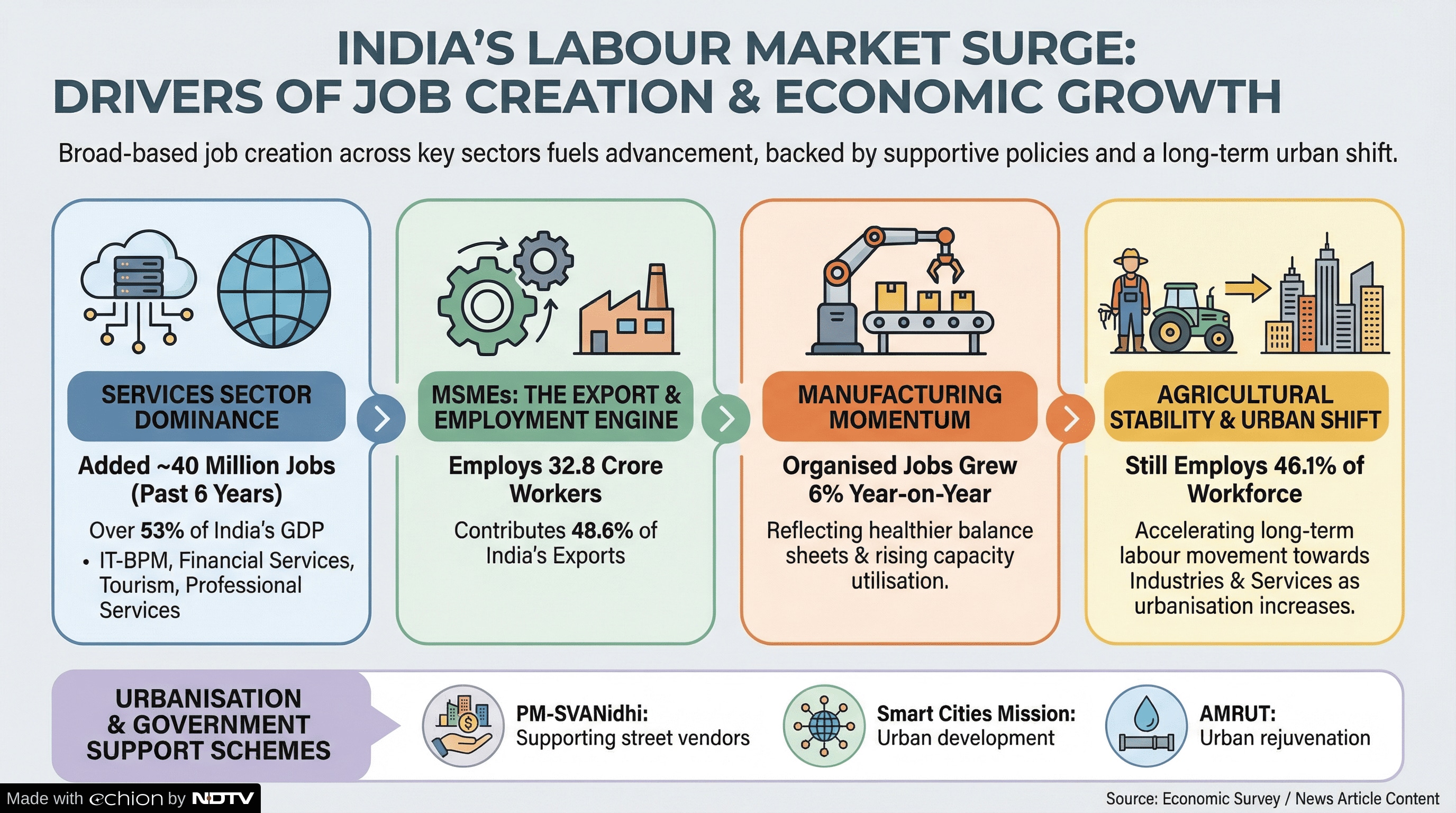
Photo Credit: NDTV Profit
Women At The Forefont
A key highlight is the improvement in labour force participation among women, with 54% of e‑Shram registrants being women. Structural reforms, expansion of digital public infrastructure and greater formalisation of the economy have lowered entry barriers to work, enabling broader participation. The Survey stressed that while gender gaps persist, the direction of change is encouraging and reflects deeper shifts in education, skilling and work arrangements
Skill development has also surged. The share of 15–59‑year‑olds receiving vocational or technical training has risen to 34.7%, aided by the revamped Skill India Digital Hub, National Skills Qualification Framework and outcome‑based financing models.
The rollout of the four new Labour Codes in late 2025, which consolidates 29 laws, promises greater flexibility, easier compliance, and portable social security benefits for employees, gig workers, and platform workers. The Survey estimates these codes could generate up to 77 lakh new jobs and potentially reduce unemployment to 1.9-2.9%.
Essential Business Intelligence, Sharp Market Insights, Practical Personal Finance Advice, Daily Fuel, Gold and Silver Prices and Latest Stories — On NDTV Profit.