- India and EU signed a Free Trade Agreement covering 25% of global GDP and one-third of trade
- Car tariffs in India will fall from 110% to 10%, with car parts tariffs fully eliminated in 5-10 years
- Wine tariffs cut from 150% to 75% initially, olive oil tariffs reduced to zero over five years
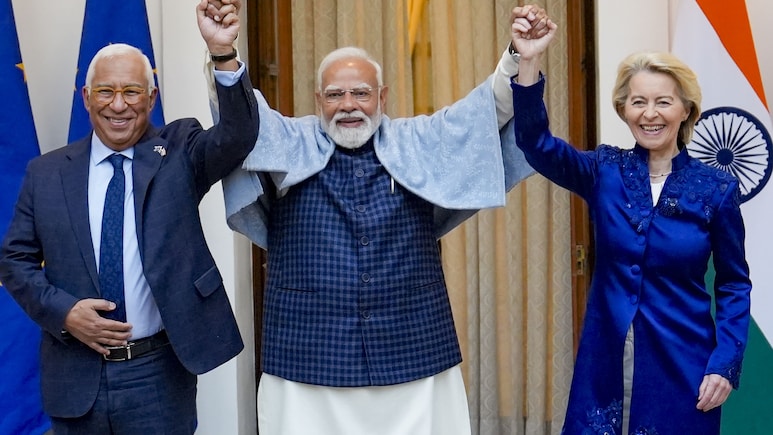
Prime Minister Narendra Modi on Tuesday announced the signing of the India-EU Free Trade Agreement (FTA), saying it accounts for 25% of the global GDP and one-third of global trade. The trade deal aims to strengthen economic and political ties between the world's second and fourth largest economies, at a time of rising geopolitical tensions and global economic challenges.
Here are the five key highlights of the India-EU Trade Deal:
Automobile tariffs will fall sharply, with duties on cars gradually reduced from 110% to as low as 10%, and car parts tariffs fully eliminated within five to ten years.
- Agri-food tariffs will drop significantly, including wine tariffs cut from 150% to 75% initially and as low as 20% later, and olive oil tariffs reduced from 45% to zero over five years.
- Sensitive EU agricultural sectors remain protected, with beef, chicken, rice and sugar excluded from tariff liberalisation.
- EU firms gain privileged access to India's services market, including financial services and maritime transport, with India making its deepest-ever commitments in services trade.
- The pact includes strong sustainability and climate commitments, alongside plans for an EU–India climate cooperation platform and up to €500 million in EU support for India's green transition.
The EU and India already trade over €180 billion worth of goods and services per year, supporting close to 800,000 EU jobs. This deal is expected to double EU goods exports to India by 2032 by eliminating or reducing tariffs in value by 96.6% of EU goods exports to India. Overall, the tariff reductions will save around €4 billion per year in duties on European products, a press release from the European Union said.
Also Read | Layoffs Are Rising In Tech, But These Skills Are Helping People Unlock Better Pay
This is the most ambitious trade opening that India has ever granted to a trade partner. It will give a significant competitive advantage for key EU industrial and agri-food sectors, granting companies privileged access to the world's most populous country of 1.45 billion people and fastest growing large economy, with an annual GDP of €3.4 trillion.
Opportunities For European Businesses Of All Sizes
India will grant the EU tariff reductions that none of its other trading partners have received. For example, tariffs on cars are gradually going down from 110% to as low as 10%, while they will be fully abolished for car parts after five to ten years. Tariffs ranging up to 44% on machinery, 22% on chemicals and 11% on pharmaceuticals will also be mostly eliminated.
Reducing agri-food tariffs
The agreement removes or reduces often prohibitive tariffs (over 36% on average) on EU exports of agri-food products, opening a massive market to European farmers. For example, Indian tariffs on wines will be cut from 150% to 75% at entry into force and eventually to levels as low as 20%, tariffs on olive oil will go down from 45% to 0% over five years, while processed agricultural products such as bread and confectionary will see tariffs of up to 50% eliminated
Sensitive European agricultural sectors will be fully protected, as products such as beef, chicken meat, rice and sugar are excluded from liberalisation in the agreement.
Access To Services Markets And Protected IP
The agreement will grant EU companies privileged access to the Indian services market, including key sectors such as financial services and maritime transport.
Sustainability Commitments Enhanced
The agreement has a dedicated trade and sustainable development chapter, which enhances environmental protection and addresses climate change, protects workers' rights, supports women's empowerment, provides for a platform for dialogue and cooperation on trade related environmental and climate issues and ensures effective implementation.
ALSO READ: 'Mother Of All Deals': PM Modi Announces India-EU Trade Agreement, Flags It As Global Game-Changer
Essential Business Intelligence, Sharp Market Insights, Practical Personal Finance Advice, Daily Fuel, Gold and Silver Prices and Latest Stories — On NDTV Profit.