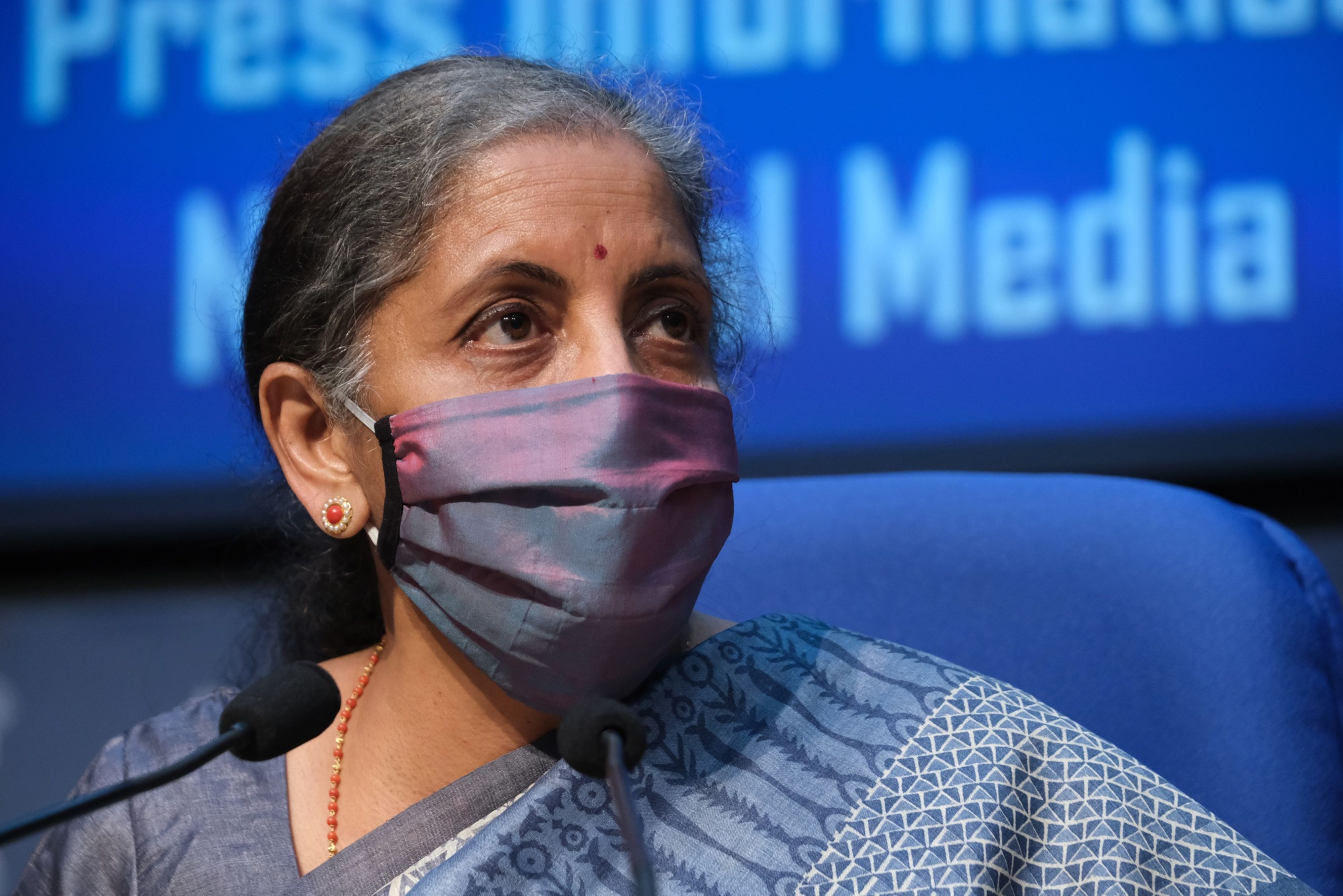
Nirmala Sitharaman, India’s finance minister, wears a protective mask while speaking during a news conference in New Delhi, India. (Photographer. T. Narayan/Bloomberg)

5 years ago
Jan 30, 2021
Catch all live updates on the Economic Survey 2021 and CEA Krishnamurthy Subramanian's commentary, here.
Chief Economic Adviser KV Subramanian has said that the government must use its fiscal policy to support growth till pre-Covid levels are reached.
Counter-cyclical fiscal policy must become an important point of emphasis in India, especially at times like these, Subramanian said in his press conference on the Economic Survey 2021. Subramanian said that fiscal rules that do not enable a counter-cyclical policy need a rethink.
Subramanian argued that higher growth will lead to more sustainable debt levels, and not the other way around. In the worst-case scenario, he said, even if India has real GDP growth of 3.8% each year between FY23-FY29, debt will still come down. "Debt will come down because nominal rate of growth would be higher than nominal rate of interest," he said.
Food inflation driven primarily by supply-side factors.
Several components of food inflation are transitory with wide variations.
Changes in consumption patterns not reflected in current index.
"For all these reasons, a greater focus on core inflation is warranted. Further, given the significant increases in e-commerce transactions, new sources of price data capturing e-commerce transactions must get incorporated in the construction of price indices."
CPI inflation from April-October 2020 was mostly driven by substantial increase in price momentum, possibly due to the initial disruptions caused by the Covid-19 lockdown
CPI inflation averaged 6.6% in 2020-21 (April-Dec) and stood at 4.6% in Dec 2020, mainly driven by rise in food inflation, which has increased from 6.7% in 2019-20 to 9.1% in 2020-21, owing to build up in vegetable prices
The Indian government may need to continue with an expansionary fiscal stance in order to sustain the recovery in aggregate demand, said the Economic Survey for 2020-21.
The soon-to-conclude financial year is likely to see a fiscal slippage, the survey, released ahead of the Union Budget presentation on Feb.1, said, adding the expenditure support provided during the year will impart the required momentum to mid-term growth.
“Going forward, in order to sustain the recovery in aggregate demand, it is expected that the government may have to continue with an expansionary fiscal stance,” the survey said. “The calibrated approach adopted by India allows space for maintaining a fiscal impulse the coming year.”
India has transformed the short-term trade-off between lives and livelihoods into a win-win in the medium to long-term that saves both lives and livelihoods, the annual economic survey authored by Chief Economic Advisor Krishnamurthy Subramanian said, in its first chapter.
“By estimating the natural number of cases and deaths expected across countries based on their population, population density, demographics, tests conducted, and the health infrastructure, we compare these estimates with actual numbers to show that India restricted the Covid-19 spread by 37 lakh cases and saved more than 1 lakh lives.”
The survey found a correlation between the stringency of the lockdown and it the number of Covid-19 cases and resultant deaths. It also found a correlation between the lockdown’s stringency and the country’s “V-shaped” recovery.
“India thus benefited from successfully pushing the peak of the pandemic curve to September, 2020 through the lockdown."
India is predicting Asia’s third-largest economy will expand 11% in the year starting April betting that the vaccine roll out will contain the pandemic, while low interest rates and measures to lure investment will spur business activity, people with knowledge of the matter said.
The forecast for next year is in line with the International Monetary Fund’s estimate for 11.5% expansion, which will once again make India the fastest-growing major economy in the world ahead of China’s 8.1% pace.
A finance ministry spokesman was not immediately available for a comment.
Finance Minister Nirmala Sitharaman has tabled the Economic Survey of India 2021 -- authored by Chief Economic Advisor Krishnamurthy Subramanian -- in the parliament, ahead of the Union Budget on Monday.
Subramanian along with his team will address a press conference at 3:30 p.m. thereafter.
The annual document acts as a platform to pitch larger economic ideas and concepts which the government may or may not act upon. On Jan. 31 2020 -- before coronavirus became a sizable threat to the Indian economy -- Subramanian outlined a difficult year for India’s growth, the need to create fiscal headroom, pitched large-scale job creation and proposed a new divestment mode. All these issues have only intensified over the last year as the Covid-19 virus rummaged through the economy, especially the country’s poorer half.
Since the last economic survey was tabled, India’s GDP contracted by nearly a quarter in the April to June period owing to a nation-wide lockdown. GDP improved but remained in the negative in the second quarter, officially taking India into recession. Unemployment rate rose to 9.1% in December, according to data released by the Centre for Monitoring Indian Economy, highest in the last six months despite an increase in overall economic activity.