Foreign Portfolio Investors (FPIs) have, over the years, preferred Indian equities over debt securities. But that's changing.
The Indian debt market has seen a significant interest and participation from FPIs in the past couple of years. In financial year 2014-15, FPIs invested Rs 1,661.27 billion (approx. $24.43 billion as per the current exchange rate) in debt securities; almost 50 percent higher than FPI inflows into equities.
The probable reasons for the increased focus of FPIs towards Indian debt securities are:
Also Read | Layoffs Are Rising In Tech, But These Skills Are Helping People Unlock Better Pay
- Indian corporates are keen to obtain funding from foreign investors as the cost of overseas borrowings is considerably low as compared to the cost of local borrowings. Accordingly, there has been an increasing trend among Indian corporates to raise funds from foreign investors.
- At the same time, the interest rate on Indian debt securities has generally been higher than the interest rates prevalent in the home countries of most FPIs - even after payment of Indian withholding taxes (WHT). Accordingly, foreign investors also have been keenly inclined to invest in Indian debt securities to secure better returns.
- The deal became sweeter when the Indian government introduced Section 194LD under the Income-tax Act, 1961 (Act) in 2013 to encourage and incentivise greater FPI investment in Indian debt securities.
Section 194LD provides that:
- interest paid to a FPI;
- during the period beginning on or after 1 June 2013 but before 1 July 2017;
- on rupee-denominated bonds of Indian companies and government securities having interest rates within the limits specified by the government;
would attract WHT at a concessional rate of 5 percent (plus applicable surcharge and cess).
Changing Scenario
However, the beneficial environment available to FPIs for investing in Indian debt securities has started showing signs of change. With the U.S. Federal rate poised to be hiked over the period of coming months, the attractiveness of U.S. bonds is expected to increase. Considering that many FPIs investing in Indian debt securities have ultimate investors in the U.S., such FPIs may start finding better opportunities in U.S. bonds. On the other hand, interest rates in India are poised to fall as an effect of demonetisation by the Indian government. These factors will reduce the advantage/benefit to India-focused FPIs after factoring the administrative, foreign exchange and tax costs involved.
Also Read: Budget 2017: What Clarity Can It Bring To International Taxation And Transfer Pricing?
There is a possibility that the Indian debt market could witness a significant outflow of foreign capital from India. This can also be observed from the fact that in financial year 2016-17 itself, FPIs have pulled out investments of Rs 360.44 billion (approx. USD 5.30 billion as per current exchange rate) from the Indian debt market.
In light of this changing environment, the Indian government needs to take positive steps to avoid outflow of further foreign capital from Indian debt securities. The government must consider extending the concessional WHT rate of 5 percent under Section 194LD of the Act beyond the current expiry date of 30 June 2017. This would not be something new considering that in 2015 the government had extended the expiry date of concessional WHT from June 1, 2015 to June 30, 2017, in light of the then economic circumstances. The continuing lower WHT rates could certainly entice FPIs to remain invested in Indian debt securities to maximize the post-tax returns for their investors.
What If Concessional WHT Rate Is Not Extended Beyond 30 June, 2017?
If the period of concessional WHT rate under Section 194LD is not extended beyond June 30, 2017, the tax cost of such FPIs would undergo a substantial change. This is because such interest will attract WHT of 20 percent under the Act. However, most FPIs then would like to take shelter under the tax treaty based on their country of residence. Most Indian tax treaties will reduce the withholding tax on interest from 20 percent to 10 percent or even lower.
The withholding tax rates under prominent Indian tax treaties for interest payments are as under:
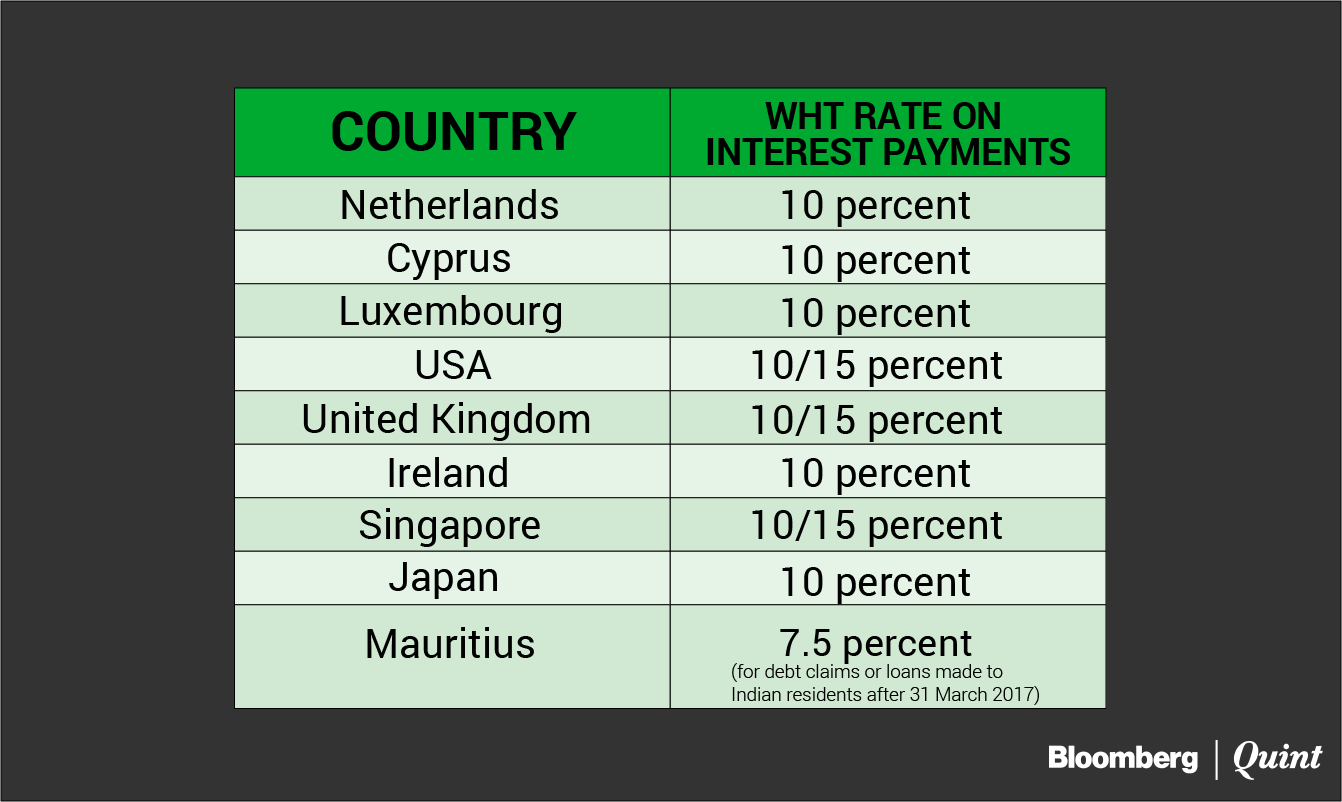
As can be seen from the table above, given that the amended India-Mauritius tax treaty provides for a WHT rate of only 7.5 percent, Mauritius may now emerge as a preferred jurisdiction for setting up such FPIs after April 1, 2017.
The structuring of such FPIs would however have to be undertaken after not only factoring the provisions of the proposed Indian General Anti-Avoidance Rule (GAAR), which are proposed to be effective from April 1, 2017, but also the proposed Multilateral Convention (MLC) published under the Base Erosion and Profit Shifting (BEPS) project of the OECD to which India could be a signatory. The MLC seeks to deny tax treaty benefits in cases of structures not having bona-fide business purpose in the jurisdictions where the income is claimed to be earned.
Also Read: What Can Budget 2017 Do For Retail Investors?
Domestic Impact
If the tax cost of FPIs increases, it is possible that the FPIs may pass on this cost to the Indian borrowers by negotiating a higher interest rate. Accordingly, this would not only increase the cost of such borrowings for Indian businesses but would also result in higher outflow of foreign exchange from India – which could in turn result in further depreciation of the Indian rupee. Therefore, it is desirable that the concessional WHT rate under Section 194LD is extended beyond 30 June 2017.
Maulik Doshi is a partner at SKP Business Consulting. The views expressed in this article are personal and do not reflect the views of the organization.
The views expressed here are those of the author and do not necessarily represent the views of BloombergQuint or its editorial team.
Essential Business Intelligence, Sharp Market Insights, Practical Personal Finance Advice, Daily Fuel, Gold and Silver Prices and Latest Stories — On NDTV Profit.