Pay fair market value to increase its shareholding or exit – those may be the two clear choices for Allianz SE as it tries to decide how to move ahead with its two insurance joint ventures with Bajaj Finserv.
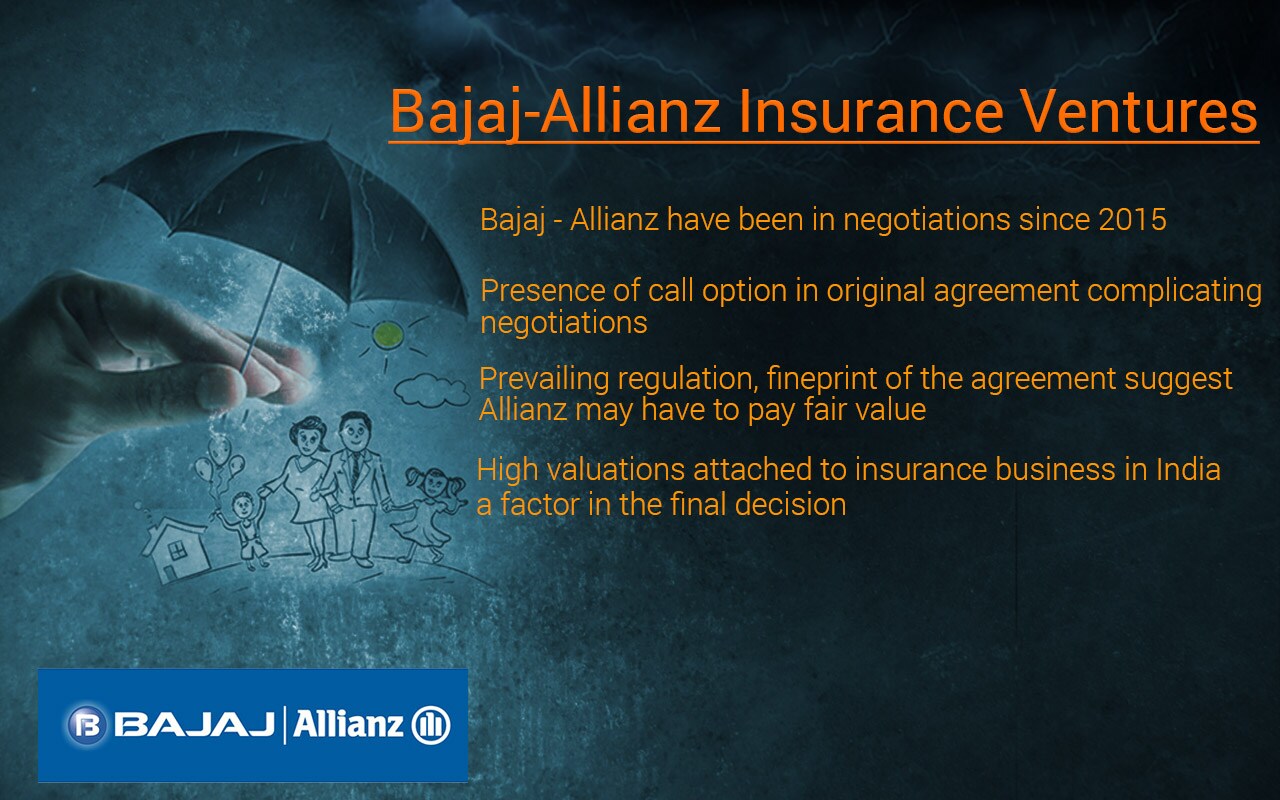
Allianz and Bajaj have been discussing the future of the joint ventures since last year, when the government increased the foreign investment limit in the insurance sector to 49 percent from the earlier 26 percent. The decision, however, is complicated by the nature of the agreement signed between the two parties in 2001.
Bajaj-Allianz Life Insurance Agreement
According to the agreement, a copy of which is available on the company's website, Allianz can exercise a ‘call option' to hike its stake up to 74 percent at Rs 5.42 a share, plus an interest of 16 percent per annum compounded annually from July 31, 2001 to the date of payment.
If call option is exercised after July 30, 2016, Allianz will have to pay the higher of:
- Rs 5.42 a share plus an interest of 16 percent per annum compounded annually from July 31, 2001 to July 30, 2016
- Or fair market value determined by a mutually accepted accounting firm
- If the company is listed, Allianz will have to pay the market price
Bajaj-Allianz General Insurance Agreement
In the case of the general insurance business, the shareholder agreement allows Allianz SE to exercise its call option up to 15 years from the subscription date and hike its stake to 50 percent in the joint venture.
To hike its stake within 15 years, Allianz would have had to pay Rs 10 for a share of Bajaj Allianz General Insurance plus an interest at 16 percent per annum compounded annually from April 23, 2001 to the date of payment.
If the call option is exercised after 15 years of signing the agreement i.e. April 22, 2016, Allianz will have to pay the higher of:
- Rs 10 a share plus interest of 16 percent per annum compounded annually from April 23, 2001 to April 22, 2016
- Or the market price
- If the company is not listed, fair value of the joint venture will be calculated by a mutually accepted firm
Is The Agreement Valid?
To answer this question, it may be worth drawing a comparison between the Bajaj-Allianz deal and the Tata-DoCoMo deal which has run into trouble.
In the case of Tata-DoCoMo, NTT DoCoMo had invested $2.6 billion to buy 26.5 percent stake in 2009 in Tata Teleservices, with an agreement that entitled the Japanese company to sell its shares back at 50 percent of the purchase price, or let Tata Sons find a suitable buyer.
In 2014, Docomo decided to sell its stake, but Tata cited the Reserve Bank of India's rules which said foreign investors can only sell or buy stake in ventures at fair market value determined using an internationally accepted pricing methodology. Therefore, the agreement cannot be honoured. DoCoMo moved London Court of International Arbitration which ruled in its favour and asked Tata Sons to pay $1.17 billion. Tata Sons has deposited the amount with the Delhi High Court and said it is willing to pay up if the RBI permits it to.
The Bajaj-Allianz deal may be different to the extent that the agreement clearly states that it would be subject to the prevailing rules.
“If and as permissible under applicable laws and subject to regulatory approvals required, Allianz SE can exercise call options to increase its holding to 50 percent from the present 26 percent in case of Bajaj Allianz General Insurance Co..”Joint Venture Agreement Between Bajaj And Allianz
Under current rules, the fair value is the minimum price at which you can sell.
According to Vivek Mehra, Partner at PwC, for any foreign investor to hike or sell stake in a venture, the Reserve Bank of India's extant regulations valid at the time of the investment would have to be complied with. This would mean that the incremental investment from Allianz would have to comply with the current laws.
Will Allianz Have To Pay Fair Value?
To understand the story fully, it is important to understand why the clause was there to begin with.
At the time the contract was signed in 2001, FEMA (foreign exchange management act) regulations of 2000 were applicable. Under those rules, fair value was calculated using a formula set by the comptroller of capital issues. That formula was based on book value.
Since insurance companies are typically loss making in the early years, fair value based on book value would have been very low. As such, Bajaj may have built in the formula based on a fixed price plus compounded interest as a downside protection, said a person familiar with the issue while requesting anonymity.
At that time, the assumption may have been that the foreign investment limit in the insurance sector may be hiked soon since discussions on the issue first started in September 2005, said the person quoted above. That was not to be and the issue dragged on for years.
In 2010, the discounted cash flow method of determining fair value came into place.
“DCF (discounted cash flow method) is a more sophisticated method of calculating fair value and values a company on discounted future cash flows on projected earnings. Therefore, typically, value used to be much higher than CCI value,” Vivek Mehra, partner at PwC said. He was not commenting specifically on the Bajaj-Allianz case.
Following that, in 2014, the RBI said that fair value has to be calculated based on internationally accepted norms.
(Transfer of shares by a resident to non-resident Indian) where the shares of an Indian company are not listed on a recognized stock exchange in India, the transfer of shares shall be at a price not less than the fair value worked out as per any internationally accepted pricing methodology for valuation of shares on arm's length basis which should be duly certified by a Chartered Accountant or a SEBI registered Merchant Banker.RBI Notification Dated July 15, 2014.
“The (revised) fair value approach captures economic realities of the transaction and also protects the foreign exchange base of the country, said Ameya Kunte , Executive Editor and Co-founder, Taxsutra.
Bajaj and Allianz have not released the fair value of the insurance businesses. However, the fair value, calculated based on internationally accepted norms, would be much higher than the alternative formula included in the agreement, said the person quoted above.
Given the prevailing regulations and the wording of the agreement between the two parties, Allianz may have no option but to buy the additional stake at fair value.
“The current penetration in the insurance sector is very low…There is a good amount of potential for someone to grow if they are invested. Even at this level if someone is looking to expand with a reasonably long-term view, then it makes sense for them to acquire at fair market value,” said Kalpesh Desai, Partner at BMR Advisors commenting broadly on the insurance sector.
Is Exit An Option?
According to the person quoted above, Allianz has met with finance ministry and RBI officials to discuss the issue and is now considering its options.
Apart from increase its shareholding at fair value, Allianz has the option to exit the venture. Tougher solvency and capital rules that came into place in Europe starting January 2016 may support the case for an exit. Due to these considerations, Allianz exited Korea and reduced its exposure to Taiwan recently.
In April 2016, Allianz sold Allianz Life Insurance Korea and Allianz Global Investors Korea to Anbang Insurance Group. In May, it sold a part of its Taiwan business to Taiwan Life Insurance.
The case may not be as open and shut as it sounds.
There may have been side agreements signed for Allianz to hike stake as per CCI based valuation. BloombergQuint could not confirm whether there were any such agreements. Even if there were such agreements, the call option can only be exercised if the Indian central bank allows an exemption to the German company, said a second person on the condition of anonymity. For Allianz to hike its stake at a premium would really depend on their business plan and the synergies that it sees from this business, said this person.
What may concern Allianz is the rich valuations being attached to insurance businesses in India.
The valuations of insurance companies are rich, which many foreign promoters probably find too stretched, said Sanket Kawatkar, Life Insurance Practice Leader at Milliman-India.
“Even if you leave the entering or exiting the venture at predetermined price clause aside, there is difference of views as to what is the fair market value,” Kawatkar added. He also pointed out that there was no benchmark for the valuation of a life insurance company until ICICI Prudential got listed last month.
The Official Position
In response to an email from BloombergQuint, a spokesperson for Allianz said the company cannot speak on the topic and does not comment on speculations.
The only thing we can say is that India is a vibrant market where Allianz holds a keen interest and remains committed. This won't answer your specific questions, but we'd like to at least give a clear commitment to India and its people.Allianz Spokesperson
“We're still in talks but they'll be able to give you a better answer. If the exit happens, it will happen in accordance with the country's laws,” said Sanjiv Bajaj, managing director of Bajaj Finserv.
Essential Business Intelligence, Continuous LIVE TV, Sharp Market Insights, Practical Personal Finance Advice and Latest Stories — On NDTV Profit.