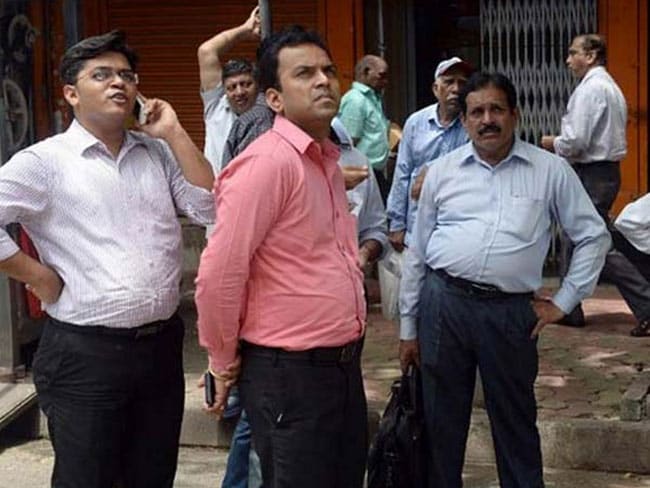
The BSE Sensex on Monday crashed 5.94 per cent to end at a 12-month low of 25,741.56. The 1,625-point loss was the biggest-ever for Sensex, while in percentage terms, Monday's crash was the biggest since January 2009. After China, the Sensex was the worst-performing index in Asia today.
Reasons For Monday's Market Crash
1) China slowdown: Fears of a massive slowdown in China have been brewing up for a while, but manufacturing activity data last week confirmed that the world's second biggest economy is indeed struggling. Shanghai stock markets have plunged over 30 per cent this year, leading to a contagion effect in other global markets. Other major global economies such as Brazil, Russia and Japan are also struggling, but China's export and import linkages with the rest of the world makes it a special case, analysts say.
"China is the largest trading partner of the US, EU, Japan and even India. Most commodity driven nations like Brazil, Australia, Indonesia, South Africa, Kazakhstan and Malaysia have literally grown in the last decade on the back of Chinese demand," wrote TS Harihar of HRBV Client Solutions in a note.
2) Fears of Currency War: The widespread unrest in global markets was set in motion nearly two weeks ago when China sharply devalued the yuan following which most emerging market currencies tumbled sharply. South Africa's rand struggled at 14-year lows, the Turkish lira languished near a record low, while the Malaysian ringgit hit a 17-year low. The Indian rupee has been better off, though it has shed over 4 per cent to a two-year low of 66.74 per dollar in last two weeks. There are fears that China could be forced to devalue the yuan even more should its economy falter further.
3) Big selloff by foreign investors: When markets in a big country like China crash, the first instinct of global traders is to sell riskier assets and hoard cash. In times of such panic-selling, economic fundamentals don't matter, and that explains the huge selling by foreign investors in India over the last few days. Foreign investors sold shares worth Rs 8,500 crore in the last three sessions, leading to a slide in domestic markets. If the momentum of selling by foreign investors increases over the next few days, Indian markets could be headed for even bigger fall.
4) Indian Oil stake sale: Domestic institutional investors have been big buyers of Indian equities over the last few months; in doing so, they have supported domestic stock markets. On Monday, a lot of domestic institutions such as state-run LIC diverted funds to the Rs 9,379-crore share sale in state-run Indian Oil. As a result, the liquidity that could have gone in to supporting markets today was missing.
"The two important factors which led to today's chaos is the sharp fall in the rupee and the high demand to the offer for sale of Indian Oil requiring a total outflow of Rs 9,400 crore," said Vinod Nair of Geojit BNP Paribas Financial Services.
5) Government must act, not just speak: Finance Minister Arun Jaitley tried to drive the point that India was better placed than many other emerging market countries to face the global crisis. Analysts say it's difficult for finance ministers to lift sentiments by statements alone.
"No Finance Minister in the world has ever been able to talk up a crashing market," tweeted Deepak Mohoni, director of trendwatchindia.com.
No Finance Minister in the world has ever been able to talk up a crashing market.— Deepak Mohoni (@deepakmohoni) August 24, 2015
In moments of crisis, there should be concrete action, analysts said, adding that one way of boosting the morale in markets is to accept recommendations of Justice AP Shah panel on the controversial minimum alternate tax. The panel has recommended that back-tax claims on foreign investors should be cancelled.
"The way it's going foreign portfolio investors will have no profits to pay MAT in any case. Government can keep on sleeping on the report," tweeted fund manager Sandip Sabharwal.
The way its going FPI's will have no profits to pay MAT in any case. Govt can keep on sleeping on the report.— sandip sabharwal (@sandipsabharwal) August 24, 2015
Essential Business Intelligence,
Continuous LIVE TV,
Sharp Market Insights,
Practical Personal Finance Advice and
Latest Stories — On NDTV Profit.