It would be an apocalyptic irony if the hand-to-hand brawl on June 15 near the poorly delineated Line of Actual Control in the Galwan Valley between Ladakh and Aksai Chin mushroomed to war between the world's two most populous declared nuclear nations. By all credible accounts, with medieval nail-studded rods, China has again challenged India's sovereignty and territorial integrity. For the first time in 45 years, death ensued, of 20 Indian soldiers, including the Commander, Colonel Bikkumalla Santosh Babu. China won't confirm its 43 casualties, but does affirm its “sovereignty over the Galwan Valley region.” India must respond with more than a repudiation of that claim as “exaggerated and untenable.”
But what are India's options after the fourth major boundary clash since 2012, when President Xi Jinping took power?

There are two: economic and diplomatic. Neither is singly sufficient to counter Chinese behavior, nor are they mutually exclusive. A purely economic response underestimates the national security threat to India and the world. A purely diplomatic response brands India as weak. India's best option is to pursue both simultaneously, tailoring each to historical lessons and present realities.
On the economic front, the choice is:
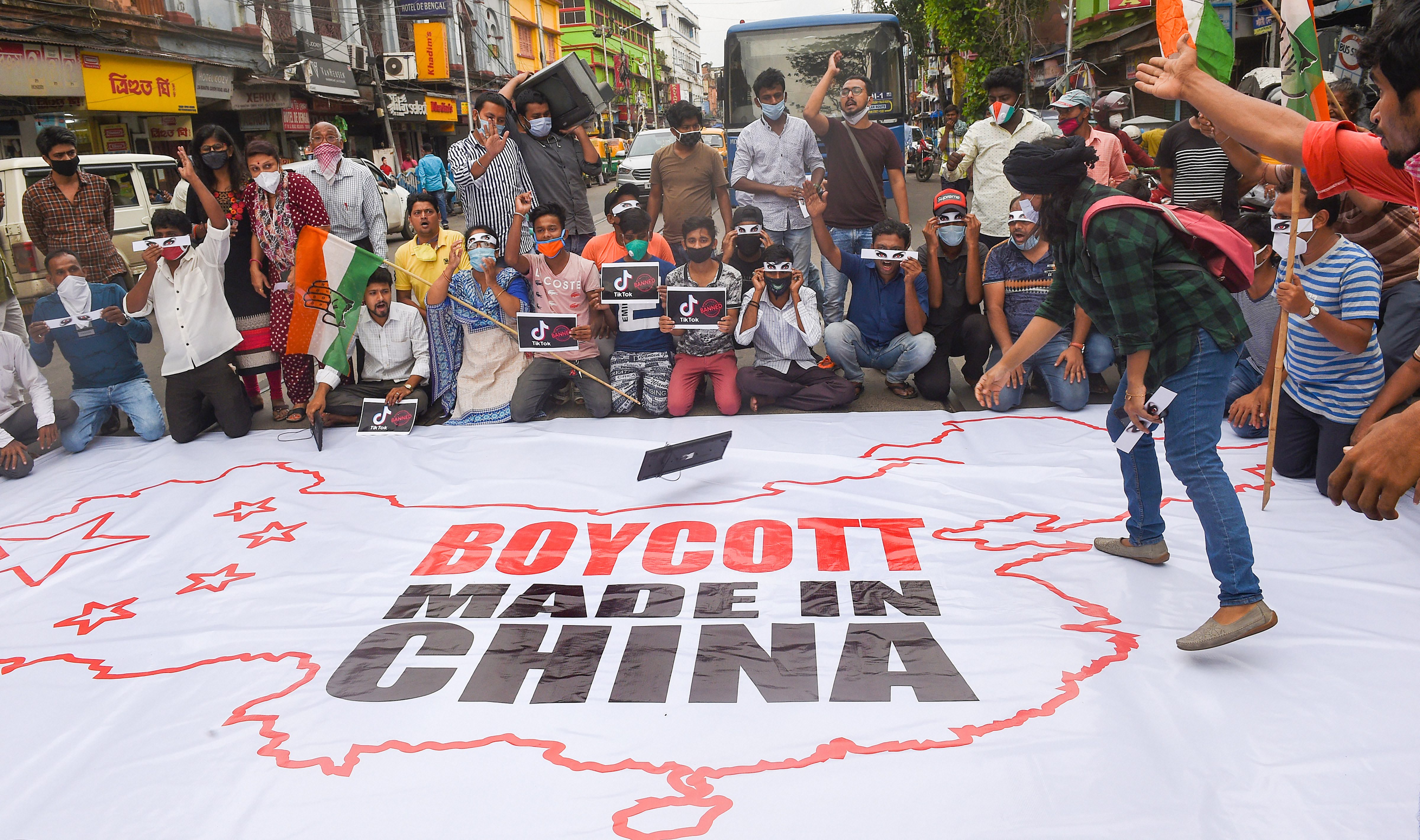
- A purely private boycott of Chinese goods, services, and foreign direct investment; versus
- A government-driven quarantine of Chinese imports and inbound investment.
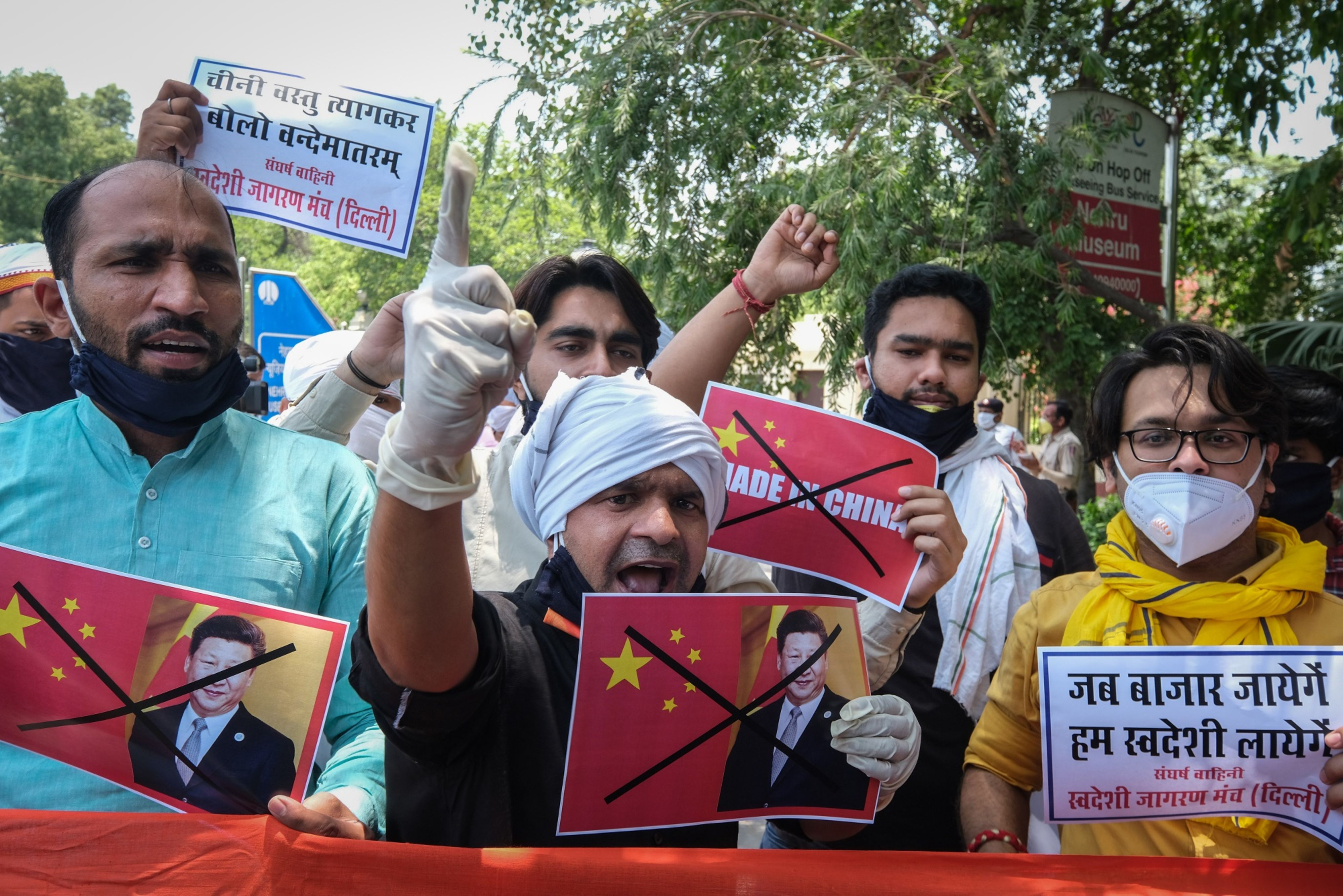
An Unofficial Boycott
The first recalls Mahatma Gandhi's Swadeshi (‘of one's own country') movement, in which he led boycotts of British goods. It was import substitution of the kind Prime Minister Narendra Modi now proclaims with his “Atmanirbhar Bharat” economic nationalist vision of a ‘self-reliant India'. The second recalls America's Trade War with China and sanctions on Iran. India should take both choices to maximise the limited economic leverage it has with China.
The private boycott option is consistent with Indian democratic values that allow for freedom of choice. Yet, patriotic Indian consumers already know they depend on Chinese-origin finished goods. Chemicals, electrical appliances, engineering goods, fertilizers, iron and steel products, plastics, power plants, and metro rail coaches are examples. So, too, are smartphones.
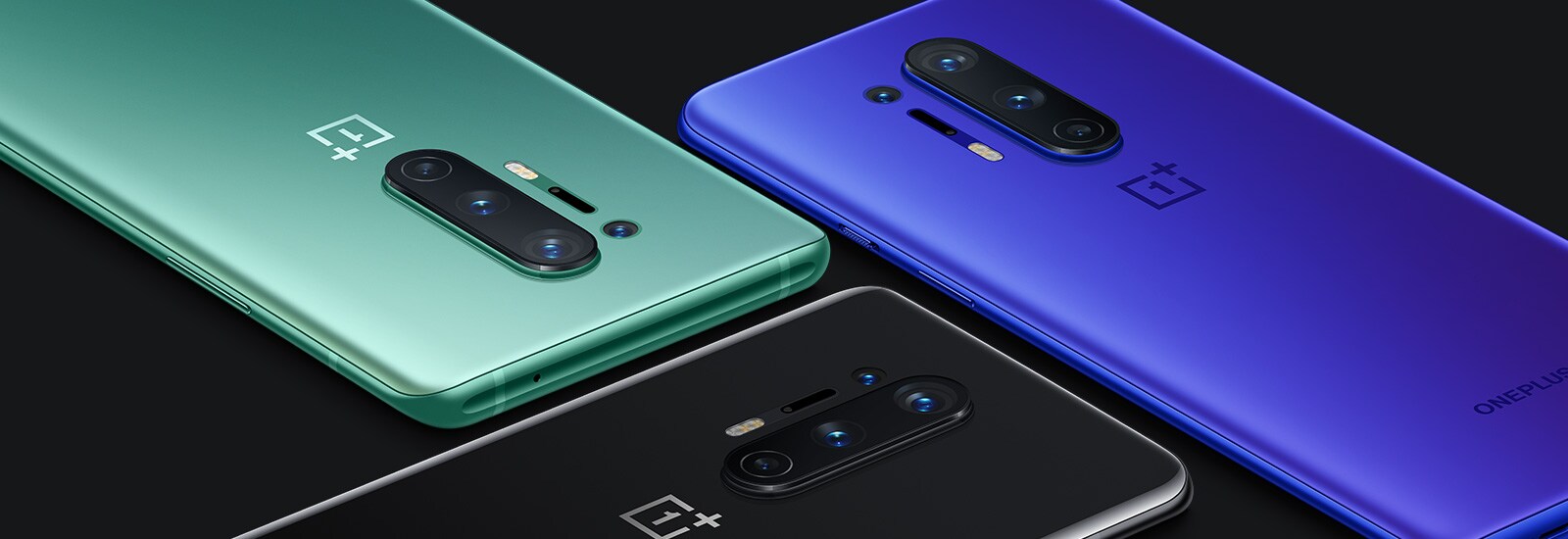
Three Chinese brands – Xiaomi, Vivo, and Oppo – hold 72% of India's market. Xiaomi itself has a 29% share (2019, 4th quarter). And, the latest model smartphones of OnePlus (owned by the same parent as Vivo and Oppo) sold out in minutes on June 18, three days after the Himalayan clash. Most Indians can't afford to shift their demand patterns. Non-Chinese smartphones, namely, Apple's iPhone and Samsung's Galaxy, are too expensive. Besides, those are ‘Made in China' too.
Likewise, the supply chain of services that Indians consume links back to China. Can wholly Indian suppliers replace Alibaba's data centers across India and its popular UC Browser mobile application?
Demand substitution is impracticable for Indian producers, too.
They need Chinese-origin auto parts and power plant inputs. They also need active pharmaceutical ingredients, two-thirds of which are Chinese. Indian drug companies could mass-produce the newly-discovered treatment for Covid-19, announced on 16 June by Oxford researchers – but not without Chinese APIs.
Ditto for FDI. India's development aspirations hinge partly on Chinese investment. The output from China's roughly 75 manufacturing facilities in India includes automobiles, chemicals, construction and power equipment, and optical fiber. Chinese investments in sectors such as automotive, chemical, electrical equipment, metallurgical, and renewable (solar) energy sectors sum to at least $4.14 billion as of 2019. The same year, India approved 5G equipment from China's telecommunications giant, Huawei Technologies, to help build India's wireless network. There's an additional $4 billion from Chinese investors into Indian startup companies, including 18 of India's 30 privately-held unicorn startups, valued at over $1 billion.
'Mere paas ma hai. Jack Ma', says @Paytm CEO @vijayshekhar on the mobile wallet company's future capital needs.https://t.co/V2WrXqgU3X pic.twitter.com/nWi7gs4wBL
November 11, 2017India's import and FDI dependence are not forever. The geopolitical climate to torque supply chains—like the Sino-American Trade War—is favorable. The Prime Minister's ‘Make in India' campaign, and shift of production to India, matters. His promise of land set-aside that are twice the size of Luxembourg is impressive. Market-based decoupling will help immunise India from Chinese economic pressure to shut up about the Galwan Valley, but it'll take time.
A Formal Embargo
What about an official quarantine of all Chinese goods, services, and FDI? Government action would need strict enforcement by Indian customs officials to block entry of Chinese origin-goods, by regulators to do so with respect to services, and cancellation of Huawei's license. To cope with the shock loss of Chinese goods, Indian businesses would scream for product exclusions, as did U.S. producers when the U.S. started levying Section 301 tariffs in the Trade War with China in July 2018.
It's dubious whether a government, whose hasty declarations mismanaged demonetisation and distorted labour markets amidst the pandemic, has the wherewithal to enforce a quarantine in the first place, much less skillfully administer an exclusion program.Would the costs of the effort yield a change in China's stance at the LAC? Lessons from America's comprehensive sanctions on Iran and Trade War with China are instructive. Even according to senior Iranian officials, by wrecking Iran's economy, those sanctions incentivized Iran's presence at the bargaining table and acceptance of the July 2015 Nuclear Deal. The U.S. was independent of Iran's hydrocarbons, so there was no economic blowback, plus most third countries acquiesced to America's secondary boycott of Iran, so Iran was stuck.
In contrast, India is of too little significance to dent China's economy. True, China accounts for 5.3% of India's exports but is the source of 14% of India's imports. China's trade surplus with India is China's vulnerability to an Indian boycott of Chinese merchandise, just as China's imbalance with the U.S. is in the Trade War. But, China needn't worry: of China's top 15 export destinations, India ranks seventh, but that's just 3% of Chinese exports, whereas America is first at 16.8%, as of 2019.
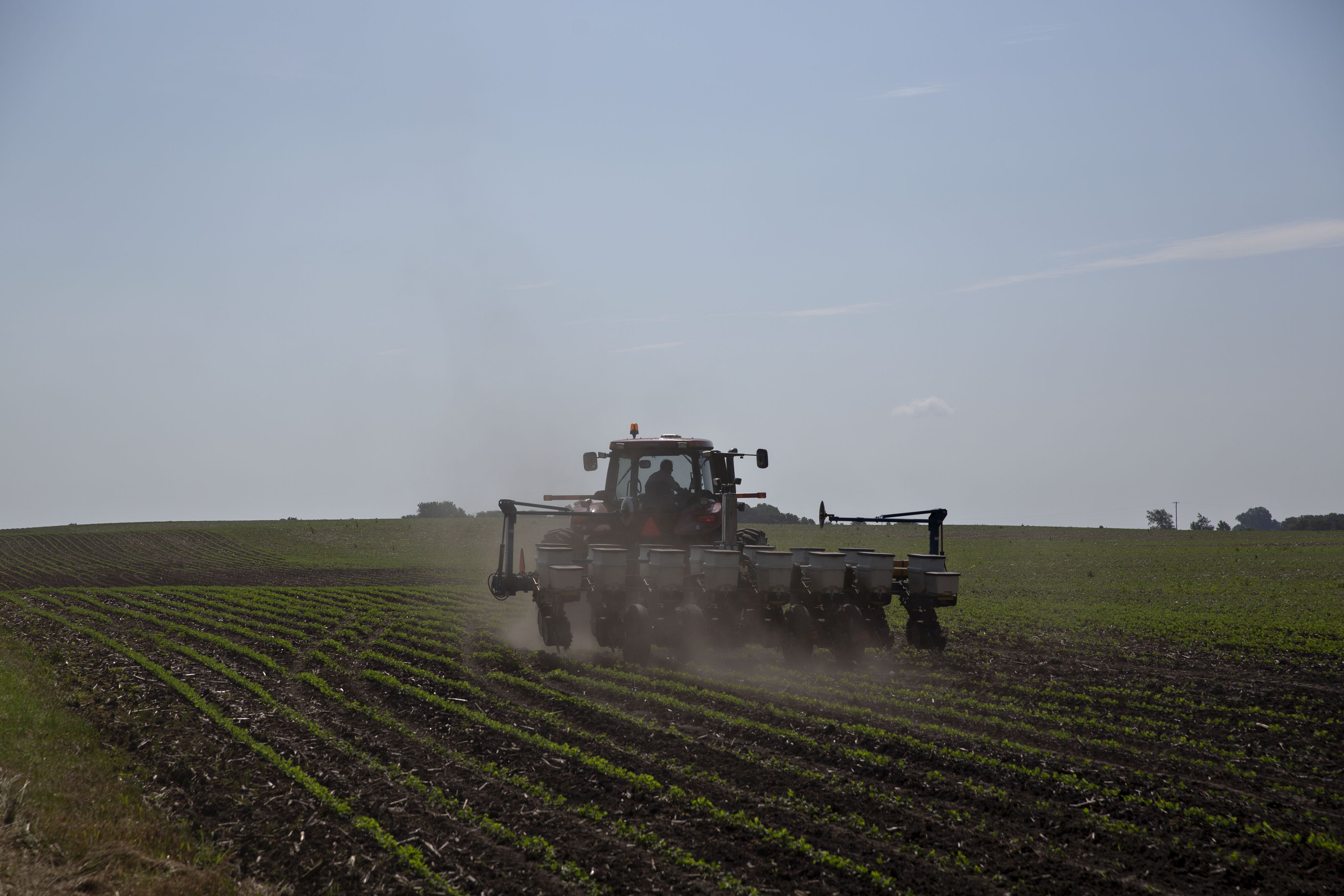
India can expect a tit-for-tat retaliation from China for formal restrictions on Chinese trade or FDI.That's how China is reacting in its Trade War with America. China is the third-largest market for Indian exports, so when China shutters its doors, Indian firms will have to find third countries to buy 5.3% of their goods. Opening new markets are what American farmers and manufacturers have been doing across two years of China's counter-retaliatory tariffs.
The U.S. has yet to accomplish anything except the December 2019 Phase One Agreement, which was doomed from inception with unrealistic targets for Chinese purchases of American goods. The recession induced by Covid-19 has killed any chance of China meeting those targets. No change in the Made in China 2025 Policy, thus a fortiori, no change at the LAC.
Oh, and there's the WTO to consider.China has a response that Iran, which is not yet a Member, lacked. China can sue India in the WTO. That's what Ukraine did, when Russia blocked Ukrainian traffic in transit eastward to Kazakhstan and the Kyrgyz Republic. That's also what Qatar did, when Saudi Arabia imposed a complete economic embargo on its goods, services, and FDI, and declined to enforce Qatari intellectual property rights. These precedents are instructive.
Ukraine proved its case, as a WTO Panel confirmed in its April 2019 report. Russia violated Article V:2 of the General Agreement on Tariffs and Trade. And, Qatar proved its case to a Panel, which issued its report in June 2020. Saudi Arabia violated Articles 41:1, 42, and 61 of the Agreement on Trade-Related Aspects of Intellectual Property Rights – concerning, obtaining legal counsel, civil enforcement, and criminal penalties, respectively.
But, there's more. Russia successfully invoked the GATT Article XXI(b)(iii) national security exception to justify its measures against Ukraine. Saudi Arabia successfully invoked TRIPS Agreement Article 73(b)(iii) to justify its denial of Qatari IP rights under Articles 41:1 and 42 (but not 61).
India, then, could plead the same defense against a Chinese complaint that India's measures violate GATT-WTO principles of non-discrimination and market access.Yet, that defense would be an acknowledgement India does not self-judge national security issues. India would cede to a Panel subject matter jurisdiction to adjudicate whether Chinese actions in Ladakh are, while not a war, an “emergency in international relations.” That's the test from the Russia Panel Report. Letting judges in Geneva decide whether India meets the test compromises Indian sovereignty.
As suggested at the outset, India has two options, economic and diplomatic. The subsequent column explores the second option, and concludes with the recommendation that India should pursue both.
Raj Bhala is the inaugural Brenneisen Distinguished Professor, The University of Kansas, School of Law, Senior Advisor to Dentons U.S. LLP, and member of the U.S. Department of State Speaker Program. The views expressed here are his and do not necessarily represent the views of the State of Kansas or University, Dentons or any of its clients, or the U.S. government, and do not constitute legal advice.
The views expressed here are those of the author, and do not necessarily represent the views of BloombergQuint or its Editorial team.
Essential Business Intelligence, Continuous LIVE TV, Sharp Market Insights, Practical Personal Finance Advice and Latest Stories — On NDTV Profit.