Blue Wave Will Derail the AI Trade but Won't Dismantle the AI Era | Unhedged Position
The Democrats' sweep of the US Congress will see politics collide with economic forces both over the long and short term.
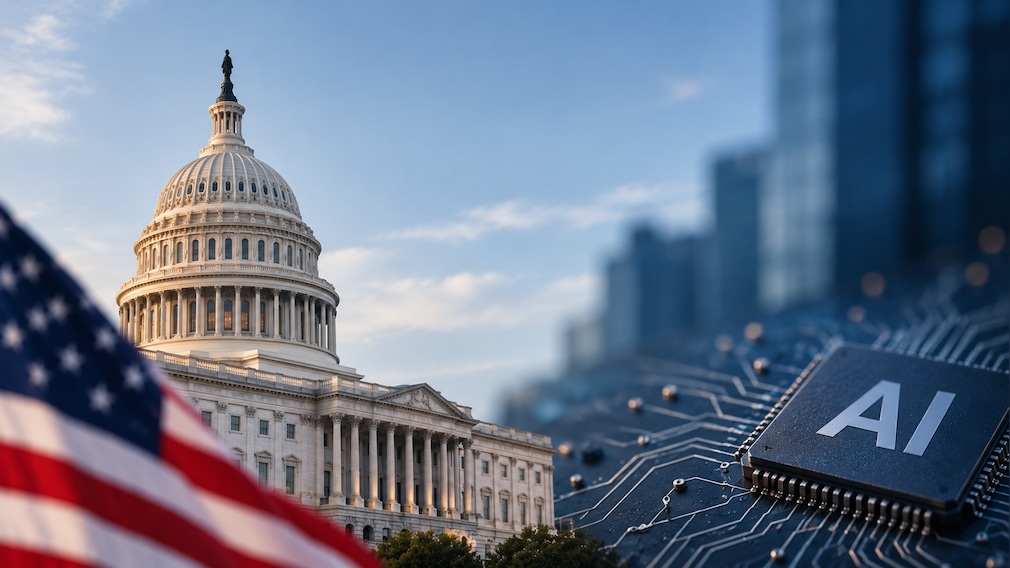
The Democratic Party taking control of both houses of the Congress will have many implications for the US, and, consequently, the world economy.
And the immediate impact will be felt on artificial intelligence.
It goes beyond some of the rather hardline views put out by Democratic party candidates on AI: it's about how the party, or any political party, typically responds to market forces and economic conditions.
ALSO READ | Trump's Political Future At Stake: What Republican Defeat In US Midterms Could Mean
Over the last few years, AI companies have put on the biggest capex boom in economic history. Such rapid progress has been made possible not just by the promise of what's doable, but also by trying to will longshots into existence, thanks to relentless execution and availability of easy capital.
The recent outflows from the AI trade show the market (which was likely sniffing a Democrat victory) is wising up to two things. One, the AI story is getting a reality check on investments-versus-productivity returns.
The second reason is populism.
The AI boom has created a dichotomy of spectacular nature. US GDP growth remains the strongest it has been in years. Yet, Main Street feels left out. While a few companies corner a big chunk of the gains made during the boom, real wages continue to stagnate.
This will make AI an easy target for Democrats. Trump has made winning the artificial intelligence race a cornerstone of his policy. Democrats will likely blame it for everything from inflation to wages.
ALSO READ | Texas Turns Blue After Over Three Decades — How The AI Game Backfired For Republicans Explained
Nowhere is this more evident than in Texas, where Gina Hinojosa -- the first Democrat governor to take office since 1990 -- has promised to pause construction of data centres.
Such an environment likely means that the AI bubble is in the middle of a burst, and that the AI trade will continue to unwind.
And yet, it is clear the AI era is only just starting.
For two seemingly opposite things can be true at the same time. Here's why.
George Soros famously said that bubbles “don't grow out of thin air; they have a solid basis in reality but reality as distorted by a misconception.”
And the reality is the AI is the most transformative force in history. The misconception is that RoI doesn't matter.
The AI boom allowed capital to compress decades' worth of progress into years – progress that would have anyway otherwise been made at a slower pace.
It allowed companies to try out everything that might work. Now that “proof of concept” of generative intelligence has been established, those that survive any shakeout will be able to build on it.
Bubbles burst when two things happen: investors stop playing the ‘greater fool' trade (where they buy on the belief that expensive prices will become more expensive because others are buying) and when cash flow takes precedence.
What they don't do is keep capital from finding its way into forces that create true economic value.
We saw the last example of this 26 years ago. The market thought dotcom companies would change the world. And they did. Just that investors started caring about them lesser than before.
-
A New Samvat Wishlist: Inclusive Prosperity And Human Development

India has strengthened its economic foundations through infrastructure, digital access and enterprise. Its next growth chapter must deepen productivity, create better livelihoods and widen participation in prosperity.
-
Love, Sex Aur Dhokha: The Audacious Plot To Spy On Jensen Huang
A Taipei dinner, a Singapore chip buyer and a suspected Chinese asset: inside the alleged spy operation that got close to NVIDIA's Jensen Huang.
-
Ten Things I Learnt This Samvat
Patience can be a trap. Cheap stocks can stay cheap. Leverage can wipe you out. What did Samvat 2082 teach us? Niraj Shah writes on 10 lessons from the year gone by.
-
Talking Points This Week: Tech Nerves, FII Buying, And A Faraway Banking Shock
The global markets are not shining this Diwali. The exception in the large markets is, India.
-
Midterm Rally Lasted A Day. The Hard Reality Of A Divided US May Last Two Years | Opinion
Between a contested AI boom, a debt ceiling that arrives in 2027 and a president with every incentive to act alone, the next two years may prove more volatile than the first day's rally suggests.
-
It's Time To Take The GST Council's Bet On Trust Global
Payment records can prove India's services exports, and clear, proportionate rules can bring foreign digital sellers into the tax net.
-
Opinion | India at 38: From Innovation Overperformer to Innovation Powerhouse
India now has 453 VC-backed deep science startups, 18 of them late-stage, after 117 percent growth since 2020. Laurus Labs, at USD 9.3 billion, is the most valuable deep science company in any middle-income economy outside China.
-
Navigating Energy Crossroads: S Jaishankar's Call For Diversified Supply Chains At G20 Ministerial Meeting
As geopolitical fault lines continue to test maritime trade routes and commodity flows, Jaishankar's message remains pertinent: true economic resilience requires open markets, protected transit lines, and a genuine commitment to multilateral cooperation rather than coercion.
-
Indians Are Travelling, But Not Every Journey Is A Holiday | The Week In Whys
Pilgrims, patients and working women are the real travellers, and the system hasn't quite caught up with them.









