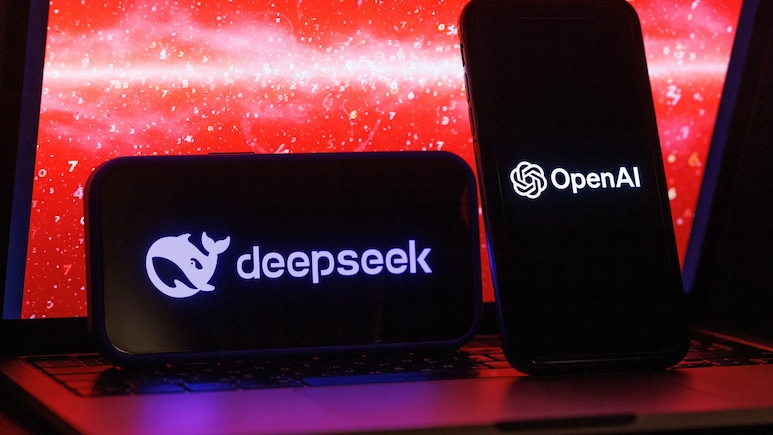
OpenAI has warned US lawmakers that its Chinese rival DeepSeek is using unfair and increasingly sophisticated methods to extract results from leading US AI models to train the next generation of its breakthrough R1 chatbot, according to a memo reviewed by Bloomberg News.
In the memo, sent Thursday to the House Select Committee on China, OpenAI said that DeepSeek had used so-called distillation techniques as part of “ongoing efforts to free-ride on the capabilities developed by OpenAI and other US frontier labs.” The company said it had detected “new, obfuscated methods” designed to evade OpenAI's defenses against misuse of its models' output.
OpenAI began privately raising concerns about the practice shortly after the R1 model's release last year, when it opened a probe with partner Microsoft Corp. into whether DeepSeek had obtained its data in an unauthorized manner, Bloomberg previously reported. In distillation, one AI model relies on the output of another for training purposes to develop similar capabilities.
Distillation, largely tied to China and occasionally Russia, has persisted and become more sophisticated despite attempts to crack down on users who violate OpenAI's terms of service, the company said in its memo, citing activity it has observed on its platform.
Since DeepSeek and many other Chinese models don't carry a monthly subscription cost, the prevalence of distillation could pose a business threat to American companies such as OpenAI and Anthropic PBC that have invested billions of dollars in AI infrastructure and charge a fee for their premium services. That imbalance risks eroding the US advantage over China in artificial intelligence.
OpenAI also highlighted other national security risks raised by DeepSeek's gains, including that its chatbot had censored results about topics considered controversial by the Chinese government such as Taiwan and Tiananmen Square. When capabilities are copied through distillation, OpenAI said, safeguards often fall to the wayside, enabling more widespread misuse of AI models in high-risk areas like biology or chemistry.
Representative John Moolenaar, the Republican chair of the House China committee, said in a statement Thursday “this is part of the CCP's playbook: steal, copy, and kill,” referring to the Chinese Communist Party. “Chinese companies will continue to distill and exploit American AI models to their advantage, just like when they ripped off OpenAI to build DeepSeek.”
OpenAI declined to comment on the memo. Spokespeople for the Chinese embassy in Washington and for DeepSeek didn't immediately respond to requests for comment.
OpenAI's memo to the House China committee suggests that its efforts to block distillation have failed to eliminate the problem. The company said an internal review suggests that accounts associated with DeepSeek employees sought to circumvent existing guardrails by accessing models through third-party routers to mask their source.
DeepSeek employees have also developed code to access US AI models and obtain outputs in “programmatic ways,” OpenAI said. It also points to networks of “unauthorized resellers of OpenAI's services,” also designed to evade the company's controls.
White House AI Czar David Sacks has previously warned about Chinese distillation tactics, telling Fox News last year that DeepSeek was “squeezing more juice” out of older chips while also citing “substantial evidence that what DeepSeek did here is they distilled the knowledge out of OpenAI's models.”
OpenAI's warning about distillation also comes as many in Washington remain concerned that access to advanced AI chips may also accelerate DeepSeek's progress. At the end of last year, President Donald Trump moved to ease chip restraints and allow Nvidia to sell its H200 processors, chips that are about 18 months behind the leading Blackwell versions.
Since the R1 release, DeepSeek has only put out minor upgrades, even as competitors in the US and China have launched a flurry of new models. Bloomberg has reported that DeepSeek is developing an agent-based model to compete with OpenAI and other rivals and had hoped to release it in late 2025.
Shortly after the R1 release, US authorities opened a probe into whether DeepSeek circumvented US export controls by purchasing chips via Singapore. Records recently obtained by the House China committee show that Nvidia Corp. provided technical support to help DeepSeek improve and co-design its R1 model. The DeepSeek-V3 base model required only 2.8 million H800 GPU hours for its full training. Those processors were allowed to be sold to China for a few months in 2023, until a rule later that year halted sales.
“DeepSeek should have been a wake-up call about the dangers of selling advanced semiconductor chips to the CCP. Using less powerful Nvidia chips, China developed the most advanced open-source models on the planet,” Republican Representative Michael McCaul, who formerly led a House panel with export control oversight, said last year in the wake of the H200 decision. “I shudder to think of what they might do with more advanced hardware like the H200 chips.”
ALSO READ: Anthropic Drops Claude Risk Report Days After Its AI Safety Chief Resigns
Essential Business Intelligence, Sharp Market Insights, Practical Personal Finance Advice, Daily Fuel, Gold and Silver Prices and Latest Stories — On NDTV Profit.