- Union Cabinet eased FDI norms for countries sharing land borders, including China
- Small-ticket investments from these countries may now get automatic approval
- Auto and electronics sectors with Chinese ties may benefit from smoother approvals
The Union Cabinet on Tuesday has eased foreign direct investment (FDI) norms for countries that share land borders with India, including China, potentially opening the door for faster capital inflows and renewed business partnerships in sectors such as automobiles, electronics manufacturing, chemicals, consumer durables and capital goods.
Sources told NDTV Profit that the Cabinet, chaired by Prime Minister Narendra Modi, has amended Press Note 3 of 2020, which had mandated government approval for investments from companies having shareholders from neighbouring countries.
Under the revised framework, small-ticket investments from these countries may now receive automatic approval, according to people familiar with the matter. The government is expected to define thresholds based on investment size or stakeholding.
The move is aimed at reducing compliance burdens and speeding up investment approvals, a step that could benefit companies with existing Chinese partnerships or supply chain dependencies.
ALSO READ: Cabinet Eases Curbs: Small-Ticket FDI From China, Other Neighbours Set For Automatic Approval
Auto And Mobility: Existing China Ties May Benefit
The automobile and auto component ecosystem is among the sectors most closely linked with Chinese partnerships and technology collaborations.
Companies such as Tata Motors, Sona BLW Precision Forgings, and JSW Group could see indirect benefits as the easing of norms may simplify future collaborations and capital flows.
Tata Motors has a joint venture with Chinese automaker Chery Automobile Co. Ltd., while Sona BLW has partnered with China's Jinnaite Machinery Co. Ltd.. The JSW Group has a partnership with SAIC Motor, which operates MG Motor in India.
Auto component makers that rely on Chinese technology or components may also benefit from smoother investment flows and easier technology collaborations.
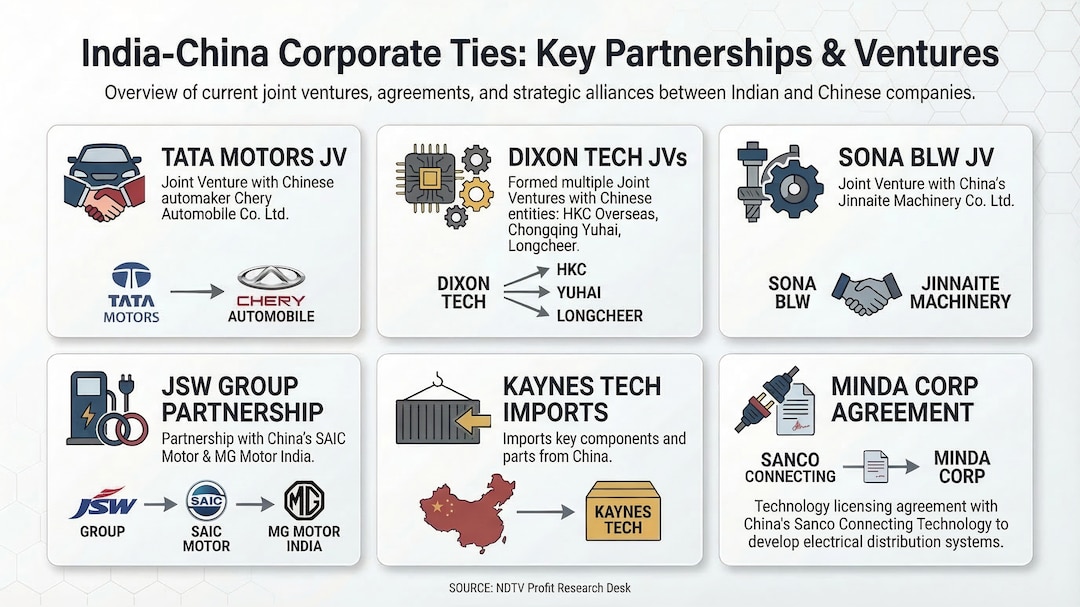
Photo Credit: NDTV Profit
Electronics Manufacturing: A Big Beneficiary
India's electronics manufacturing sector, which depends significantly on Chinese components and technical collaborations, may also gain from the relaxation.
Companies such as Dixon Technologies have already established joint ventures with Chinese firms including HKC Overseas, Chongqing Yuhai, and Longcheer.
These partnerships are crucial for manufacturing smartphones, televisions and other consumer electronics in India. Easier approval processes could accelerate new investments or expansions in the electronics ecosystem.
Sectors Importing Material From China
India's chemical sector relies heavily on raw materials imported from China, making it another area where policy changes could ease operational friction. Companies such as Aarti Industries, Deepak Nitrite, SRF, Atul Ltd, and Gujarat Alkalies and Chemicals import key intermediates from China.
Companies including Voltas, Blue Star, Whirlpool of India, and Havells India import components such as compressors, electronic controllers, printed circuit boards (PCBs) and washing machine parts from China, when it comes to the consumer durable and electronics components.
Capital goods and power infrastructure companies also rely on Chinese machinery, components or project equipment. Firms such as Thermax, Triveni Turbine, KEC International, ABB India, Siemens India, and Kalpataru Projects International import components or equipment from China for infrastructure and power projects.
Similarly, energy companies such as Tata Power and Sterling and Wilson Renewable Energy rely on Chinese solar modules and equipment.
ALSO READ: Despite PLI Push, India Sources Over 70% Key Pharma Inputs From China: Govt Disclosure
China's Share In India FDI Remains Small
Despite strong trade ties, China's share in India's FDI remains relatively limited.
Between April 2000 and December 2025, China ranked 23rd among investors, accounting for 0.32% of India's total FDI equity inflows, amounting to $2.51 billion.
However, bilateral trade between the two countries has expanded significantly.
China has emerged as India's second-largest trading partner, even as the trade deficit continues to widen.
In 2024–25, India's exports to China fell 14.5% to $14.25 billion, compared with $16.66 billion a year earlier. Imports, however, rose 11.52% to $113.45 billion, pushing the trade deficit to $99.2 billion from $85 billion in the previous year.
During April–January 2025–26, India's exports to China rose 38.37% to $15.88 billion, while imports increased 13.82% to $108.18 billion, leaving the trade deficit at $92.3 billion.
Essential Business Intelligence, Continuous LIVE TV, Sharp Market Insights, Practical Personal Finance Advice and Latest Stories — On NDTV Profit.