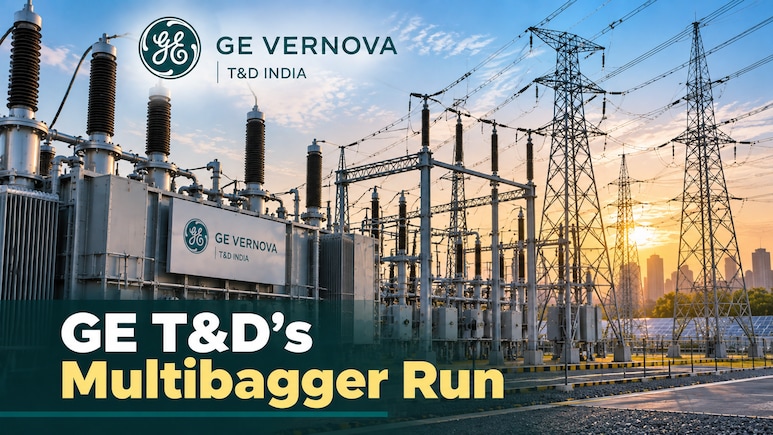
GE Vernova T&D India Ltd. has emerged as one of the clearest beneficiaries of the investment cycle unfolding in India's power transmission network. What was once largely a transmission equipment business has steadily moved towards higher-value technologies such as high-voltage direct current, 765 kV equipment, digital grid solutions and renewable power evacuation. At the same time, a much larger order pipeline and sharper improvement in profitability have changed the financial profile of the company.
That transformation has been reflected in the stock price. A Rs 1 lakh investment in GE T&D India five years ago would be worth roughly Rs 34 lakh today, based on the stock's 3,313% five-year return. The business numbers explain why the market has re-rated the company so sharply.
Financials Also Read | Layoffs Are Rising In Tech, But These Skills Are Helping People Unlock Better Pay | FY21 | FY26 | Change |
Revenue | Rs 3,452 Cr | Rs 6,206 Cr | +80% |
Operating Profit | Rs 145 Cr | Rs 1,637 Cr | 11.3x |
Operating Margin | 4.2% | 26.4% | +22.2 ppt |
PAT | Rs 60 Cr | Rs 1,233 Cr | 20.4x |
Order Backlog | Rs 4,590 Cr | Rs 21,456 Cr | 4.7x |
From Modest Margins To A High-Profitability Business
The striking part of the five-year change is not revenue alone. Revenue increased by about 80% or less than 1.8 times, but operating profit jumped more than 11 times and profit after tax more than 20 times. Operating margin expanded from just 4.2% in FY21 to 26.4% in FY26.
The starting point was challenging, as power demand declined significantly due to the worldwide lockdown, and COVID-related disruption and delays in transmission projects affected the business. But the company's existing capabilities in high-voltage equipment, substations, automation, and grid technologies gave GE T&D a base to participate in the larger transmission build-out that followed.
As renewable generation expanded, the nature of the opportunity also changed. India needed not only more substations and transformers but increasingly sophisticated infrastructure to move power across long distances and integrate intermittent renewable generation.
Also Read: Outperforming Nifty Metal: Welspun Corp Delivers Massive 20x Return With A 1,990% 5-Year Rally
HVDC And Manufacturing Changed The Opportunity
GE Vernova T&D India has increasingly moved into that higher-value segment. The company commissioned the 6 GW Champa-Kurukshetra HVDC project and won the 2.5 GW Khavda VSC-based HVDC project. The portfolio now spans from medium voltage to ultra-high voltage solutions up to 1200 kV, while more than 100 smart grid control-centre projects have been delivered.
Manufacturing has expanded alongside the technology portfolio. The Vadodara transformer and reactor facility is being expanded by 50%, while capacity additions are underway for GIS, AIS and HVDC-related equipment. The company has also expanded exports, with India-manufactured solutions reaching more than 60 countries.
This combination matters because India's transmission investment requirements are becoming much larger. The company estimates that around 20,000 circuit km of high-voltage transmission lines and 125 GVA of transformation capacity will be required annually through 2032, while more than 60 GW of new HVDC corridors are identified in the longer-term transmission outlook.
What Could Drive The Next Phase
The near-term picture remains linked to execution and order conversion. In the quarter ended on June 30, revenue rose 38% year on year to Rs 1,840 crore, while Ebitda margin stood at 25.1%. Management expects base annual orders of around Rs 7,000-8,000 crore and continues to guide for mid-20s Ebitda margins.
Exports are becoming an important part of the mix, while the HVDC pipeline remains strong despite some project timelines moving out.
The latest development adds to that pipeline. GE Vernova T&D India has emerged as the L1 bidder for a 6,000 MW, ±800 kV HVDC project connecting Barmer II with South Kalamb. The project involves two 3,000 MW converter terminals and, if formally awarded, would add another large multi-year opportunity to the company's portfolio.
The stock's multibagger journey has therefore been backed by a fundamental change in the business, including a larger order book, dramatically higher margins and greater exposure to complex transmission technologies. The challenge from here is to convert that opportunity into sustained revenue and profitability without giving back the margin gains that have driven the re-rating.
Also Read: Stock In Focus: GE Vernova T&D Share Price Jumps Nearly 7%; Here's Why
Essential Business Intelligence, Sharp Market Insights, Practical Personal Finance Advice, Daily Fuel, Gold and Silver Prices and Latest Stories — On NDTV Profit.