BJP Manifesto A Boost For Auto, Railway, Cement, Real Estate Sectors, Say Analysts
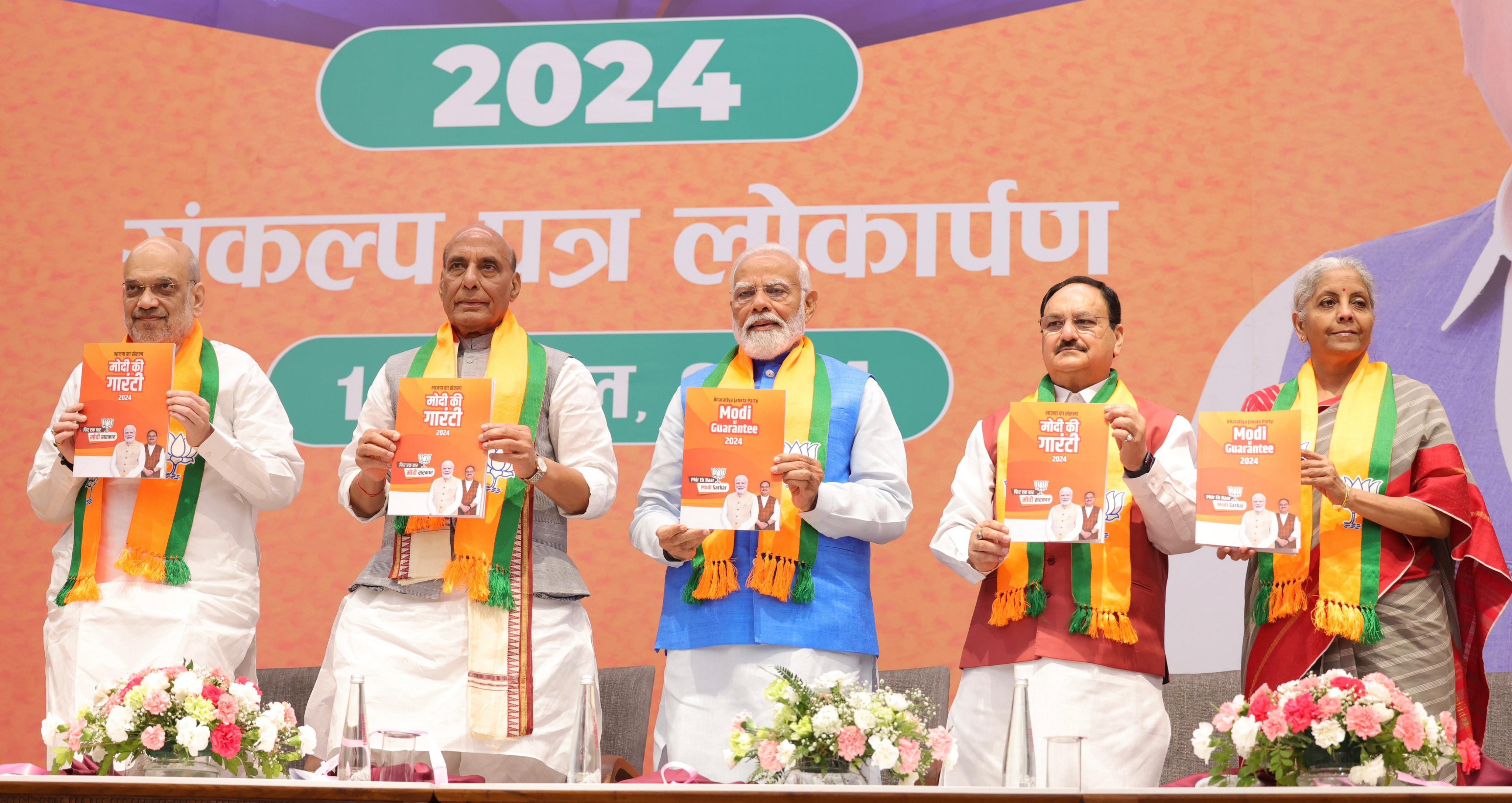
Automobiles, cement, metals and real estate are some sectors that are likely to see positive impact if the Bharatiya Janata Party-led government comes back in power after the Lok Sabha elections as its manifesto suggests a continuation of infrastructure and auto lead initiatives, according to brokerages.
Prime Minister Narendra Modi unveiled his party's manifesto for the next five years on Sunday, emphasising continuity and enhancement of previous policies, as well as introducing new measures to further India's economic progress.
BJP's poll promise pledges to sustain the state-led infrastructure initiatives undertaken in recent years. It aims to construct over 5,000 km of railway tracks annually and develop 15,000 km of access-controlled highways. Electric-vehicle charging infrastructure is highlighted twice in the manifesto, signalling the party's commitment to this growing sector, according to Emkay Global Financial Services Ltd.
There is also a strong reaffirmation of green initiatives, including the development of 500 GW of renewable energy, the Green Energy Corridor project and the enhancement of green hydrogen production, Emkay said in a note.
Here What Brokerages Say
Phillip Capital
The BJP's manifesto indicates policy continuity and there is greater scale, clarity, confidence, and fiscal at play.
In its third term, Phillip Capital expects the party to be more aggressive in terms of execution and policy development.
It is also likely to execute plans that were laid out in the previous regime.
The research firm expects broad-based focus across sectors and segments over the next five years.
It remains bullish on India's economy and equities, with a long-term perspective.
Phillip Capital expects the country's economy at $6.7 trillion and the Nifty at 40,000 by fiscal 2030.
Positive on automobiles (EV play, income play and penetration), cement, metals (and pipes), real estate, alternative fuels (solar, ethanol, hydrogen), financials (PFCs, NBFCs, PSBs), pharma (CDMO), FMCG, EMS, hotels, airline.
Citi Research
Citi Research has highlighted six areas of continuity in the pre-election report — infra capex, manufacturing-focused industrial policy, fiscal consolidation and macro stability, inflation control, ease of doing business and trade protectionism.
The BJP manifesto sets an ambitious vision for transforming India into a global electronics manufacturing hub by 2030, aiming to expand electronics manufacturing threefold and nurture indigenous brands.
It also outlines a series of key focus areas and initiatives across various sectors to enhance India's economic growth and self-reliance. These include:
Semiconductor and chip manufacturing.
Automobiles and EVs.
Defence manufacturing.
Railway manufacturing.
Aviation manufacturing and maintenance, repair and overhaul.
Shipbuilding.
Pharmacy.
Textile manufacturing.
Toy manufacturing.
Rare earth and strategic minerals.
Bio-manufacturing hubs.
Industrial cities along industrial corridors.
While the manifesto doesn't provide specific details on extending the Production-Linked Incentive scheme or the Make in India initiative, it emphasises promoting exports through international cooperation, infrastructure development and legal simplification.
The undertone of the manifesto is to provide more credit-centric support to foster entrepreneurial spirits, whether it is for doubling of Mudra loan limits or emphasising the PM Svanidhi scheme for street vendors.
Emkay Global
The BJP continues to favour an outcome-based strategy in the social sector over subsidy-driven targets. Key focus areas are delivering a better quality of life through piped water and LPG connections.
The promise of zero-electricity bills is likely to be achieved through renewable energy rather than cash transfers.
Lowering the cost of healthcare remains a commitment, more likely via a continued push through the state insurance scheme rather than explicit control of prices.
"We see a focus on enhancing the efficiency of every rupee spent, rather than risking the fiscal balance via increased spending," it said.
Watch The Video Here

-
Talking Points This Week: Tech Nerves, FII Buying, And A Faraway Banking Shock

The global markets are not shining this Diwali. The exception in the large markets is, India.
-
Midterm Rally Lasted A Day. The Hard Reality Of A Divided US May Last Two Years | Opinion
Between a contested AI boom, a debt ceiling that arrives in 2027 and a president with every incentive to act alone, the next two years may prove more volatile than the first day's rally suggests.
-
Blue Wave Will Derail the AI Trade but Won't Dismantle the AI Era | Unhedged Position
The Democrats' sweep of the US Congress will see politics collide with economic forces both over the long and short term.
-
It's Time To Take The GST Council's Bet On Trust Global
Payment records can prove India's services exports, and clear, proportionate rules can bring foreign digital sellers into the tax net.
-
Opinion | India at 38: From Innovation Overperformer to Innovation Powerhouse
India now has 453 VC-backed deep science startups, 18 of them late-stage, after 117 percent growth since 2020. Laurus Labs, at USD 9.3 billion, is the most valuable deep science company in any middle-income economy outside China.
-
Navigating Energy Crossroads: S Jaishankar's Call For Diversified Supply Chains At G20 Ministerial Meeting
As geopolitical fault lines continue to test maritime trade routes and commodity flows, Jaishankar's message remains pertinent: true economic resilience requires open markets, protected transit lines, and a genuine commitment to multilateral cooperation rather than coercion.
-
Indians Are Travelling, But Not Every Journey Is A Holiday | The Week In Whys
Pilgrims, patients and working women are the real travellers, and the system hasn't quite caught up with them.
-
Getting To Work Costs Women More | The Reason Why
It is not just about women paying more than men. It is about women paying much more in cities than in villages.
-
AI Bias In Investing Cannot Be Eliminated, But It Can Be Governed
Framing is a particularly important example as identical financial information presented in terms of gains rather than losses can lead an LLM to reach a different assessment.









