Scan to Download
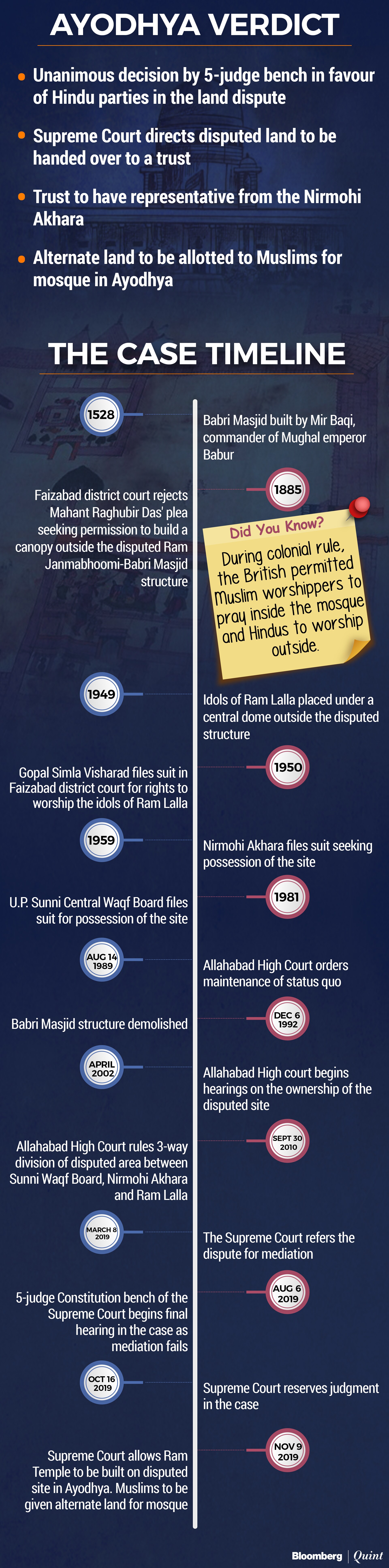
Ayodhya Verdict: Mandir, Masjid And Supreme Court - A Story In Pictures
Today's historic day and verdict has been gracefully accepted by the 1.25 crore citizens of the country. This is not taken from the pages of history, instead is being lived and written by the country in the present, said Prime Minister Narendra Modi.
"It's heartening that the verdict came unanimously," he said.
Today is also a golden chapter in the history of the judiciary of India, says PM Modi on Supreme Court's Ayodhya verdict.
Nov. 9 will go down in India’s history as the day masjid and mandir won and lost legitimacy in the temple of justice.
BloombergQuint’s Arpan Chaturvedi captures the day, the verdict, the winners and losers.
Watch the best shots from the Ayodhya verdict here.
— Asaduddin Owaisi (@asadowaisi) November 9, 2019
The halls of justice have amicably concluded a matter going on for decades. Every side, every point of view was given adequate time and opportunity to express differing points of view. This verdict will further increase people’s faith in judicial processes.
— Narendra Modi (@narendramodi) November 9, 2019
मुझे पूर्ण विश्वास है कि सर्वोच्च न्यायालय द्वारा दिया गया यह ऐतिहासिक निर्णय अपने आप में एक मील का पत्थर साबित होगा। यह निर्णय भारत की एकता, अखंडता और महान संस्कृति को और बल प्रदान करेगा।
— Amit Shah (@AmitShah) November 9, 2019
Road Transport and Highway Minister has said that in a democratic country everyone must accept the court's verdict. “Being a democratic country, we must all accept the court verdict. My only appeal to all the people is to maintain peace and calm across the country,” Gadkari said in a statement.
Congress holds a press conference after the Supreme Court delivers its verdict in the Ayodhya land dispute case. #BQLive
— BloombergQuint (@BloombergQuint) November 9, 2019
Catch all #AyodhyaVerdict live updates: https://t.co/iAjUicTNOg https://t.co/54K5LONHYJ
Section 144, which prohibits assembly of four or more people in an area, has been imposed in various parts of the country following the Supreme Court’s verdict. In Delhi and Uttar Pradesh, it had been imposed as a precautionary measure last night itself.
Varun Kumar Sinha, Lawyer of Hindu Mahasabha: It is a historic judgement. With this judgement, the Supreme Court has given the message of unity in diversity. pic.twitter.com/pJW3jJDmx7
— ANI (@ANI) November 9, 2019
Zafaryab Jilani, Sunni Waqf Board Lawyer: We respect the judgement but we are not satisfied, we will decide further course of action. #AyodhyaJudgment pic.twitter.com/5TCpC0QXl6
— ANI (@ANI) November 9, 2019
Supreme Court orders that Central Govt within 3-4 months formulate scheme for setting up of trust and hand over the disputed site to it for construction of temple at the site and a suitable alternative plot of land measuring 5 acres at Ayodhya will be given to Sunni Wakf Board. pic.twitter.com/VgkYe1oUuN
— ANI (@ANI) November 9, 2019
Ayodhya Verdict: Disputed Site Goes To Hindus For Ram Temple, Muslims To Be Given Alternate Land For Mosque
The Supreme Court has directed allotment of an alternate land to the Muslims for construction.
The evidence of Hindus stands on a better footing than Muslims, it said. On the balance of probabilities, there is evidence that worship by Hindus in the outer courtyard had continued, it added.
The Supreme Court said that the mosque was not abandoned or seceded by the Muslims.
The CJI said:
The Supreme Court said that Ram Janmabhoomi, the birth place of Hindu deity Ram, is not a juristic person or a legal entity. However, it said that Ram Lalla, the child form of the deity, is a juristic person under Indian law.
The Chief Justice said that the title of the land must be decided on settled legal positions.
The CJI said:
The Archaeological Survey of India's report has noted that the Babri mosque was not constructed on vacant land, CJI said while reading the verdict. The report showed an existence of an underlying structure which was not of an Islamic origin, CJI said.
The ASI has not opined whether a temple was demolished for the construction of a mosque, he added.
The Supreme Court has said that secularism is a basic feature of the Constitution.
The mosque was built by Mir Baki under the orders of Mughal emperor Babur, the Chief Justice said. He noted that one of the parties to the case Nirmohi Akhara is not a shebait, or someone who serves a deity.
The suit by Nirmohi Akhara is barred by limitation, the CJI has said. Their acts do not satisfy the legal test of exclusive rights of management.
The Chief Justice of India said that the bench has dismissed the Single Leave Petition filed by Shia Waqf Board challenging the 1946 order of Faizabad Court.
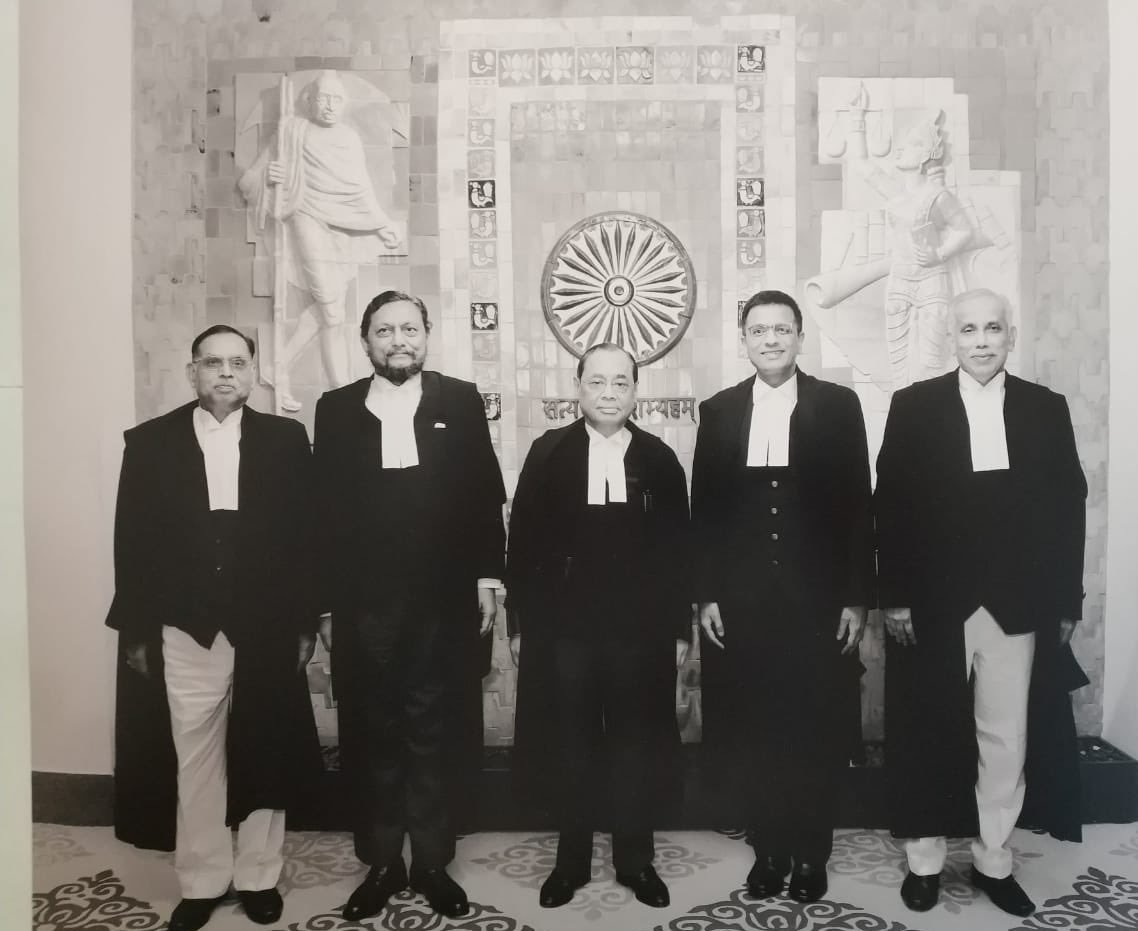
As the five-judge bench assembles to deliver its verdict, Chief Justice of India Ranjan Gogoi said that the judgment is unanimous.
Delhi: Chief Justice of India Ranjan Gogoi arrives at Supreme Court #AyodhyaJudgement https://t.co/HwNU8V7dB9 pic.twitter.com/Y72MSIFje0
— ANI (@ANI) November 9, 2019
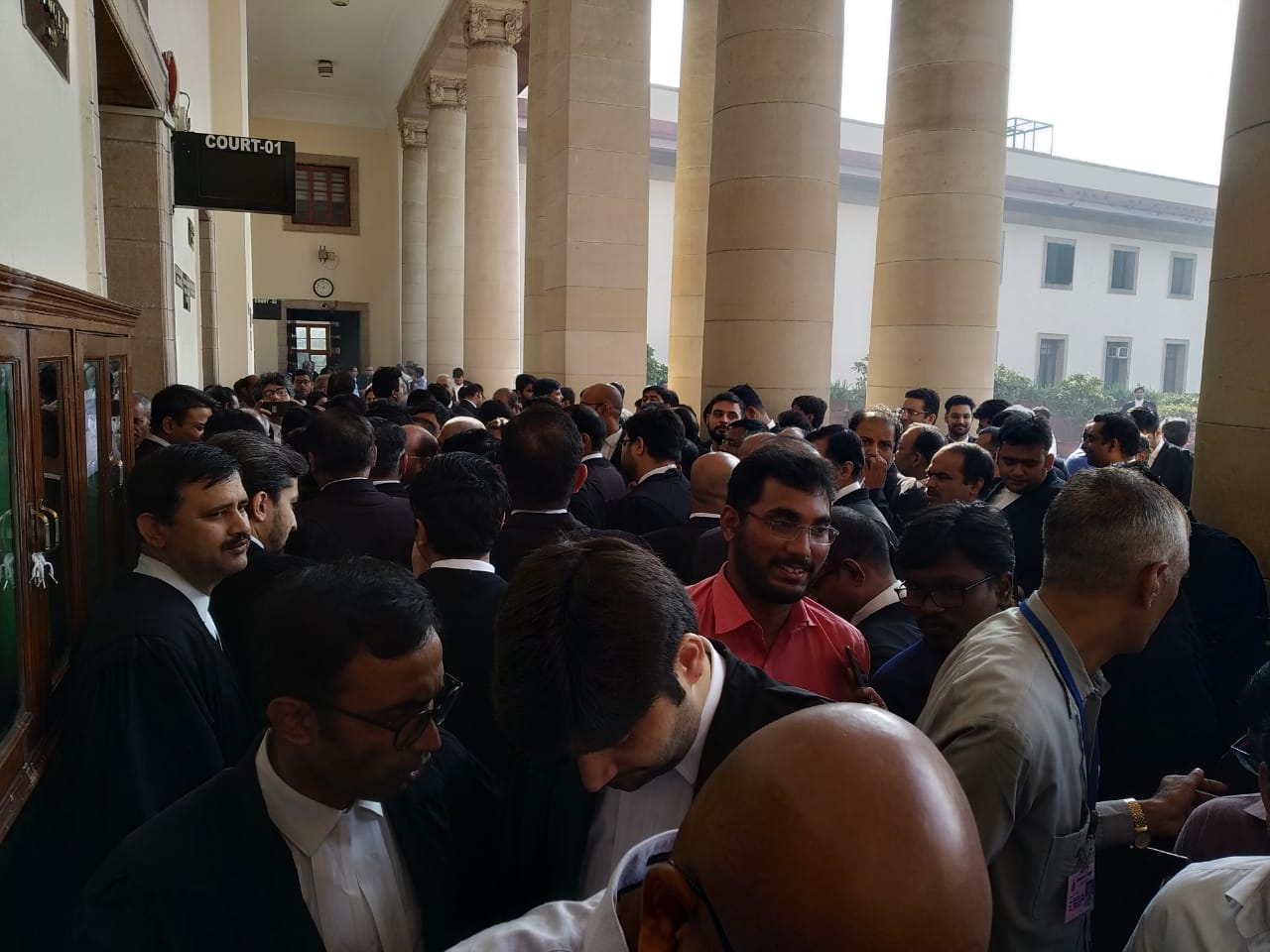
Supreme Court: Ram Lalla deity lawyer, CS Vaidyanathan (extreme right) in conversation with Dr Rajeev Dhavan, senior lawyer for Sunni Wakf Board, outside the CJI courtroom. #AyodhyaJudgment pic.twitter.com/GZvt2q8cd0
— ANI (@ANI) November 9, 2019
Ayodhya On Edge: Schools, Colleges To Be Shut In UP, Security Beefed Up Across Country
Essential Business Intelligence, Continuous LIVE TV, Sharp Market Insights, Practical Personal Finance Advice and Latest Stories — On NDTV Profit.