What Does The Revised GDP Figure Mean For India's Fiscal Deficit?
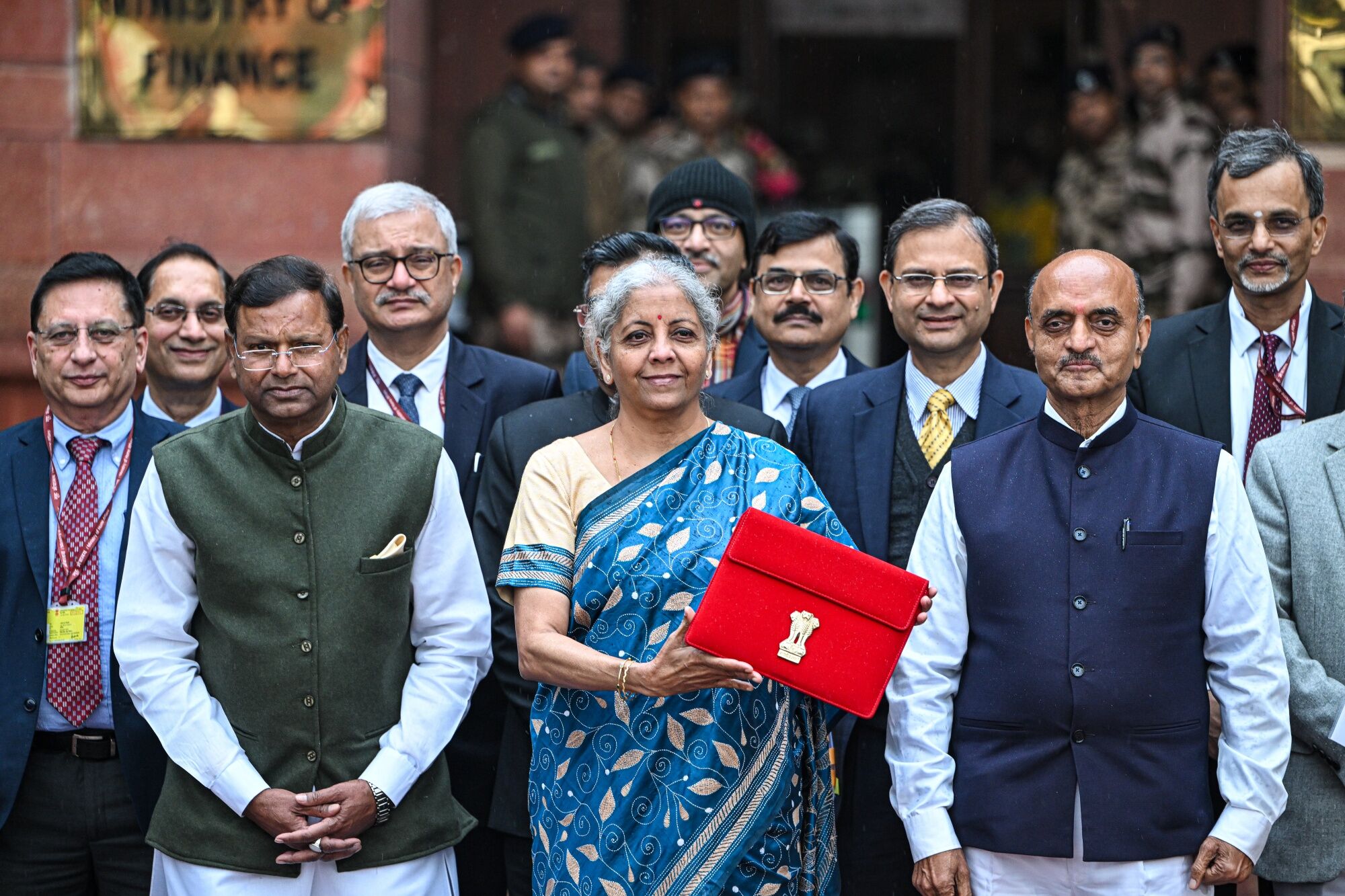
Economists are divided about the impact of India's revised gross domestic product figures, released a day ago, on the government's fiscal deficit.
Some economists think a revision in the nominal GDP would result in a slight uptick in the fiscal deficit. Others said growth in net taxes will more than make up for a higher deficit.
A senior official of the Ministry of Finance noted that the government expects to stick to its revised fiscal deficit target of 5.8% of the GDP, in line with the government's stand.
India's GDP defied expectations on Thursday to grow by 8.4% year-on-year in the quarter ended December. The latest estimates released by the government's statistical agency were sharply higher than previous projections that ranged about 6.6%.
Growth in nominal GDP during the ongoing financial year is estimated at 9.1%, compared to 14.2% in FY23. The nominal GDP, however, becomes more important in the calculation of the fiscal deficit.
In its interim budget, the Union government revised its fiscal deficit target downward to 5.8% of GDP from the budgeted 5.9%. In absolute terms, this brings the fiscal deficit to Rs 17.34 lakh crore from the Rs 17.86 lakh crore announced in the 2023 budget.
The union government's review of accounts on Thursday revealed that as of January 2024, the government has reached only 63.6% of its fiscal deficit target or Rs 11.02 lakh crore in absolute terms, exhibiting a comfortable headroom after the first 10 months of the year.
What Economists Say
D.K. Srivastava, chief policy advisor at EY India, noted that fiscal data released by the Controller General of Accounts (CGA) indicates a "healthily buoyant growth" in gross tax revenues at 14.5% between April 2023 and January 2024. This, he said, will help attain the committed fiscal deficit.
"With only 5.8% growth required in the remaining two months of the fiscal year in order to meet the revised estimates for FY24, the improvement in the fiscal deficit target to 5.8% of GDP seems quite feasible," Srivastava noted.
Sunil Kumar Sinha, senior director for public finance and principal economist at India Ratings and Research, agrees that though the lower denominator in terms of the nominal GDP revision means an upward bias and higher tax revenue, along with the levels of deficit currently seen, the result could be a lower fiscal deficit.
"The wedge between GVA growth and GDP growth is the net taxes, which have increased in the second advanced estimate (15.5%), indicating a very robust tax collection," Sinha told NDTV Profit. "As a result, I won't be surprised if the FY24 fiscal deficit turns out to be even better than the revised 5.8% of GDP."
Others said a lower denominator in the nominal GDP could result in a mild increase in the fiscal deficit.
"(While) it might appear that given the real GDP growth number, the fiscal deficit could have looked better than what the government had announced," Yuvika Singhal, India economist at QuantEco Research, told NDTV Profit. "But the revised GDP numbers released on Thursday mathematically bring back the fiscal deficit to 5.9%, when actually the FY24 revised estimate is pegged at 5.8%."
The nominal GDP growth rate in FY24 as per the first advance estimates came in at 8.9%, while the second advance estimate revised it upwards to 9.1%.
As per data released on Thursday, in absolute terms, nominal GDP, or GDP at current prices in FY24, is estimated to attain a level of Rs 293.90 lakh crore, against Rs 269.50 lakh crore in FY23.
"...what has changed (between the first and second advance estimates for FY24) is that now revisions have been carried out to FY22 and FY23 GDP data as well. So, in absolute terms, nominal GDP for FY23 and FY24 both stand revised lower. On an annualised basis, nominal GDP growth for FY24 improves marginally to 9.1% (vs. 8.9% earlier) so the absolute number is actually lower," she said before adding that"... the fiscal deficit as a percentage of GDP, (hence) reverts to 5.9% owing to a smaller denominator.”
Similarly, Madhavi Arora, lead economist at Emkay Global Services, believes the fiscal deficit would see a slight uptick on the back of the revision in nominal GDP to the extent of 0.05%.
“Given that the nominal GDP is about 10% lower than initial estimates, the fiscal deficit would likely go up mildly by 0.05 % in FY24,” she told NDTV Profit.

-
Love, Sex Aur Dhokha: The Audacious Plot To Spy On Jensen Huang

A Taipei dinner, a Singapore chip buyer and a suspected Chinese asset: inside the alleged spy operation that got close to NVIDIA's Jensen Huang.
-
Ten Things I Learnt This Samvat
Patience can be a trap. Cheap stocks can stay cheap. Leverage can wipe you out. What did Samvat 2082 teach us? Niraj Shah writes on 10 lessons from the year gone by.
-
Talking Points This Week: Tech Nerves, FII Buying, And A Faraway Banking Shock
The global markets are not shining this Diwali. The exception in the large markets is, India.
-
Midterm Rally Lasted A Day. The Hard Reality Of A Divided US May Last Two Years | Opinion
Between a contested AI boom, a debt ceiling that arrives in 2027 and a president with every incentive to act alone, the next two years may prove more volatile than the first day's rally suggests.
-
Blue Wave Will Derail the AI Trade but Won't Dismantle the AI Era | Unhedged Position
The Democrats' sweep of the US Congress will see politics collide with economic forces both over the long and short term.
-
It's Time To Take The GST Council's Bet On Trust Global
Payment records can prove India's services exports, and clear, proportionate rules can bring foreign digital sellers into the tax net.
-
Opinion | India at 38: From Innovation Overperformer to Innovation Powerhouse
India now has 453 VC-backed deep science startups, 18 of them late-stage, after 117 percent growth since 2020. Laurus Labs, at USD 9.3 billion, is the most valuable deep science company in any middle-income economy outside China.
-
Navigating Energy Crossroads: S Jaishankar's Call For Diversified Supply Chains At G20 Ministerial Meeting
As geopolitical fault lines continue to test maritime trade routes and commodity flows, Jaishankar's message remains pertinent: true economic resilience requires open markets, protected transit lines, and a genuine commitment to multilateral cooperation rather than coercion.
-
Indians Are Travelling, But Not Every Journey Is A Holiday | The Week In Whys
Pilgrims, patients and working women are the real travellers, and the system hasn't quite caught up with them.









