India-EU trade Deal: Tariffs Ease, New Services Open As Leaders Frame Pact — As It Happened
From cars to services, IndiaEU trade talks reach a decisive moment. What the agreement signals for tariffs, markets and strategic ties.

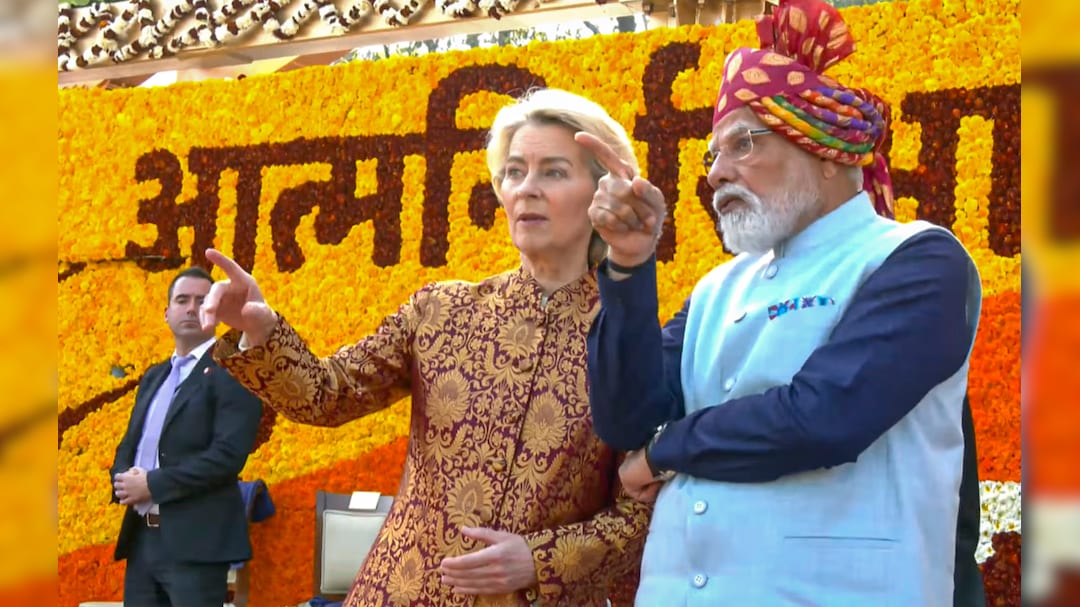
India and the European Union closed the summit with leaders outlining the scope and intent of the announced trade deal, alongside a wider push to deepen strategic ties.
Key Highlights From The Trade Deal Announced Today
- Automobile tariffs will fall sharply, with duties on cars set to reduce gradually from 110% to as low as 10%. Tariffs on car parts will be fully eliminated within five to ten years.
- Agri-food tariffs will drop across several categories. Wine duties will be cut from 150% to 75% initially and reduced further to as low as 20% over time. Olive oil tariffs will fall from 45% to zero over five years.
- Sensitive European agricultural sectors will remain protected, with beef, chicken, rice and sugar excluded from tariff liberalisation.
- EU companies will gain privileged access to India's services market, including financial services and maritime transport. India has made its deepest commitments so far in services trade under this arrangement.
- The deal also includes sustainability and climate commitments, with plans for an EU–India climate cooperation platform and up to 500 million euros in EU support for India's green transition, subject to procedures.
Leaders Set Tone At Joint Briefing
Prime Minister Narendra Modi held a joint briefing with European Commission President Ursula von der Leyen and European Council President António Luís Santos da Costa, describing India–EU ties as a partnership aimed at global good.
Modi said the engagement between the world's two largest democratic powers marked a new chapter in relations and could provide stability at a time of global uncertainty. He said the announced deal would support investment, innovation and stronger supply chains, calling it India's largest trade arrangement to date and a blueprint for shared prosperity. He added that cooperation would extend beyond trade, from the Indo-Pacific to the Caribbean.
Costa said the partnership carried personal meaning for him due to his family roots in Goa and reflected deep historical and people-to-people ties. He said India and the EU share responsibility as major democracies to uphold the principles of the UN Charter and a rules-based international order. Costa added that trade acts as a geopolitical stabiliser and that the announced deal ranks among the most ambitious outlined, with the potential to link a market of about two billion people.
Von der Leyen said the announcement delivered what she described as the “mother of all deals” and marked a defining moment in India–EU relations. She said the partnership represents a win-win outcome and the beginning of deeper political, economic and strategic engagement. Drawing a parallel with Makar Sankranti, she said the time was right to open a new chapter in EU–India friendship.
India and the European Union also announced a new Security and Defence Partnership to deepen cooperation in the defence industry and maritime security. Von der Leyen said the move reflected trust between the two sides and the nature of reliable partners working together.
That concludes our live coverage of the India–EU trade deal and summit developments.
India-EU trade Deal Live: India, EU Launch Security And Defence Partnership
India and the European Union announced a new Security and Defence Partnership aimed at strengthening strategic cooperation.
The initiative will deepen collaboration in the defence industry and maritime security. Von der Leyen said the move reflected the trust between India and the EU, adding that such cooperation was a mark of reliable partners working together.
India-EU Trade Deal Live: Time Ripe For New Chapter In EU-India Friendship, Says Von Der Leyen
Ursula von der Leyen said the moment was right for opening a new chapter in EU–India relations, drawing a parallel with Makar Sankranti and the start of Uttarayan. She said the transition from darkness to light mirrored the direction of India–EU ties, as Prime Minister Narendra Modi looked on during her remarks at the summit.
India-EU Trade Deal Live: Deal Marks Win-Win Start To Deeper India-EU Ties, Says Von Der Leyen
European Commission President Ursula von der Leyen said the announced India–EU trade deal reflects a win-win partnership and marks the beginning of deeper engagement between the two sides. She added that the step forward signalled long-term commitment to stronger political, economic and strategic ties.
India-EU trade Deal Live: ‘Delivered Mother Of All Deals', Says Ursula von der Leyen
European Commission President Ursula von der Leyen said India and the European Union have delivered what she described as the “mother of all deals”, as leaders announced the trade agreement at the India–EU summit.
Addressing Prime Minister Narendra Modi, von der Leyen said the announcement marked a defining moment in India–EU relations and reflected the scale and ambition of cooperation between the two sides.
India-EU trade Deal Live: Trade Acts As Geopolitical Stabiliser, Says Costa
Costa said India’s position as the world’s fastest-growing major economy and centuries of trade links with Europe underline the importance of the announced India–EU trade deal.
He said trade serves as a key geopolitical stabiliser and a driver of economic growth, adding that trade agreements reinforce a rules-based economic order and shared prosperity. Costa said the announced deal ranked among the most ambitious arrangements ever outlined, with the potential to create a combined market of about two billion people.
India-EU trade Deal Live: 'My Goa Roots Underline Deep Europe-India Link', Says Costa
European Council President António Luís Santos da Costa said his family roots in Goa reflected the long-standing historical and personal links between Europe and India.
He said the connection between the two regions was not only strategic but also deeply rooted in shared histories and people-to-people ties, giving added meaning to the India–EU partnership.
India-EU Trade Deal Live: World’s Largest Democracies Must Uphold UN Charter, Says Costa
Costa said India and the European Union, as the world’s largest democracies and supporters of multilateralism, carry a shared responsibility to uphold the principles of the United Nations Charter.
He said cooperation between India and the EU was rooted in common values and a commitment to a rules-based international order.
India-EU Trade Deal Live: India-EU Ties Personal For Me, Says European Council Chief Antonio Costa
European Council President Antonio Luis Santos da Costa said the partnership between India and the European Union carries personal meaning for him, citing his roots in Goa and long-standing links between Europe and India.
Costa said his family background and connection to India underscored the depth of ties between the two regions, adding that the relationship went beyond formal diplomacy.
India-EU Trade Deal Live: India-EU Ties To Offer Stability Amid Global Turmoil, PM Modi Says
Prime Minister Narendra Modi said the India–EU partnership could provide a sense of stability at a time of global uncertainty, as leaders announced the trade deal at the summit in New Delhi.
He said the announced arrangement would support investment, innovation and stronger supply chains, calling it India’s largest free trade deal to date and describing it as a blueprint for shared prosperity rather than just a trade arrangement.
Modi said the deal marked a decisive moment in India’s economic engagement with Europe and reflected the scale and ambition of cooperation between the two sides.
India-EU Trade Deal Live: Partnership To Expand From Indo-Pacific To Caribbean, PM Modi says
Prime Minister Narendra Modi said the India–EU partnership will extend well beyond bilateral trade, stretching from the Indo-Pacific region to the Caribbean as cooperation deepens across regions.
He said the expanding engagement reflected shared interests and growing coordination between India and the European Union across multiple geographies and policy areas.
India-EU trade Deal Live: India-EU Partnership Meant For Global Good, Says PM Modi
Prime Minister Narendra Modi said the India–EU relationship represents a partnership aimed at global good, as leaders announced a major step forward in bilateral ties at the India–EU summit.
He described the engagement between the world’s two largest democratic powers as the start of a new chapter in relations, underscoring the broader role India and the European Union aim to play on global economic and strategic issues.
India-EU trade Deal Live: Modi, Von Der Leyen And Antonio Costa Hold Joint Briefing
PM Modi holds joint briefing with European Commission President Ursula von der Leyen and European Council President Antonio Costa for the talks.
India-EU Trade Deal Live: Tariff Cuts To Lift EU exports, SMEs Get Dedicated Support
India and the European Union said the deal removes or reduces tariffs on 96.6% of EU goods exports to India, a move expected to significantly expand trade flows. EU goods exports to India are projected to double by 2032, with tariff savings estimated at about 4 billion euros a year.
The agreement includes a dedicated chapter for small and medium-sized enterprises. Both sides will set up contact points to help SMEs access information and resolve issues related to using the deal’s provisions, alongside gains from tariff cuts and reduced regulatory barriers.
India-EU trade Deal Live: Services Access Opens As IP Protection Strengthened
The deal announced by the European Union provides expanded access for EU companies to India’s services market, including financial services and maritime transport. The commitments on financial services go beyond those India has offered in other trade arrangements.
The agreement also raises protection and enforcement of intellectual property rights, covering copyrights, trademarks, designs, trade secrets and plant variety rights. Officials said this alignment of IP rules is intended to support cross-border trade and investment by businesses that rely on innovation and branding.
India-EU Trade Deal Live: Beef, Rice, Sugar Excluded As Sensitive Farm Sectors Protected
The European Union said sensitive agricultural products will remain outside tariff liberalisation under the announced trade deal. Products such as beef, chicken meat, rice and sugar are excluded, ensuring continued protection for key European farm sectors.
At the same time, the deal cuts or removes tariffs on several agri-food exports. Indian duties on wines will fall from 150% to 75% at entry and later to as low as 20%, while tariffs on olive oil will be reduced from 45% to zero over five years. Tariffs on processed food products such as bread and confectionery will also be eliminated.
All Indian agricultural imports will continue to comply with the EU’s health and food safety standards.
India-EU trade Deal Live: Auto Tariffs To Fall Sharply, Parts Duties To Be Scrapped Over Time
India and the European Union announced that the trade deal includes steep reductions in tariffs on automobiles and auto components. Tariffs on cars are set to fall gradually from 110% to as low as 10%, while duties on car parts will be fully removed over a period of five to 10 years.
The announcement signals expanded market access for European auto manufacturers and suppliers as India opens up sectors where tariff barriers have remained high.
India-EU Trade Deal LIVE: FTA Concluded, Here Are The Key Highlights
1) Automobile tariffs will fall sharply, with duties on cars gradually reduced from 110% to as low as 10%, and car parts tariffs fully eliminated within five to ten years.
2) Agri-food tariffs will drop significantly, including wine tariffs cut from 150% to 75% initially and as low as 20% later, and olive oil tariffs reduced from 45% to zero over five years.
3) Sensitive EU agricultural sectors remain protected, with beef, chicken, rice and sugar excluded from tariff liberalisation.
4) EU firms gain privileged access to India’s services market, including financial services and maritime transport, with India making its deepest-ever commitments in services trade.
5) The pact includes strong sustainability and climate commitments, alongside plans for an EU–India climate cooperation platform and up to €500 million in EU support for India’s green transition.
India-EU Trade Relations: 'Delivered Biggest FTA Ever,' Says EU Trade Chief
🤝 After a year of tireless engagement and more than a decade in the making, we've delivered the biggest FTA ever. High tariffs down, opportunity unleashed. Proof that win-win trade is real and that genuine partnership, like with Minister @PiyushGoyal, is always worth the effort. pic.twitter.com/VqQj1Braeu
— Maroš Šefčovič🇪🇺 (@MarosSefcovic) January 27, 2026
India-EU Trade Deal LIVE: 'Mother Of All Deals' Concluded, EU's Von Der Leyen
Europe and India are making history today.
— Ursula von der Leyen (@vonderleyen) January 27, 2026
We have concluded the mother of all deals.
We have created a free trade zone of two billion people, with both sides set to benefit.
This is only the beginning.
We will grow our strategic relationship to be even stronger. pic.twitter.com/C7L1kQQEtr
India-EU Trade Deal LIVE: Antonio Costa, Von Der Leyen, Meet PM Modi
European Council President Antonio Luis Santos da Costa and European Commission President Ursula Von Der Leyen meet Prime Minister Narendra Modi.
President of the European Council, António Luís Santos da Costa and President of the European Commission, Ursula Von Der Leyen, meet Prime Minister Narendra Modi at the Hyderabad House in Delhi
— ANI (@ANI) January 27, 2026
(Pics: DD) pic.twitter.com/uw6YPUYz1G
India-EU Trade Deal LIVE: FTA To Lift Labour-Intensive Exports If Single-Market Access Widens, Says ICRIER Expert
Dr Arpita Mukherjee, a professor at the Indian Council for Research on International Economic Relations, said the India–EU free trade deal could support labour-intensive export sectors if it leads to wider access to the European Union’s single market.
She said the proposed arrangement could help Indian industries improve competitiveness and enable deeper participation in European value chains, depending on how market access and trade rules are implemented.
VIDEO | "India–EU FTA offers major boost for labour-intensive exports and single-market access," says Dr Arpita Mukherjee, Professor at ICRIER about India-EU Free Trade Deal.
— Press Trust of India (@PTI_News) January 27, 2026
(Full video available on PTI Videos - https://t.co/n147TvrpG7) pic.twitter.com/Wuhtv2yqWG
India-EU Trade Deal LIVE: ‘Mother Of All Trade Deals’ Only If India Taps EU Market, Standards
Abhijit Mukhopadhyay, Senior Research Consultant at the Chintan Research Foundation, said the India–EU free trade deal could become the “mother of all trade deals” only if India effectively leverages the European Union’s market size and its regulatory standards.
He said outcomes would depend on how India uses access to the EU market and aligns with its regulatory framework to deepen trade engagement.
VIDEO | "India–EU FTA could be the 'mother of all trade deals' if India leverages EU market size and high standards," says Abhijit Mukhopadhyay, Senior Research Consultant at Chintan Research Foundation.
— Press Trust of India (@PTI_News) January 27, 2026
(Full video available on PTI Videos - https://t.co/n147TvrpG7) pic.twitter.com/wh5zMy5p3w
India-EU Trade Deal LIVE: Rajnath Singh Meets EU Leaders As Defence Talks Advance
Defence Minister Rajnath Singh held talks with European Council President Antonio Costa and European Commission President Ursula von der Leyen in New Delhi on Tuesday, according to a post on X by PTI.
The meetings took place as India and the European Union moved ahead with cooperation on defence, security and wider strategic engagement during the India-EU summit.
VIDEO | Delhi: Defence Minister Rajnath Singh holds talks with Antonio Costa, President of the European Council, and Ursula von der Leyen, President of the European Commission.
— Press Trust of India (@PTI_News) January 27, 2026
(Full video available on PTI Videos - https://t.co/n147TvrpG7) pic.twitter.com/rSPSbAxlHJ
India-EU trade Deal LIVE: What To Watch As India, EU Announce Trade Deal
India and the European Union are expected to announce a free trade deal today, along with steps to deepen cooperation on defence, security, climate action, critical technologies and global governance. Prime Minister Narendra Modi is hosting European Commission President Ursula von der Leyen and European Council President Antonio Costa for the talks.
India-EU Trade Deal LIVE: PM Modi Announces 'Mother Of All Deals' With EU
Prime Minister Narendra Modi on Tuesday said India and the European Union have announced an agreement, describing it as the “mother of all deals”, during remarks at the India-EU summit.
Addressing the nation, Modi said the agreement announced between India and the European Union would create new opportunities for people in both regions and reflected a partnership between two major global economies. He said the arrangement covered nearly 25% of global GDP and about one-third of global trade, underlining its scale and reach.
"This is a perfect example of a partnership between two major economies of the world...," Modi said.
Essential Business Intelligence, Sharp Market Insights, Practical Personal Finance Advice, Daily Fuel, Gold and Silver Prices and Latest Stories — On NDTV Profit.