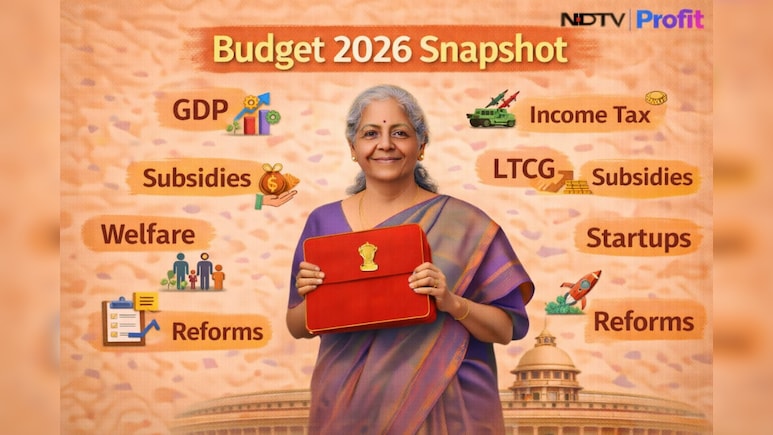
- Union Budget 2026 focuses on three pillars: growth, capacity building, and universal access
- Capital expenditure rises to Rs 12.2 lakh crore with major infrastructure and manufacturing schemes
- New sectoral initiatives target biopharma, electronics, semiconductors, textiles, and container making
Unveiled on the twin occasions of Magh Purnima and Guru Ravidas Jayanti, the Union Budget 2026 was positioned by Finance Minister Nirmala Sitharaman as a continuation of 12 years of economic stability and disciplined fiscal stewardship. The government framed the document around three guiding ‘Kartavya' pillars—productivity‑led growth, national capacity creation and universal opportunity access—signalling a push toward a more competitive, future‑ready economy.
With a historic capital expenditure outlay of Rs 12.2 lakh crore, a renewed manufacturing push across strategic sectors, stronger support systems for MSMEs and rural enterprises, large-scale tourism and heritage initiatives, and a sweeping regulatory refresh, the Budget attempts to fire the economy on multiple engines.
Yet, amid this expansive vision, markets were shaken by the steepest announcement of the day—the tripling of Securities Transaction Tax on futures trading, a move that increases costs for brokers and leveraged traders even as the government doubles down on long-term, supply‑side reforms.
Also Read | Layoffs Are Rising In Tech, But These Skills Are Helping People Unlock Better Pay
Highlight 1: The Three Kartavya Pillars
Accelerate Growth
The Budget places strong emphasis on driving growth through higher productivity, deeper innovation and stronger economic resilience. The government seeks to enhance India's competitiveness by expanding R&D, boosting technology adoption and supporting sectors capable of delivering sustained high‑value expansion.
Fulfil Aspirations
A nationwide effort toward capacity building underpins this pillar. The Budget channels investment into skill development, industrial capability, infrastructure expansion and entrepreneurship support—all aimed at helping citizens and businesses access meaningful economic opportunity.
Universal Resource Access
Aligned with the vision of Sabka Saath, Sabka Vikas, this pillar focuses on ensuring equitable access to essential resources—finance, infrastructure, public services and digital tools—so that growth benefits are shared widely across geographies and income classes.
Highlight 2: Manufacturing & Scale‑Up Push
The Budget advances India's ambition to become a global manufacturing hub by prioritising seven high‑impact strategic sectors and offering new incentives to strengthen domestic capacity. It also sets the stage for a more robust MSME ecosystem, supported by significant infrastructure momentum.
Bio Pharma Shakti
A Rs 10,000 crore, five‑year programme aims to accelerate India's biopharma innovation pipeline by facilitating advanced research, scaling production capabilities and nurturing biotech startups.
Electronics Manufacturing Scheme: With a Rs 40,000 crore outlay, the scheme seeks to expand domestic electronics production, localise key components and deepen India's role in global supply chains.
Infrastructure & Construction Equipment Scheme: This initiative intends to build indigenous strength in construction machinery and advanced equipment manufacturing to support India's ongoing infra boom.
Sectoral Initiatives
The Budget outlines targeted interventions in multiple sectors to boost domestic capacity and reduce import dependence.
Container Manufacturing: A Rs 10,000 crore, five‑year programme aims to develop a strong domestic container ecosystem, lowering logistics costs and vulnerability to global supply disruptions.
ISM 2.0 for Semiconductors: The upgraded scheme focuses on supporting semiconductor materials, equipment, design IP and deep‑tech supply chains, strengthening India's long-term chip ecosystem.
Textiles Package: A National Fibre Mission, expanded production capacity and renewed handloom support aim to modernise India's textile value chain and revive traditional crafts.
Cluster Modernisation & Sports Goods Hub: The government plans to upgrade 200 legacy industrial clusters and establish a dedicated hub to scale India's sports goods manufacturing capabilities.
MSME & Rural Development
To fortify India's vast MSME and rural enterprise landscape, several funding and ecosystem-building measures have been announced.
SME Growth Fund: A Rs 10,000 crore fund has been set up to promote scale, technology adoption and modernisation across small and medium enterprises.
Self-Reliant India Fund Top-Up: The fund receives a Rs 2,000 crore infusion to provide growth capital to innovative startups and MSMEs.
Mahatma Gandhi Gram Swaraj Mission: This mission will expand support for khadi, handicrafts, village industries and ODOP (One District One Product) enterprises, boosting rural livelihoods and production networks.
Capex & Infrastructure Surge
The government continues its aggressive infrastructure expansion, raising capital expenditure to Rs 12.2 lakh crore from Rs 11.2 lakh crore last year.
Key initiatives include:
Infra Risk Guarantee Fund to de‑risk large private investments.
Development of 20 new waterways to enhance cargo movement.
CPSE REITs to accelerate monetisation of public-sector assets.
Seven high‑speed rail corridors, including the major Mumbai–Pune–Hyderabad–Chennai–Varanasi–Siliguri network, signalling a long-term shift towards faster, cleaner mobility.
ALSO READ: Budget 2026: Sitharaman Allocates Rs 12.2 Lakh Crore For Capex
Highlight 3: Financial & Regulatory Reforms
The Budget introduced a series of reforms to deepen financial markets, accelerate green transitions and modernise regulatory frameworks.
Banking Expansion: With banking networks now covering 98% of villages, the focus shifts to restructuring PFC and REC to improve efficiency and governance.
Carbon Capture Fund: A Rs 20,000 crore allocation will support decarbonisation efforts across five hard‑to‑abate sectors.
Bond Market Reforms: Total return swaps will be introduced to broaden hedging tools, while FEMA will undergo a comprehensive review to align with modern capital flows.
Municipal Bond Incentive: A Rs 100 crore incentive aims to motivate more cities to issue municipal bonds and strengthen urban financing.
STT Hike – Market Impact
The most market‑sensitive measure was the steep rise in STT on futures trading—from 0.02% to 0.05%, a threefold increase.
The move is expected to squeeze brokerage margins and reduce cost-sensitive retail participation in F&O.
Stocks of exchanges and brokerages, particularly BSE and discount brokers, may face immediate pressure.
Leveraged and intraday futures trading could decline in the short term as transaction costs rise.
ALSO READ: Budget 2026: BSE Shares Hit Lower Circuit As Nirmala Sitharaman Makes Key F&O Announcement
Highlights 4: Tourism, Culture & Sports
Heritage Development
The government plans to transform 15 key archaeological sites—including Sarnath and Hastinapur—into vibrant cultural and tourism destinations. A digital knowledge grid will map historic locations and make cultural content widely accessible.
Job & Skill Creation
A new ecosystem will bring together researchers, historians, universities and technology partners to develop content, experiences and heritage-linked skills. Local employment is expected to rise through tourism-driven economic activity.
Sports & Youth
A refreshed Khelo India Mission aims to strengthen grassroots sports infrastructure, athlete support systems and talent pathways.
Hospitality & Nature Tourism
A National Institute of Hospitality will bridge the gap between academia, industry and government. Additionally, 10,000 guides will be trained, and new nature-based trails—including trekking, turtle conservation and birdwatching circuits—will be developed nationwide.
ALSO READ: Budget 2026: Nirmala Sitharaman Announces Proposal To Build Rare Earth Mineral Corridors In India
Essential Business Intelligence, Sharp Market Insights, Practical Personal Finance Advice, Daily Fuel, Gold and Silver Prices and Latest Stories — On NDTV Profit.