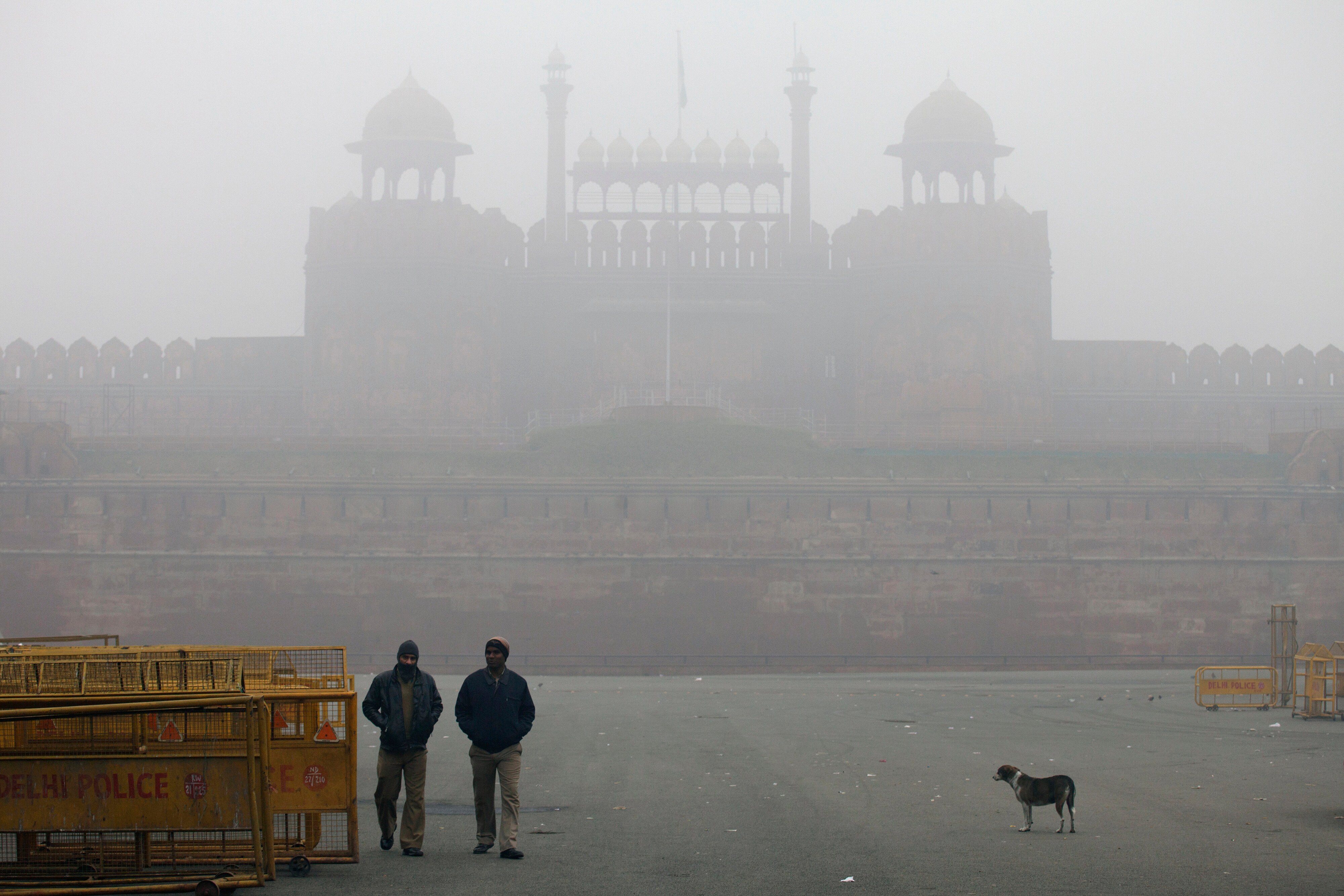
The share of stubble burning in Delhi's pollution rose to 40% on Sunday, the maximum so far this season, according to a central government air quality monitoring agency.
The Ministry of Earth Sciences' air quality monitor, SAFAR, said 3,216 farm fires were spotted over Punjab, Haryana, Uttar Pradesh and Uttarakhand on Saturday.
The share of stubble burning in Delhi's PM 2.5 pollution was 40% on Sunday, the maximum so far this season. It was 32% on Saturday, 19% on Friday and 36% on Thursday, the second-highest this season so far.
Last year, the stubble contribution to Delhi's pollution had peaked to 44% on Nov. 1, according to SAFAR data.
NASA's satellite imagery showed a large, dense cluster of fire dots covering Punjab and parts of Haryana and Uttar Pradesh.
SAFAR said air quality has not improved much despite improved ventilation due to high stubble-related intrusion and trapping of pollutants during night time due to low wintertime boundary layer height.
"However, it has not deteriorated further despite favourable North-North-Westerly boundary level wind direction. The highly favourable conditions for fire-related intrusion in Delhi is expected to continue," it said.
SAFAR predicted better ventilation for the next two days but said the AQI is likely to improve only marginally, depending on farm fires. It is set to deteriorate slightly on Nov. 3, it said.
The city recorded an air quality index of 370 at 3 p.m.. The 24-hour average AQI was 367 on Saturday. It was 374 on Friday, 395 on Thursday, 297 on Wednesday, 312 on Tuesday and 353 on Monday.
An AQI between 0 and 50 is considered 'good', 51 and 100 'satisfactory', 101 and 200 'moderate', 201 and 300 'poor', 301 and 400 'very poor', and 401 and 500 'severe'.
Essential Business Intelligence, Continuous LIVE TV, Sharp Market Insights, Practical Personal Finance Advice and Latest Stories — On NDTV Profit.