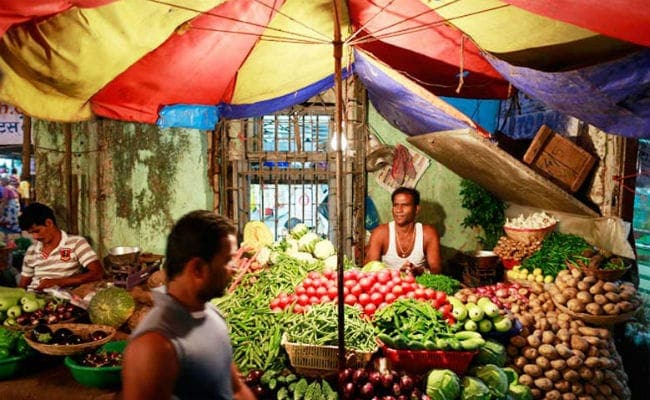
New Delhi: Retail inflation is likely to be well below the Reserve Bank of India's target of 5 per cent in the current fiscal year as demonetisation would discourage any price headwind, the Economic Survey for 2016-17 said.
The new inflation targeting approach by the Monetary Policy Committee (MPC) and gains from macroeconomic stability will help India consolidate gains on price control, meaning prices will be less susceptible of individual whims and caprice of governments, the Survey said.
"The outlook for the year as a whole is for CPI inflation to be below the RBI's target of 5 per cent, a trend likely to be assisted by demonetisation," said the Economic Survey, presented in Parliament by Finance Minister Arun Jaitley on Tuesday.
In the current fiscal year so far, retail inflation has stabilised around 5 per cent, while wholesale price-based inflation averaged around 2.9 per cent during April-December.
"Codified the institutional arrangements on monetary policy with the Reserve Bank to consolidate the gains from macroeconomic stability by ensuring that inflation control will be less susceptible to the whims of individuals and the caprice of governments," it said.
The six-member MPC with three members outside of the central bank has been a deviation from the old practice when policy rate setting was a sole discretion of the RBI.
The Survey pointed out that inflation is being driven by narrow group of food items in which pulses are major contributor of food inflation in the country.
According to the Survey, the Indian economy has continued to consolidate gains achieved in restoring macroeconomic stability.
During April-December, retail inflation averaged 4.9 per cent and displayed a downward trend since July when it became apparent that kharif agricultural production in general, and pulses in particular would be bountiful, it said.
"Decline in pulses prices has contributed substantially to decline in CPI (consumer price index) inflation which reached 3.4 per cent at end-December."
On wholesale-price front, a reversal trend was observed from a trough of (-)5.1 per cent in August 2015 to 3.4 per cent at the end of December 2016 due to rising crude prices.
The Survey couationed that geopolitics could take oil prices up further than forecast.
"The ability of shale oil production to respond quickly should contain risks of a sharp increase, but even if prices rose merely to $60-65 per barrel, Indian economy would nonetheless be affected... The scope for monetary easing might also narrow, if higher oil prices stoked inflationary pressure," said the Survey.
The Survey also said that though the wedge between CPI inflation and WPI inflation "has converged to zero this year as per December 2016 data, nominal magnitudes remain a better basis for identifying demonetisation effect until the wedge closes durably".
In the last two years, the government has institutionalised a commitment to low inflation in the new monetary policy framework agreement, the Economic Survey added.
Essential Business Intelligence, Continuous LIVE TV, Sharp Market Insights, Practical Personal Finance Advice and Latest Stories — On NDTV Profit.