- Bitcoin fell near two-month lows after Trump named Kevin Warsh as Federal Reserve chair
- Warsh's hawkish background left crypto investors uncertain about future Fed policies
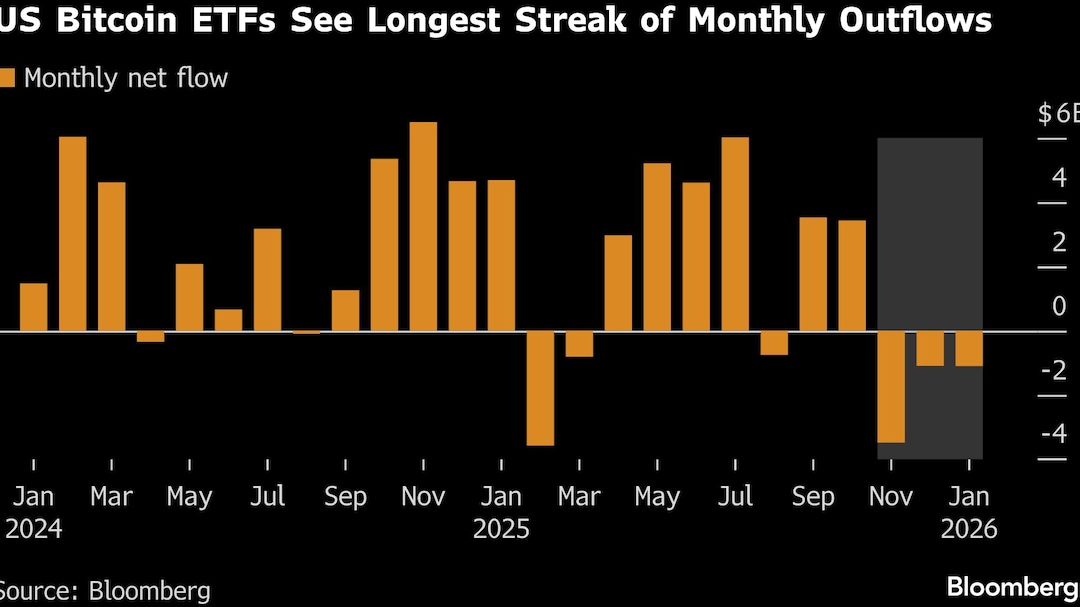
- Bitcoin ETFs saw three straight months of outflows, totaling $5.7 billion since October
Bitcoin traded near two-month lows after Donald Trump named Kevin Warsh as the next Federal Reserve chair — a choice that did little to lift sentiment in a market already under pressure from persistent ETF outflows.
The largest cryptocurrency dropped as much as 4% to $81,045, its weakest level since November, before paring losses to around $84,000. Some traders had hoped the Fed chair announcement might offer a narrative pivot. Warsh, a former central bank governor with deep establishment ties, has recently aligned with Trump's push for lower rates. But his traditional background and prior hawkish record have left crypto investors unsure which version of Warsh will show up at the Fed.
Instead, a risk-off tone lingered over markets as the Warsh news circulated: stock fell and the dollar traded just off four-year lows. With Bitcoin now down more than 30% from its October peak — and US spot ETFs posting their longest streak of monthly outflows since launching — traders appear unconvinced that either macro or policy signals offer much near-term relief. Around $1.4 billion in bullish positions across all tokens have been liquidated in the past 24-hours, according to CoinGlass data.
“While his nomination would support the case that rates will continue to decline in 2026 through to 2027, Warsh is a career economist who is all too aware of reducing too much, too quickly,” said Hayden Hughes, general partner at Tokenize Capital.
Meanwhile, Binance announced that the exchange's emergency insurance reserve fund known as SAFU will convert its roughly $1 billion of assets held in stablecoins to Bitcoin over the next 30 days. The fund was established in 2018 to reimburse users in the event of security breaches or platform failures.
The 12 US-listed spot Bitcoin ETFs have recorded three consecutive months of net redemptions which, if the trend holds through the end of January, will mark the longest sustained run of outflows since these vehicles launched in 2024. Some $5.7 billion has been drained from the products over that period, according to data compiled by Bloomberg.
Bitcoin
Photo Credit: (Photo: Bloomberg)
Bitcoin's malaise contrasts with the recent surge in gold and other precious metals, as investors seeking refuge from geopolitical uncertainty shun cryptocurrencies in favor of traditional safe-haven assets. That's raising doubts over claims the token functions as a kind of “digital gold.”
“Suddenly, cryptocurrencies no longer appear to be an alternative to fiat money and a hedge against the not-so-responsible financial policies of major countries,” said Alex Kuptsikevich, chief market analyst at FxPro.
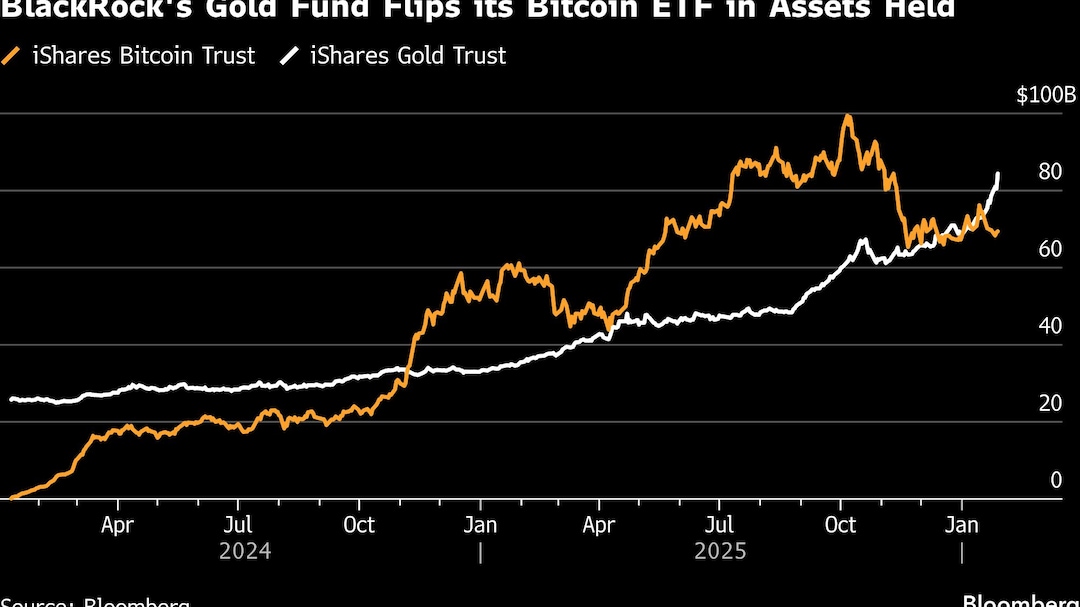
Fund flows underscore the shift. BlackRock's iShares Bitcoin Trust, the largest Bitcoin ETF, and one of the most successful fund launches ever, has fallen behind BlackRock's Gold ETF in total assets.
Bitcoin
Photo Credit: (Photo: Bloomberg)
“Crypto sold off with the tech move,” Jake Ostrovskis, head of over-the-counter trading at Wintermute, said Thursday. “For Bitcoin, buyers are showing up around current levels. That is keeping Bitcoin between roughly $85,000 and $90,000 into the upcoming options expiry.”
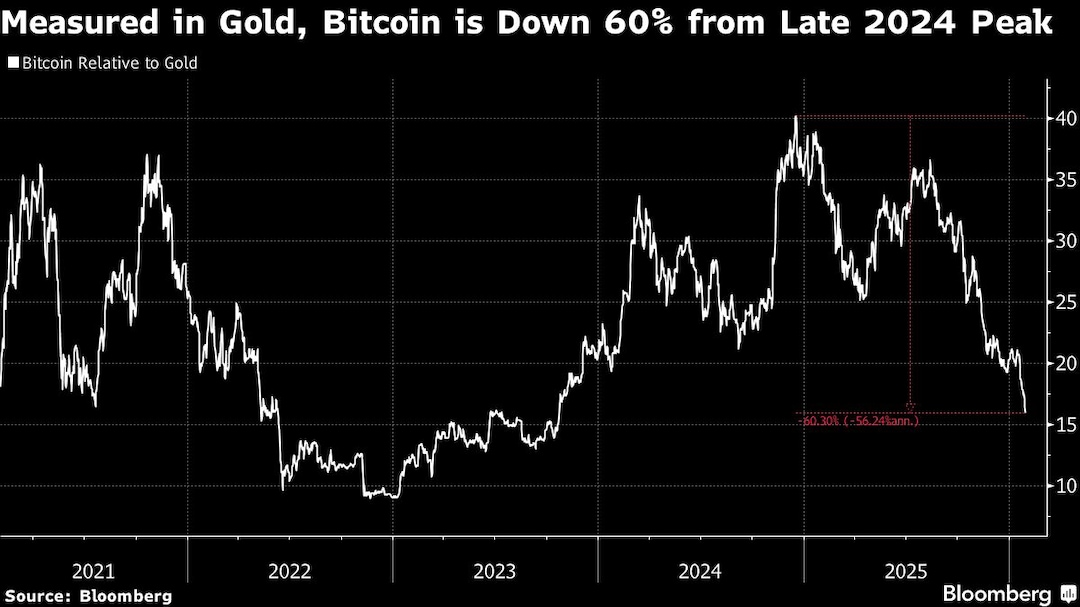
One way to assess whether Bitcoin is fulfilling its potential as digital gold is to measure its value in the precious metal itself. On that metric it is failing, slumping some 60% in gold terms from a late 2024 peak.
Bitcoin
Photo Credit: (Photo: Bloomberg)
For some traders, the latest slide points to more pain for Bitcoin, with the potential for a break below $80,000 if bearish sentiment persists into the weekend.
“I wouldn't be shocked to see BTC trade in the $70,000 range soon,” said Adam McCarthy, a research analyst at Kaiko. If it falls below $80,000 today “it could continue to slide into the weekend and with lower liquidity on these days that could have an outsized impact,” he said.
Tony Sycamore, market analyst at IG Australia, said the latest selloff is in line with his view that the advance from November's low was a corrective or counter-trend rally.
“Its decline overnight suggests the downtrend has now resumed,” he said.
Essential Business Intelligence, Sharp Market Insights, Practical Personal Finance Advice, Daily Fuel, Gold and Silver Prices and Latest Stories — On NDTV Profit.