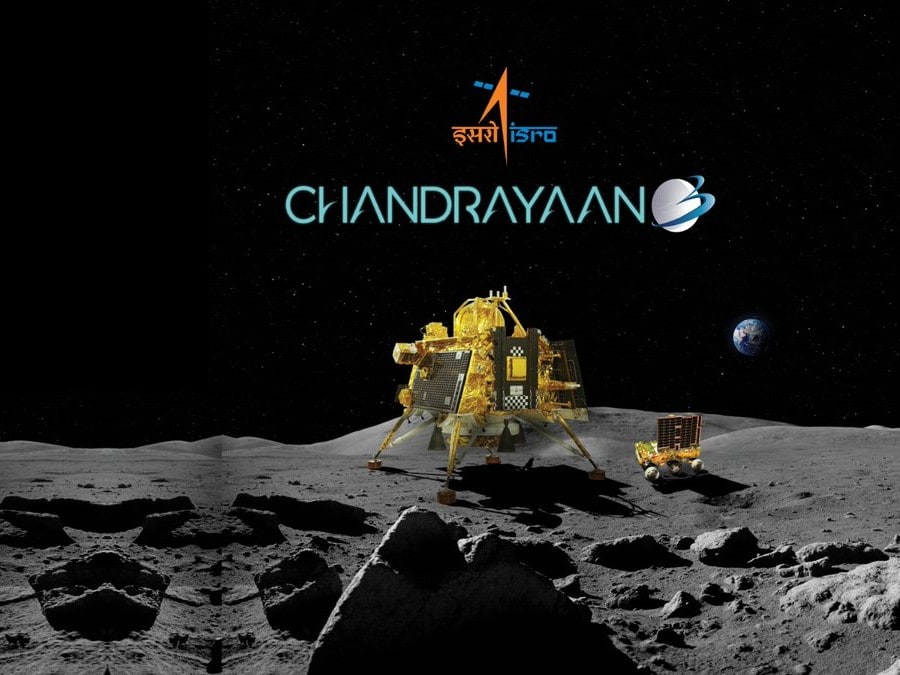
The Indian Space Research Organisation on Wednesday released an image of the Vikram Lander clicked by Pragyan Rover.
In a post on X (formerly Twitter), ISRO said that the image was taken by the Navigation Camera onboard the Rover (NavCam).
ISRO described it as the "image of the mission."
Pragyan Rover captured the image on August 30 at 7:35 Hrs. IST.
NavCams for the Chandrayaan-3 Mission are developed by the Laboratory for Electro-Optics Systems (LEOS) in Bengaluru.
Chandrayaan-3 New Images
Chandrayaan-3 Mission:
August 30, 2023
Smile, please📸!
Pragyan Rover clicked an image of Vikram Lander this morning.
The 'image of the mission' was taken by the Navigation Camera onboard the Rover (NavCam).
NavCams for the Chandrayaan-3 Mission are developed by the Laboratory for… pic.twitter.com/Oece2bi6zEChandrayaan-3 Mission Update
The Laser-Induced Breakdown Spectroscope instrument onboard 'Pragyan' rover of Chandrayaan-3 has unambiguously confirmed the presence of sulphur on the lunar surface near south pole, through first-ever in-situ measurements, ISRO said on Tuesday.
It also said the instrument also detected aluminium, calcium, iron, chromium, titanium, manganese, silicon and oxygen, as expected.
"The Laser-Induced Breakdown Spectroscopy (LIBS) instrument onboard Chandrayaan-3 Rover has made the first-ever in-situ measurements on the elemental composition of the lunar surface near the south pole. These in-situ measurements confirm the presence of Sulphur (S) in the region unambiguously, something that was not feasible by the instruments onboard the orbiters," ISRO said in a statement.
According to ISRO, LIBS is a scientific technique that analyses the composition of materials by exposing them to intense laser pulses.
Chandrayaan-3 Mission:
August 29, 2023
In-situ scientific experiments continue .....
Laser-Induced Breakdown Spectroscope (LIBS) instrument onboard the Rover unambiguously confirms the presence of Sulphur (S) in the lunar surface near the south pole, through first-ever in-situ measurements.… pic.twitter.com/vDQmByWcSL"A high-energy laser pulse is focused onto the surface of a material, such as a rock or soil. The laser pulse generates an extremely hot and localised plasma. The collected plasma light is spectrally resolved and detected by detectors such as Charge Coupled Devices. Since each element emits a characteristic set of wavelengths of light when it's in a plasma state, the elemental composition of the material is determined," it said.
Preliminary analyses have unveiled the presence of Aluminum (Al), Sulphur (S), Calcium (Ca), Iron (Fe), Chromium (Cr), and Titanium (Ti) on the lunar surface. Further measurements have revealed the presence of manganese (Mn), silicon (Si), and oxygen (O), it said.
"Thorough investigation regarding the presence of Hydrogen is underway," ISRO said.
(With PTI inputs)
Essential Business Intelligence, Continuous LIVE TV, Sharp Market Insights, Practical Personal Finance Advice and Latest Stories — On NDTV Profit.